Overview
When sourcing a state-of-the-art Battery Energy Storage System (BESS), understanding the manufacturing equipment used in its production is critical to assessing quality, longevity, and performance. Our automated production lines leverage advanced robotics, precision laser welding, and rigorous in-line testing to ensure each battery module meets the highest standards. This FAQ addresses the most common questions from engineers, procurement specialists, and facility managers regarding the specific equipment and processes that define modern BESS manufacturing.
Frequently Asked Questions
- Q1: What core equipment is used in your automated production line for high-capacity BESS?
- Our production line integrates five core equipment types: high-precision electrode coaters, automated stacking machines for cell assembly, laser welding systems for busbar connections, in-line X-ray inspection for defect detection, and fully automated aging test chambers for initial cell activation. These are all synchronized via a central Manufacturing Execution System (MES) to ensure flawless quality control.
- Q2: How do you ensure cell-to-cell consistency and capacity matching with your equipment?
- We utilize precision voltage and internal resistance (ACIR/DCIR) sorting equipment that categorizes each LFP cell into sub-groups with less than a 0.5% variance in capacity. This is followed by an automated ‘Cell Matching’ algorithm that groups cells with identical performance profiles before they are welded into modules, ensuring optimal pack balance and extended cycle life.
- Q3: What type of welding equipment is used for busbar connections, and why does it matter?
- We employ 6000W fiber optic laser welding systems. This equipment provides a non-contact, high-energy weld with a minimal heat-affected zone, which is crucial for maintaining the integrity of the cell terminals and reducing internal resistance. Automated vision systems inspect every weld in real-time for penetration depth and position accuracy, which reduces the risk of connection failure over the system’s lifetime.
- Q4: What are the ‘Aging Chamber’ specifications, and how long does the process take?
- Our aging and formation chambers are temperature-controlled to ±2°C, housing up to 2,000 cells per rack. The initial charge/discharge (formation) process takes 72 hours to create the solid electrolyte interphase (SEI) layer, followed by a 14-day static aging period where continuous data logging captures self-discharge rates. This equipment is critical to weeding out latent defects before a system leaves the factory.
- Q5: What quality control equipment is used for safety testing (e.g., insulation, short circuits)?
- The production line is equipped with automated HiPot (High Potential) testers and insulation resistance testers that apply up to 4,500V DC to verify dielectric strength. We also have a dedicated short-circuit test setup that measures the response of the BMS (Battery Management System) to simulated faults, ensuring the protective devices (fuses, contactors) operate within the required 2-millisecond window.
- Q6: How is the final cabinet assembled and integrated with the BMS?
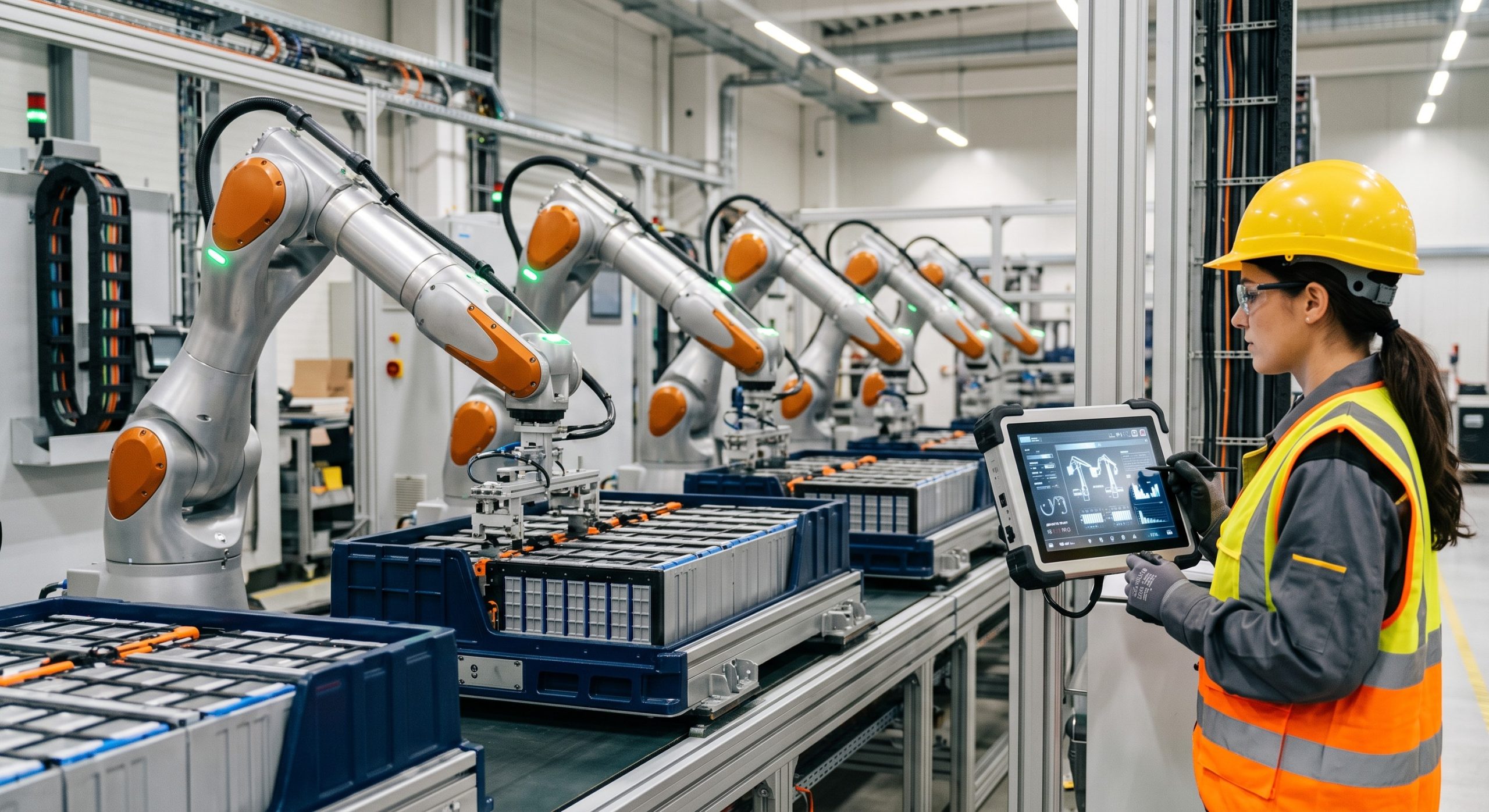
- Final assembly is handled by robotic arms and guided by augmented reality (AR) headsets for technicians. The equipment includes automated screwdriving systems and torque wrenches calibrated to ISO standards to assemble the rack, connect the DC busbars, and wire the BMS harnesses. A 24-hour ‘Burn-In’ test is then run on the completed system to validate all communication channels between the BMS, PCS, and EMS.
- Q7: How does your production equipment support scalability for large (MWh) orders?
- Our equipment uses modular conveyor systems and quick-change tooling, allowing us to switch between different cell formats and cabinet sizes with less than 30 minutes of changeover time. This flexibility, combined with automated guided vehicles (AGVs) for material handling, enables our facility to produce up to 10 GWh annually, ensuring consistent lead times for large-scale projects.
- Q8: What traceability does your equipment provide for warranty and lifecycle claims?
- Every piece of manufacturing equipment is integrated with our MES, which records the serial number of every component, process parameters (temperature, pressure, torque), and test results. We provide a ‘Digital Twin’ of your specific system, allowing you to trace the entire production history. This equipment-driven data is the foundation of our 10-year performance warranty, as it guarantees the quality of the components and the processes used to assemble them.