Overview
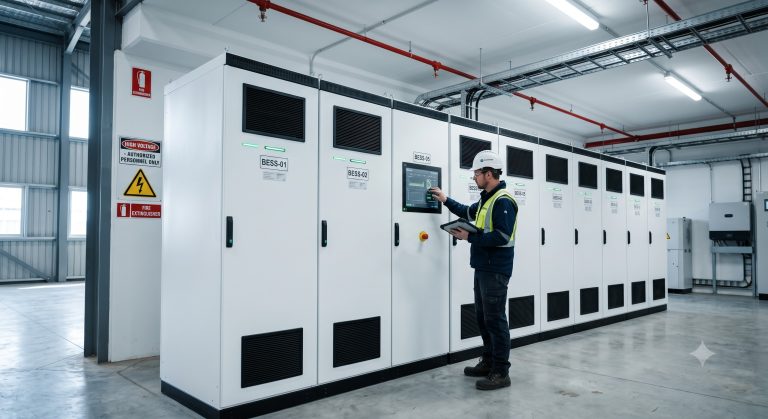
Accurate State of Charge (SOC) calculation is the cornerstone of reliable BESS performance, safety, and ROI. Inaccurate SOC leads to premature curtailment, unexpected shutdowns, and reduced battery lifespan. This technical FAQ addresses the most common pre-sales and post-sales questions plant engineers and procurement teams ask when troubleshooting SOC accuracy in commercial and industrial energy storage systems.
Frequently Asked Questions
- Q1: How is State of Charge (SOC) calculated in a BESS, and why does it drift?
- SOC is calculated by a BMS using coulomb counting (ampere-hour integration) as the primary method, periodically recalibrated by open-circuit voltage (OCV) measurements and impedance tracking. Drift occurs due to current sensor offset errors, temperature fluctuations, cell aging, and incomplete charge/discharge cycles that prevent full recalibration. Advanced BMS platforms fuse coulomb counting with model-based algorithms to maintain ±2-3% accuracy over the system’s life.
- Q2: What BMS calibration protocol ensures accurate SOC for LFP battery systems?
- The standard LFP SOC calibration protocol requires a full charge to 100% SOC (cell voltage ≥3.55V) followed by a controlled discharge to the low-voltage cutoff at least every 30-90 days, depending on cycling frequency. This allows the BMS to reset coulomb-counting errors and re-anchor the SOC-OCV curve. Tier-1 BMS units automate this via scheduled maintenance cycles, and some use adaptive learning to reduce calibration frequency without sacrificing accuracy.
- Q3: How does grid-tie vs off-grid configuration affect SOC accuracy and drift?
- Grid-tie systems maintain SOC accuracy more easily because the grid provides stable frequency and voltage references, allowing the PCS and BMS to synchronize charge/discharge cycles precisely. Off-grid systems experience higher SOC drift due to variable load profiles, frequent partial cycling, and reliance on inverter-based frequency references. Off-grid installations typically require more frequent BMS recalibration and may need a higher SOC safety margin (10-15%) to prevent unexpected low-SOC shutdowns.
- Q4: Can liquid cooling systems improve SOC calculation accuracy?
- Yes, liquid cooling significantly improves SOC accuracy by maintaining cells within a narrow temperature band (typically 25-35°C), which stabilizes internal resistance and OCV readings. Temperature uniformity across the module reduces cell-to-cell SOC divergence, enabling the BMS to estimate pack SOC with greater confidence. Systems with active thermal management typically achieve ±2% SOC accuracy, while passively cooled systems may drift to ±5% or more under high C-rates.
- Q5: What causes SOC jump errors in BESS, and how are they fixed?
- SOC jump errors—sudden unexplained changes in reported SOC—are typically caused by BMS firmware bugs, cell voltage sensor failures, or abrupt OCV correction when the battery rests after a high-current event. Fixes include updating BMS firmware to the latest revision, validating voltage sense harness connections, and configuring the BMS to apply OCV corrections only during stable rest periods (≥30 minutes at <0.05C). Persistent jump errors may indicate a failing cell or loose busbar connection requiring physical inspection.
- Q6: How does LFP cell degradation impact SOC accuracy over 10 years?
- LFP cell degradation increases SOC estimation error by 0.5-1.5% per year if the BMS does not adapt to capacity fade and rising internal resistance. As cells age, the usable capacity decreases, and the SOC-OCV curve shifts, causing coulomb-counting errors to accumulate faster. Tier-1 BMS platforms track capacity fade through periodic full cycles and update the battery model accordingly, maintaining SOC accuracy within ±3% even after 6,000+ cycles at 80% DoD.
- Q7: What fire safety mechanisms prevent thermal runaway when SOC is misreported?
- Multi-tier fire safety mechanisms include cell-level pressure and temperature sensors, module-level gas and smoke detection, and pack-level aerosol or clean-agent suppression systems. If SOC is misreported and cells are overcharged, the BMS must independently trigger a hard cutoff at the cell voltage limit (e.g., 3.65V for LFP) regardless of reported SOC. UL 9540A-tested enclosures with deflagration panels and isolation of affected modules prevent propagation, ensuring safety even during SOC estimation failures.
- Q8: How can plant engineers verify SOC accuracy during routine O&M?
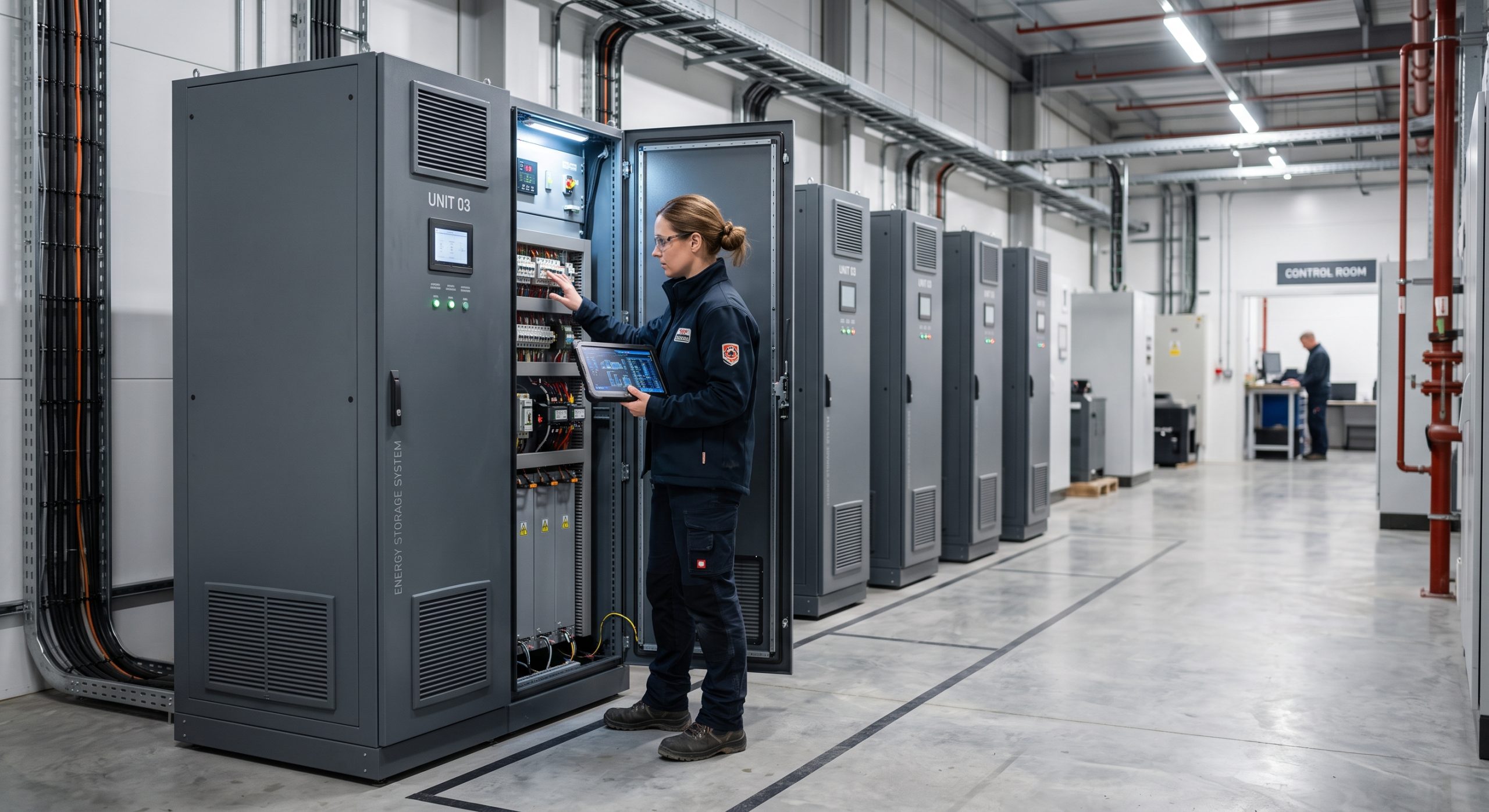
- Plant engineers can verify SOC accuracy during routine O&M by comparing BMS-reported SOC against a controlled full charge/discharge cycle quarterly. Key checks include: (1) confirming cell voltage spread remains <50mV at rest, (2) validating current sensor calibration with a clamp meter, (3) reviewing SOC drift logs for jumps >5%, and (4) ensuring the BMS firmware is current. For critical applications, a secondary SOC estimation via DC bus energy integration over 24 hours provides an independent cross-check.