Overview
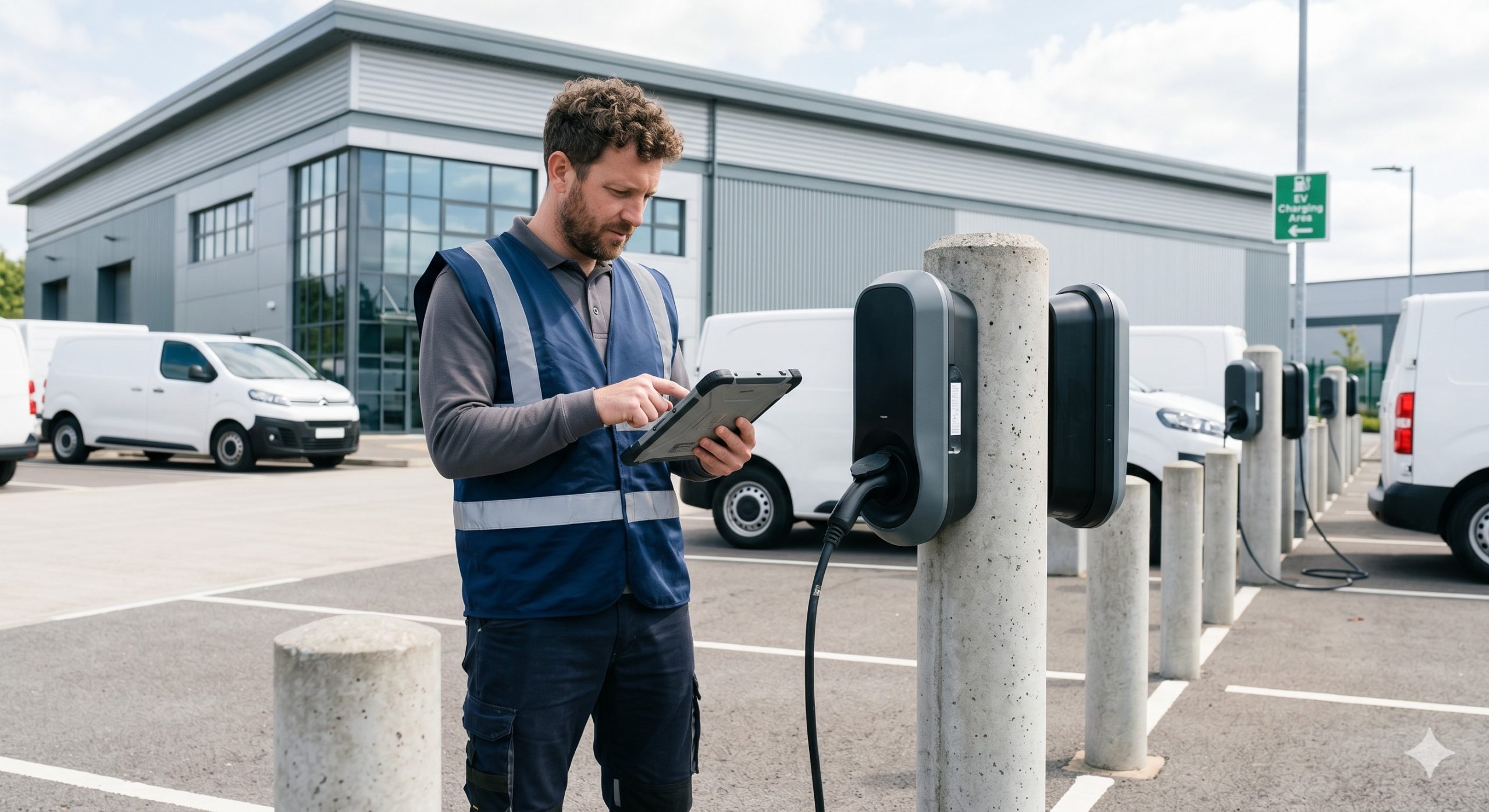
For B2B fleet managers, commercial property developers, and workplace charging hosts, the 7kW AC EV charger represents the standard for cost-effective overnight and daytime destination charging. Unlike high-power DC chargers, AC chargers rely on the vehicle’s onboard rectifier, offering a simpler, more durable, and grid-friendly solution for predictable duty cycles. This FAQ addresses engineering, safety, financial, and integration questions specific to deploying 7kW AC EV chargers across commercial and industrial sites.
Frequently Asked Questions
- Q1: What is the typical payback period and ROI calculation for a commercial 7kW AC EV charger installation?
- The typical simple payback period for a commercial 7kW AC EV charger ranges from 18 to 36 months, depending on utilization, local electricity tariffs, and available incentive programs. ROI is calculated as (Annual Revenue from charging + Operational savings from fleet electrification + Avoided demand charges) / (Total installed hardware + electrical upgrades + networking costs). For a fleet operating 10 chargers at 60% utilization, gross annual revenue can reach $15,000-$25,000, while workplace amenity installations see ROI primarily through employee retention and ESG credits rather than direct charging revenue.
- Q2: How does active BMS monitoring work in a 7kW AC EV charger for battery health protection?
- Active BMS monitoring in a 7kW AC EV charger continuously communicates with the vehicle’s battery management system via the CP (Control Pilot) signal line, adjusting voltage and current limits in real-time. The charger’s internal monitoring logic tracks temperature, voltage sag, and state-of-charge (SoC) during the session, automatically terminating or reducing power if it detects over-voltage, under-voltage, or abnormal thermal gradients. For dedicated fleet chargers paired with depot storage batteries, the BMS also prevents simultaneous peak loads by load-balancing across multiple AC units.
- Q3: What cooling system does a 7kW AC EV charger use, and how does it prevent thermal runaway?
- A 7kW AC EV charger uses passive natural convection cooling via aluminum heat sinks integrated into the enclosure, with no active liquid or fan cooling required at this power level. Thermal runaway prevention is achieved through redundant temperature sensors placed on the AC-DC relay, contactor, and main PCB, which trigger an immediate contactor dropout if internal temperature exceeds 85°C (185°F). Additionally, the CP signal automatically requests the vehicle to reduce charge current or halt the session when the charger’s internal ambient reaches 75°C, preventing component degradation before thermal limits are reached.
- Q4: Can the 7kW AC EV charger be configured for grid-tie, off-grid, or hybrid islanding operation?
- The 7kW AC EV charger is inherently a grid-tied device and requires a stable AC voltage reference from either the utility grid or a grid-forming inverter to operate. For off-grid or islanding applications, the charger must be connected to a battery energy storage system (BESS) with a grid-forming bidirectional inverter that creates a local 230V/240V AC microgrid. In hybrid configurations with solar+storage, the charger can operate seamlessly during grid outages only when paired with an automatic transfer switch (ATS) and a storage inverter capable of frequency-watt and volt-watt response to prevent overcharging the BESS.
- Q5: How does parallel scalability work when deploying multiple 7kW AC EV chargers at a commercial site?
- Parallel scalability for 7kW AC EV chargers is achieved by load-balancing up to 32 or 64 chargers through a central Energy Management System (EMS) or OCPP-compliant backend platform. Each charger connects to a dedicated AC circuit breaker, typically 40A single-phase or 20A three-phase, with group-level protection and a shared CT clamp monitoring total site capacity. The EMS dynamically allocates available current among active chargers, preventing main breaker trips while maximizing throughput. For future expansion, daisy-chained RS485 or Ethernet backhaul allows adding chargers in increments of 4-8 units, with software reconfiguration only.
- Q6: What are the fire safety mechanisms and gas detection requirements for a 7kW AC EV charger in a parking structure?
- Fire safety mechanisms for a 7kW AC EV charger include a built-in Type A or Type B (DC-sensitive) residual current device (RCD) with 6mA DC leakage detection, a thermal fuse on the AC relay, and arc fault detection (AFCI) compliant with UL 1699B or IEC 62606. Gas detection is typically not integrated into the charger but should be provided by the parking structure’s fire alarm system, specifically hydrogen and carbon monoxide sensors at 20cm above floor level. Additionally, NFPA 88A requires a 600mm clearance from the charger to combustible materials and a manual emergency stop that de-energizes all chargers in the zone within 5 seconds.
- Q7: How do I monitor real-time performance, energy consumption, and carbon offset reporting for a fleet of 7kW AC EV chargers?
- Real-time monitoring for a fleet of 7kW AC EV chargers is performed through an OCPP 1.6J or 2.0.1 backend platform that logs per-session energy (kWh), peak power (kW), idle time, and connector temperature. For carbon reporting, the platform multiplies delivered kWh by local grid carbon intensity (gCO2/kWh) or uses granular hourly data from utility APIs. Key performance metrics include charger uptime (target >99.5%), average session duration, and load factor (actual kWh delivered vs. theoretical maximum). Leading platforms also offer automated CSV export for Scope 2 reporting and integration with telematics systems for per-vehicle efficiency tracking.
- Q8: What international standards (UL, IEC, CE) apply to a 7kW AC EV charger for B2B procurement?
- A compliant 7kW AC EV charger for B2B procurement must meet UL 2594 (USA), UL 2231-1/2 (personnel protection), IEC 61851-1 (global safety), IEC 61851-21-2 (EMC and谐波), and CE (European conformity) including LVD 2014/35/EU and EMC 2014/30/EU. For export to North America, certification to CSA C22.2 No. 280 is mandatory. Additionally, charging stations used in public or commercial parking must comply with ADA accessibility standards (Section 508 for controls) and, in California, Title 20 efficiency requirements including standby power below 1.5W. Always demand test reports from ISO 17025 accredited labs such as TÜV SÜD, Intertek, or UL.