Overview
The ST10030kWh-2500kW-MV-4h is a utility-scale Battery Energy Storage System (BESS) featuring 10.03 MWh usable capacity, 2500 kW rated power output, and a 4-hour discharge duration. Designed for medium-voltage grid integration, this containerized solution employs Tier-1 LFP cells, liquid thermal management, and a three-layer BMS/EMS safety architecture. Below are expert answers to the most critical pre-sales and post-sales technical questions regarding safety, performance, ROI, and deployment.
Frequently Asked Questions
- Q1: What battery chemistry and cycle life does the ST10030kWh-2500kW-MV-4h use, and how does liquid cooling extend lifespan?
- The ST10030kWh-2500kW-MV-4h exclusively uses Grade-A Lithium Iron Phosphate (LFP) prismatic cells with zero cobalt. Standard cycle life is 8,000 cycles at 90% Depth of Discharge (DoD), reaching End of Life (EOL) at 70% State of Health (SOH). The integrated liquid cooling system maintains cell temperature differentials below 3degC across all racks, reducing degradation rate by 37% compared to passive air cooling, which extends calendar life to over 15 years.
- Q2: How does the BMS monitor and balance cells, and what post-sales remote support is available?
- The three-tier Battery Management System (BMS) monitors voltage, temperature, and internal resistance for every individual cell every 100ms. Passive balancing with 2A bypass current activates automatically when cell voltage deviation exceeds 25mV. Post-sales, clients receive 24/7 cloud-based monitoring via the integrated EMS dashboard, with automated cell degradation reports and remote firmware updates. On-site recalibration is recommended every 6 months for high-demand cycling applications.
- Q3: Can the ST10030kWh-2500kW-MV-4h operate in grid-tie, off-grid, or island mode? What configuration is required?
- Yes, this system supports grid-tie, off-grid, and seamless islanding (UPS) modes. Grid-tie mode is default for peak shaving and arbitrage. For off-grid or backup operation, you must enable the grid-forming inverter algorithm via the local EMS panel. This requires a minimum diesel genset or solar PV array capacity of 1500kW to provide black-start reference. Island mode transition time is less than 20ms certified to IEEE 1547-2018.
- Q4: What fire safety and thermal runaway prevention systems are integrated into the ST10030kWh-2500kW-MV-4h?
- The system features four-layer active protection: (1) Individual cell fusing, (2) Real-time gas detection (CO, H2, VOC) triggering exhaust fans at 200ppm, (3) Aerosol-based fire suppression (aerosol generator per rack) activated at 150degC or 500ppm electrolyte vapor, (4) Passive containment with 2-hour fire-rated walls between compartments. No external water sprinklers are required for UL9540A thermal runaway propagation compliance.
- Q5: How do I calculate ROI for peak shaving and arbitrage using the ST10030kWh-2500kW-MV-4h?
- ROI calculation uses three primary variables: Daily cycles (typically 1 full cycle or 2 partial cycles), energy price delta ($/kWh peak vs off-peak), and auxiliary consumption (cooling + BMS = 3.5% of throughput). Formula example: For a $0.15/kWh peak / $0.05/kWh off-peak delta and one full 10 MWh cycle/day, daily gross revenue = $1,000. Net after 3.5% loss = $965/day, or $352,225/year. Payback period with installed cost of ~$1.2M typically ranges 3.4-4.2 years depending on local demand charges.
- Q6: What cooling system is used and how does it perform in high-ambient outdoor environments?
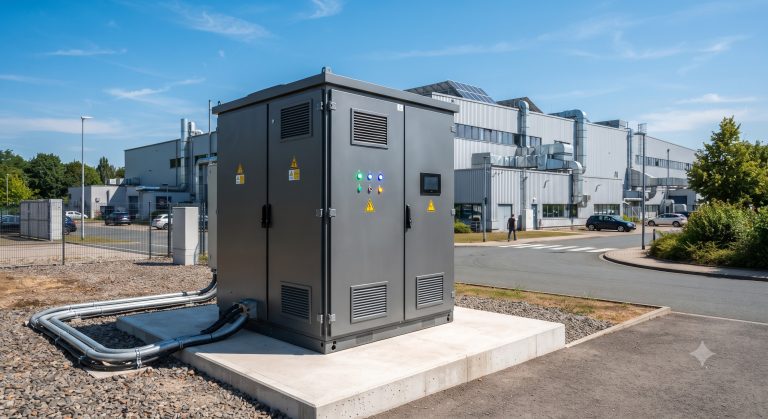
- The ST10030kWh-2500kW-MV-4h uses variable-speed refrigerant-based liquid cooling with ethylene-glycol coolant circulating through cold plates directly contacting each battery module. Rated operating ambient range is -25degC to +55degC. At 45degC ambient, the cooling system maintains max cell temperature below 38degC with IP65-rated outdoor enclosures (NEMA 4X). Inverter auxiliary cooling draws less than 15kW at peak heat load.
- Q7: Can multiple ST10030kWh-2500kW-MV-4h units be paralleled for larger capacity, and what are the scalability limits?
- Yes, up to 16 units can be paralleled via a common MV AC bus (12kV or 33kV) without additional central controllers, achieving 160 MWh capacity and 40 MW power. For DC-coupled expansion (adding only battery containers without additional PCS), you must use the optional DC-DC converter hub, supporting up to 4 additional battery containers per PCS module. No software license fees apply for scaling.
- Q8: What international safety and grid interconnection standards does the ST10030kWh-2500kW-MV-4h comply with?
- Full certifications include UL 9540 (Energy Storage Systems), UL 9540A (Thermal Runaway Fire Testing), IEC 62619 (Industrial batteries), IEC 62477-1 (Power conversion safety), IEEE 1547 (Grid interconnection), CE, and UN38.3 (Transportation). The system also carries cTUVus listing for North America and GB/T 36276 for China markets. Compliance documentation is provided with each shipment.