Overview
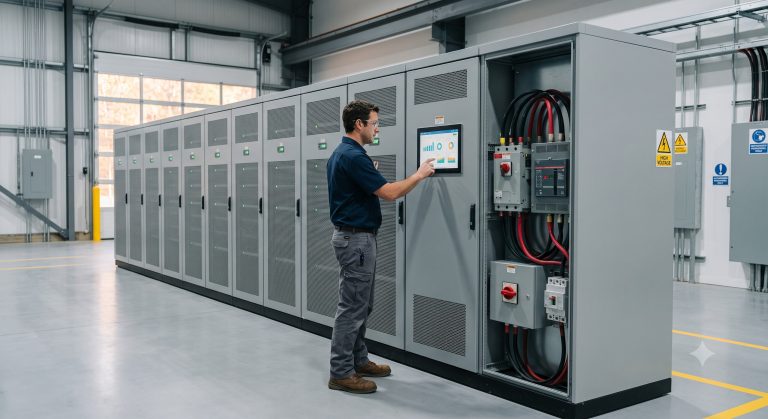
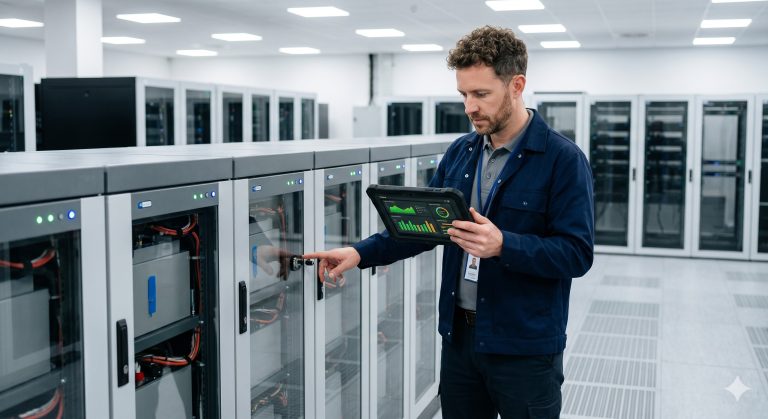
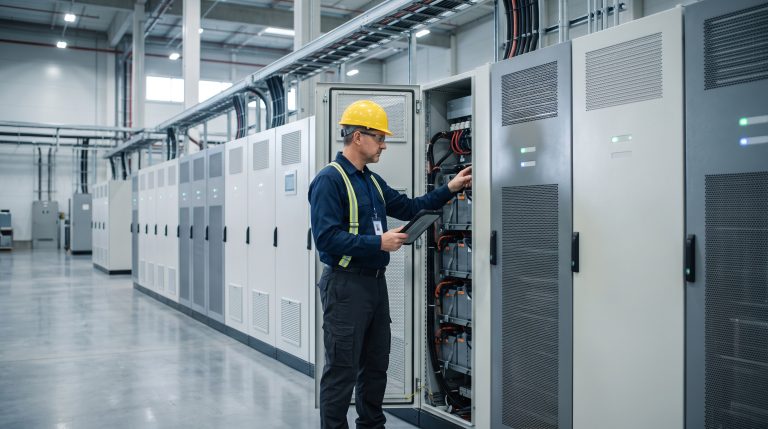
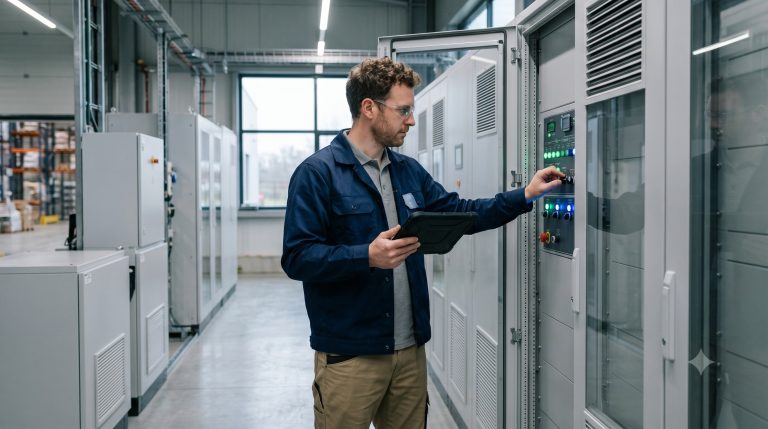
For critical industrial operations, the response time of your battery energy storage system (BESS) during a power outage is not just a specification—it is a promise of operational continuity. Our utility-scale and commercial storage solutions are engineered to transition from grid-tied to island mode in under 20 milliseconds, ensuring seamless power for sensitive manufacturing processes and data centers. In this comprehensive FAQ, we address the most pressing technical, safety, and financial questions from B2B engineers and procurement specialists, covering everything from LFP cell degradation to UL 9540 compliance and peak shaving ROI. 
Frequently Asked Questions
- Q1: What is the standard response time of your industrial battery storage during a grid power outage?
- The standard response time is less than 20 milliseconds (ms) for seamless transition to off-grid (island) mode. This ultra-fast switchover is achieved through our bi-directional PCS and static transfer switch technology, which detects grid frequency or voltage drops within half a cycle (10ms) and instantly isolates the facility. For most C&I applications, this is fast enough to prevent PLC resets and keep critical HVAC or conveyor systems running without interruption.
- Q2: What battery chemistry do you use, and what is the guaranteed cycle life?
- We exclusively use Tier-1 prismatic Lithium Iron Phosphate (LFP) cells, which offer a guaranteed cycle life of 6,000 cycles at 90% Depth of Discharge (DoD) before reaching 80% State of Health (SOH). This equates to over 15 years of daily cycling in a standard industrial environment. Unlike NMC chemistry, our LFP cells provide superior thermal stability and a flat degradation curve, ensuring consistent capacity throughout the system’s operational lifespan.
- Q3: How does the advanced liquid cooling system improve performance and safety?
- Our industrial BESS utilizes a patented liquid cooling circuitry that maintains cell temperature variance within ±2°C across all 280Ah or 314Ah cells. This precision cooling prevents hot spots, directly enhances cycle life by up to 25%, and ensures optimal charge/discharge efficiency even in ambient temperatures up to 55°C. For post-sales safety, this closed-loop thermal management system acts as a first line of defense against thermal runaway by actively dissipating heat before it can accumulate.
- Q4: What are the multi-tier fire safety mechanisms and thermal runaway prevention protocols?
- Our systems feature a 4-tier fire safety architecture: 1) Cell-level fuses and flame-retardant enclosures, 2) Module-level gas detection and smoke sensors that trigger early isolation, 3) Rack-level aerosol fire suppression (FM-200 or Novec 1230 equivalent) activated at 70°C, and 4) Container-level water mist deluge system. The BMS actively monitors internal resistance and temperature gradients to predict and prevent thermal runaway, shutting down modules 30 seconds before critical thresholds are reached.
- Q5: Can this system be configured for both grid-tie and off-grid/islanding operation?
- Yes, every system is designed as a hybrid unit with dual-mode capabilities. In grid-tie mode, it performs peak shaving and demand response; upon grid loss, it automatically switches to off-grid (island) mode to power your critical loads. This configuration is supported by a high-speed static switch and does not require external synchronizers, making it ideal for manufacturing plants with sensitive CNC machinery or medical equipment.
- Q6: How do we calculate the ROI and payback period for peak shaving arbitrage?
- ROI is calculated by analyzing the delta between peak and off-peak utility tariffs and the facility’s peak demand charges (kW). Our EMS platform provides a site-specific analysis using historical load data. For a typical 1MW/4MWh system, the payback period ranges from 3.5 to 5 years based on a 20% peak demand reduction and daily charge/discharge cycles. We provide a guaranteed performance contract that validates the projected annual savings against actual utility bills.
- Q7: What is the scalability potential for a 20ft or 40ft containerized solution?
- Our 40ft HC container offers a baseline capacity of 4MWh to 6MWh, which is fully modular and parallel scalable up to 100MWh+ on a single site. The system supports parallel DC busbar linkage and AC coupling, allowing you to add cabinets without disrupting existing operations. This ‘pay-as-you-grow’ architecture minimizes upfront capital expenditure and allows for capacity upgrades in 1MWh increments as your production demands increase.
- Q8: What does the comprehensive post-sales O&M support and global warranty cover?
- Our 10-year standard warranty includes parts, remote BMS monitoring, and annual on-site performance testing. The O&M package covers 100% of cell replacement costs if capacity falls below 80% SOH within the warranty period. We maintain global spare parts depots (US, EU, SEA) and provide 24/7 remote diagnostics, with a guaranteed 4-hour technical response time and 48-hour on-site support for critical post-sales issues.