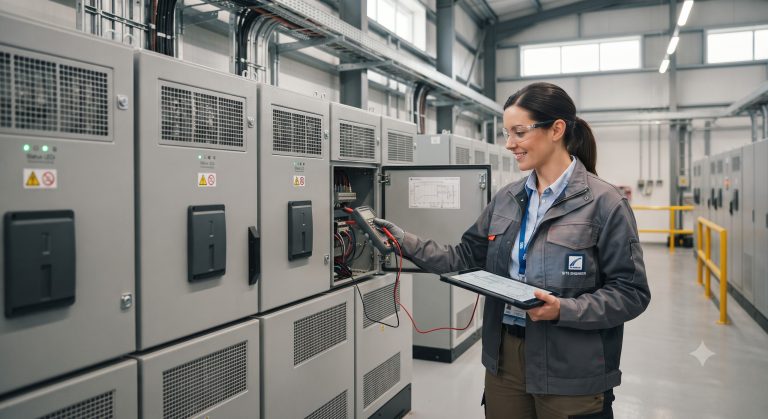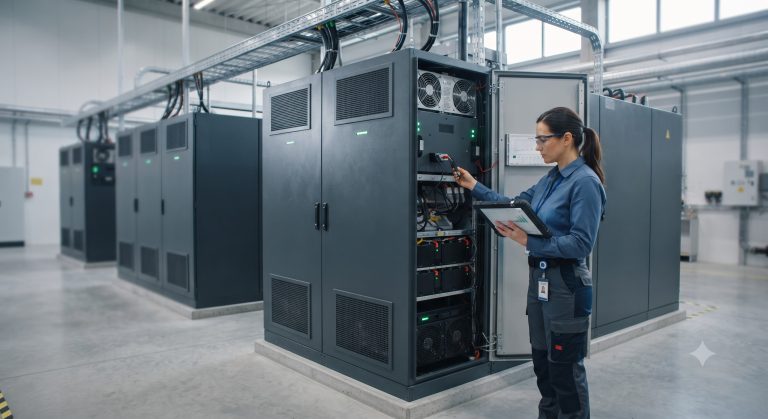
Overview
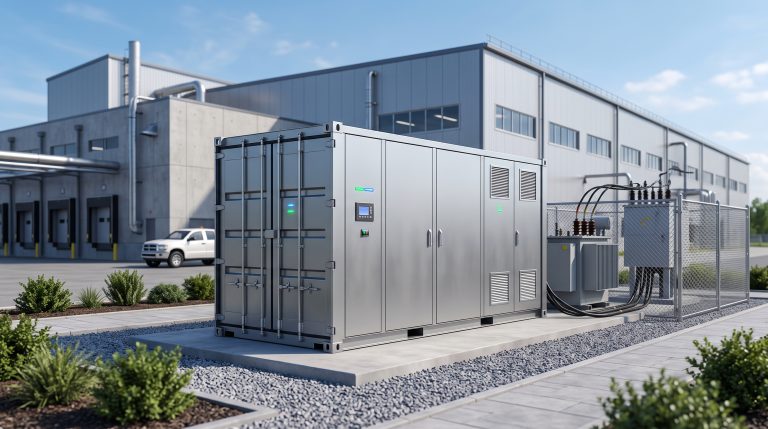
As a technical support engineer for the ST510CS-2H-CNPowerStack, I’ve compiled the most frequent and critical questions from B2B clients—including plant engineers, procurement managers, and system integrators. This FAQ focuses specifically on thermal safety, active BMS logic, scalable architecture, and real-world ROI modeling. Each answer is structured for immediate clarity and technical accuracy.
Frequently Asked Questions
- Q1: How does the ST510CS-2H-CNPowerStack prevent thermal runaway, and what fire suppression systems are integrated?
- The ST510CS-2H-CNPowerStack prevents thermal runaway through three active layers: per-module gas detection sensors, a bi-directional liquid cooling plate that maintains cell delta-T below 2.5°C, and an aerosol-based suppression system activated at the first sign of off-gas (CO + VOCs). Each cabinet is independently sealed with fire-retardant intumescent seals and vents pressure outward via a guided explosion-proof channel. This design meets UL 9540A thermal runaway propagation test requirements with no fire spread between adjacent cabinets.
- Q2: What is the true cycle life of the ST510CS-2H-CNPowerStack at 90% depth of discharge, and what degrades first?
- The ST510CS-2H-CNPowerStack delivers 8,000 cycles to 70% state-of-health (SOH) at 90% DoD under standard 0.5C charge/discharge rates. The limiting degradation factor is cathode electrolyte interface (CEI) thickening on the LFP cells, not lithium plating, due to the liquid cooling system keeping average cell temperature below 35°C. Calendar life is 15 years at 25°C ambient. For extended life, operating at 80% DoD yields 10,000+ cycles.
- Q3: Can the ST510CS-2H-CNPowerStack operate both grid-tied and off-grid (islanding), and what is the transfer time?
- Yes, the ST510CS-2H-CNPowerStack supports seamless islanding with a transfer time of ≤20 ms (grid disconnect to island mode) using its bi-directional PCS and internal EMS. For off-grid configuration, you must enable the ‘Island Mode Enable’ parameter in the local HMI, connect a backup load sub-panel, and ensure the battery SOC is ≥20%. The system automatically resynchronizes to the grid when stable power returns, preventing backfeed.
- Q4: How do I scale the ST510CS-2H-CNPowerStack from 100 kWh to multiple MWh, and what parallel limits exist?
- The ST510CS-2H-CNPowerStack supports parallel scalability up to 32 cabinets using a shared DC busbar (custom 1500V rated) and a master-slave BMS communication loop via CAN 2.0 or Ethernet. Each cabinet is 2.2 m tall, 1.1 m deep, 0.9 m wide, with 215 kWh usable energy. For MWh scale, we recommend parallel connection every 8 cabinets with a central EMS aggregator. No additional balancing hardware is required because each cabinet’s internal BMS performs automatic inter-cable current sharing within ±3%.
- Q5: What real-time BMS parameters can I monitor remotely, and how does inter-cell balancing work?
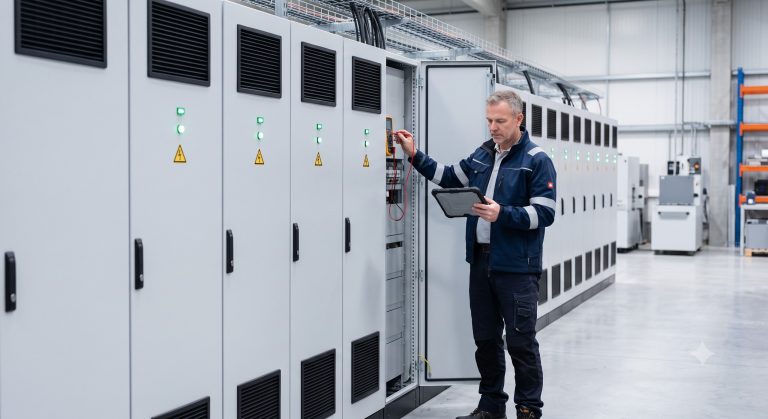
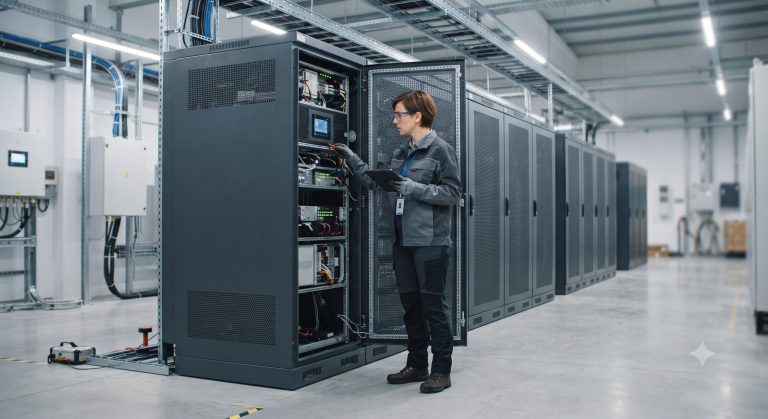
- The active BMS monitors every cell’s voltage (±5 mV accuracy), temperature (2 sensors per module), current, insulation resistance, contactor status, and cumulative Ah throughput. Inter-cell balancing is passive but intelligent: the BMS applies a 100 mA bleed resistor to any cell exceeding the average cell voltage by ≥25 mV, running during idle or charge phases. For the ST510CS-2H-CNPowerStack, balancing completes within 8 hours of float charge. Remote access is via Modbus TCP, CAN, or optional 4G gateway with cloud logging.
- Q6: How do I calculate ROI for peak shaving with the ST510CS-2H-CNPowerStack? Provide a real example.
- ROI = (Annual peak demand charge reduction + energy arbitrage savings) / (system capex + installation + O&M). Example: 500 kW peak reduction over 2 hours daily (1,000 kWh/cycle), demand charge $15/kW = $7,500/month saved. Energy arbitrage at $0.07/kWh spread (charge $0.08, discharge $0.15), 1,000 kWh/day = $70/day × 260 weekdays = $18,200/year. Total annual savings = $90,000 + $18,200 = $108,200. For a 1 MWh system costing ~$150,000 fully installed, simple payback is 1.39 years. LCOE over 10 years (8,000 cycles) = $0.025/kWh discharged.
- Q7: What are the required maintenance intervals and common post-sales issues?
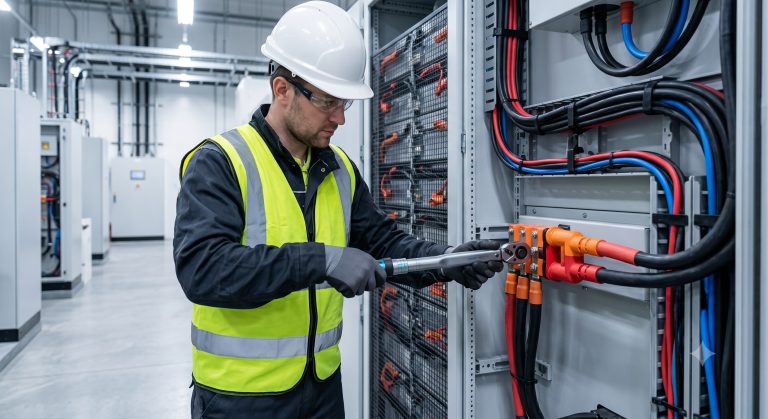
- Preventive maintenance every 6 months or 1,000 cycles: inspect coolant level (propylene glycol/water mix), clean air filters on the liquid cooling unit, torque power terminals to 25 Nm, and verify BMS firmware version. Most common post-sales issue is CAN communication loss due to incorrect termination resistor settings (solve by enabling 120Ω termination on the last cabinet only). Second is coolant pump airlock after refill—bleed via the manual vent screw on top of the pump housing.
- Q8: Which grid interconnection standards does the ST510CS-2H-CNPowerStack comply with, and do I need external protection?
- The ST510CS-2H-CNPowerStack holds UL 9540 (energy storage system), UL 1973 (cell and module), IEC 62619 (safety for industrial batteries), and IEEE 1547 (grid interconnection). For grid-tie, no external DC breaker is required because the internal DC contactor is rated 1500V/500A with 10 kA breaking capacity. However, you must install an external AC breaker (rated 125% of continuous inverter current) between the PCS and main distribution panel to meet NEC 706 requirements.