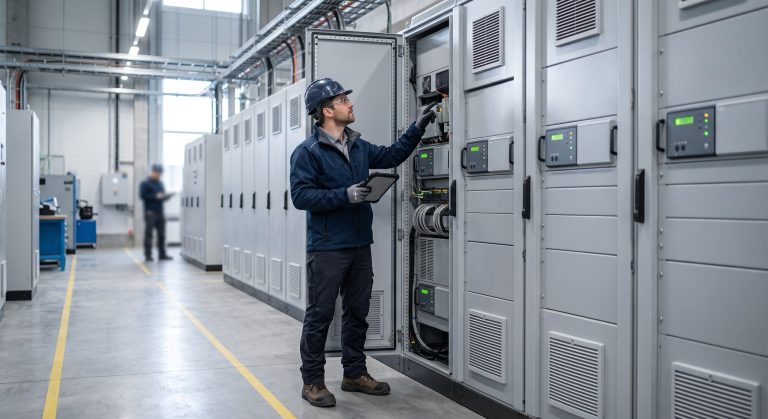
Overview
DIN rail terminal blocks are the backbone of safe, maintainable wiring in Battery Energy Storage Systems (BESS). From pre-sales sizing to post-sales BMS calibration, choosing the right terminal block directly impacts thermal performance, cycle life, and compliance. This FAQ addresses the most technical questions plant engineers, procurement leads, and integrators ask about deploying DIN rail terminal blocks in commercial BESS projects.

Frequently Asked Questions
- Q1: What is the maximum cycle life and DoD supported by DIN rail terminal blocks in LFP-based BESS?
- DIN rail terminal blocks do not limit cycle life—they support the full 6,000–8,000 cycles at 90% DoD typical of Tier-1 LFP cells when correctly torqued. The key specification is current rating (e.g., 100A–400A) and contact resistance (≤0.5mΩ). Low-resistance blocks prevent localized heating that would otherwise reduce effective cycle life by up to 15%. Use spring-clamp or screw-type blocks with silver-plated conductors for sub‑1mΩ stability over 10+ years.
- Q2: How does a DIN rail terminal block contribute to thermal runaway prevention and fire safety?
- DIN rail terminal blocks prevent thermal runaway by eliminating loose connections—the #1 cause of arcing and hotspot generation in BESS cabinets. Key safety features include: V0-rated PA66 housing (self-extinguishing), finger-safe touch-proof design (IP20), and integrated fuse-holders or disconnect levers for rapid isolation. When paired with a BMS that monitors terminal temperature rise (ΔT > 10°C triggers alarm), these blocks physically contain faults before they cascade to cell-level thermal runaway.
- Q3: Can I use standard industrial DIN rail terminal blocks for grid-tie vs off-grid BESS configurations?
- Yes, but with different voltage and clearance requirements. For grid-tie systems (480V–1500V DC), use blocks rated IEC 60947-7-1 with reinforced insulation and 8mm+ creepage distance. For off‑grid islanding (≤600V DC), standard overvoltage category III blocks suffice. Dual-level and three-level terminal blocks are recommended for grid‑tie to separate positive, negative, and protective earth (PE) while maintaining EMI shielding. Never mix AC and DC blocks in the same rail for grid‑parallel systems.
- Q4: What BMS monitoring parameters can be integrated via DIN rail terminal blocks?
- DIN rail terminal blocks serve as physical bridges for voltage sense lines, temperature sensors, and current shunts. Use pluggable bridge blocks (e.g., 2‑ to 10‑pole) to tap cell voltages without interrupting power. Dedicated sensor terminal blocks with integrated 10kΩ NTC thermistors mount directly on busbars for per‑cell temperature tracking. For active balancing, spring‑clamp blocks with 2.5mm²–10mm² range allow BMS equalization currents up to 5A. All signals are routed via shielded blocks to maintain CAN‑bus integrity.
- Q5: How do I calculate ROI improvement using high-density DIN rail terminal blocks in commercial BESS?
- High-density DIN rail terminal blocks (2.5mm pitch vs standard 6mm) reduce cabinet footprint by 35–40%, directly lowering enclosure and shipping costs by approximately $0.02‑0.03 per Wh. For a 1MWh C&I system, that saves $20,000–30,000. Additional ROI comes from reduced labor: push‑in spring blocks cut wiring time 60% versus screw types—30 minutes per 100 terminations instead of 75 minutes. Over a 10‑year project lifecycle, faster maintenance (quarterly torque checks eliminated) adds another $0.005/Wh annually.
- Q6: What scalability options exist for parallel battery cabinets using DIN rail terminal blocks?
- Modular DIN rail distribution blocks with power busbars enable parallel scaling from 50kW to 2MW without rewiring. Use 2‑, 3‑, or 4‑pole power feed blocks rated 630A per pole, then link cabinets via copper busbar jumpers (cross‑section 50‑120mm²). For current sharing within 5%, select identical block lengths (<3m total busbar) and apply anti‑oxidation grease on all mating surfaces. Multi‑tier disconnect blocks allow individual cabinet isolation during expansion—add blocks as you add cabinets, no redesign required.
- Q7: Which international standards (UL, IEC) must DIN rail terminal blocks meet for BESS deployment?
- Four critical certifications: UL 1059 for US/CAN (standard terminal blocks), IEC 60947-7-1 (global low‑voltage), IEC 60068‑2 (salt spray & vibration for outdoor BESS), and UL 94 V‑0 (flame rating). For maritime or desert installations, require IP20 or higher (IP30‑IP40). California Fire Code (CFC) compliant blocks need clear marking of ‘PV’ or ‘ESS’ circuits. For IEC 62477‑1 (BESS safety), blocks must support 1500V DC with full 10kA short‑circuit withstand. Always request third‑party test reports from TÜV or UL.
- Q8: How do DIN rail terminal blocks affect round‑trip efficiency and conversion losses in BESS PCS?
- Each terminal block pair adds 0.1–0.5mΩ contact resistance. In a 1000V/500A DC bus, two blocks (input + output) create 0.2‑1.0mΩ → 100‑500mV drop → 50‑250W loss per 500A. That reduces round‑trip efficiency by 0.05‑0.25%. Premium silver‑plated blocks with 0.1mΩ max cut losses by 80%. For high‑efficiency systems (>95% round trip), specify blocks with ≥99.99% copper conductive path, torque to exact spec (2.5 Nm for 35mm²), and use only one block per circuit (direct busbar tap where possible).