Overview
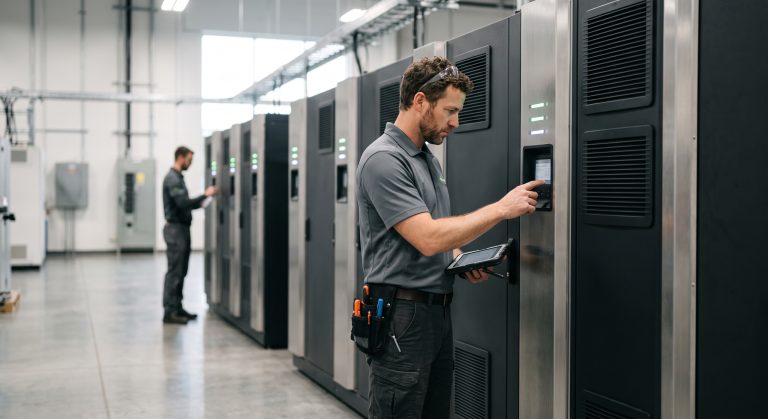
Requesting a customized solution design for a specific factory project begins with a documented load profile, site constraints, and grid interconnection requirements submitted to a BESS engineer. This FAQ answers the eight most critical pre-sales and post-sales questions plant engineers, EPC contractors, and procurement teams ask before approving a commercial energy storage deployment. Each answer is structured for rapid technical evaluation and direct vendor comparison.
Frequently Asked Questions
- Q1: How do I request a customized BESS solution design for a specific factory project?
- Submit a formal design request package containing your 12-month interval load data, single-line diagram, available footprint, grid interconnection voltage, and target discharge duration to a BESS technical support engineer. The engineer then performs a site-specific sizing simulation and returns a turnkey proposal with cabinet layout, PCS rating, and EMS configuration within 5-10 business days. A complete request package eliminates 80% of back-and-forth engineering clarification and accelerates approval.
- Q2: Which battery chemistry is best for a factory energy storage system, and why is LFP preferred?
- Lithium iron phosphate (LFP) is the preferred chemistry for factory BESS projects due to its superior thermal stability, long cycle life, and lower levelized cost of storage. LFP cells typically deliver 6,000-8,000 cycles at 80% depth of discharge (DoD) versus 3,000-5,000 cycles for NMC, making them ideal for daily peak shaving and arbitrage. Tier-1 LFP cells also reduce thermal runaway risk, which is critical for indoor or container-adjacent industrial installations.
- Q3: What is the standard cycle life and DoD of a commercial factory BESS, and how is it guaranteed?
- The standard cycle life of a commercial factory BESS is 6,000 cycles at 80% DoD with a 10-year performance warranty. This is guaranteed through a combination of Tier-1 LFP cell qualification, liquid cooling thermal management, and active BMS cell balancing that keeps cell-to-cell voltage deviation below 30 mV. Vendors typically provide a capacity retention curve, not just a cycle count, so request the warranty exhibit that defines end-of-life (EOL) threshold at 70% or 80% of nameplate capacity.
- Q4: How does liquid cooling compare to air cooling for factory BESS thermal management?
- Liquid cooling maintains cell temperature uniformity within ±3°C, while air cooling typically allows ±8-10°C variation across a cabinet. This tighter thermal control slows LFP degradation, extends cycle life by 15-25%, and enables higher continuous C-rates for peak shaving. For factories in ambient temperatures above 35°C or with high-duty cycling profiles, liquid cooling is the recommended thermal architecture.
- Q5: How do I calculate ROI and peak shaving arbitrage savings for a factory BESS?
- Calculate ROI by dividing annual energy cost savings (peak shaving + arbitrage + demand charge reduction) by total installed cost, then expressing the result as a payback period in years. A typical 1 MWh / 500 kW factory BESS in a high-demand-charge region delivers 4-6 year payback with 15-20% internal rate of return (IRR). Key inputs include your utility’s demand charge ($/kW), time-of-use rate spread, and annual cycling days.
- Q6: How does the BMS monitor and balance cells after the BESS is commissioned?
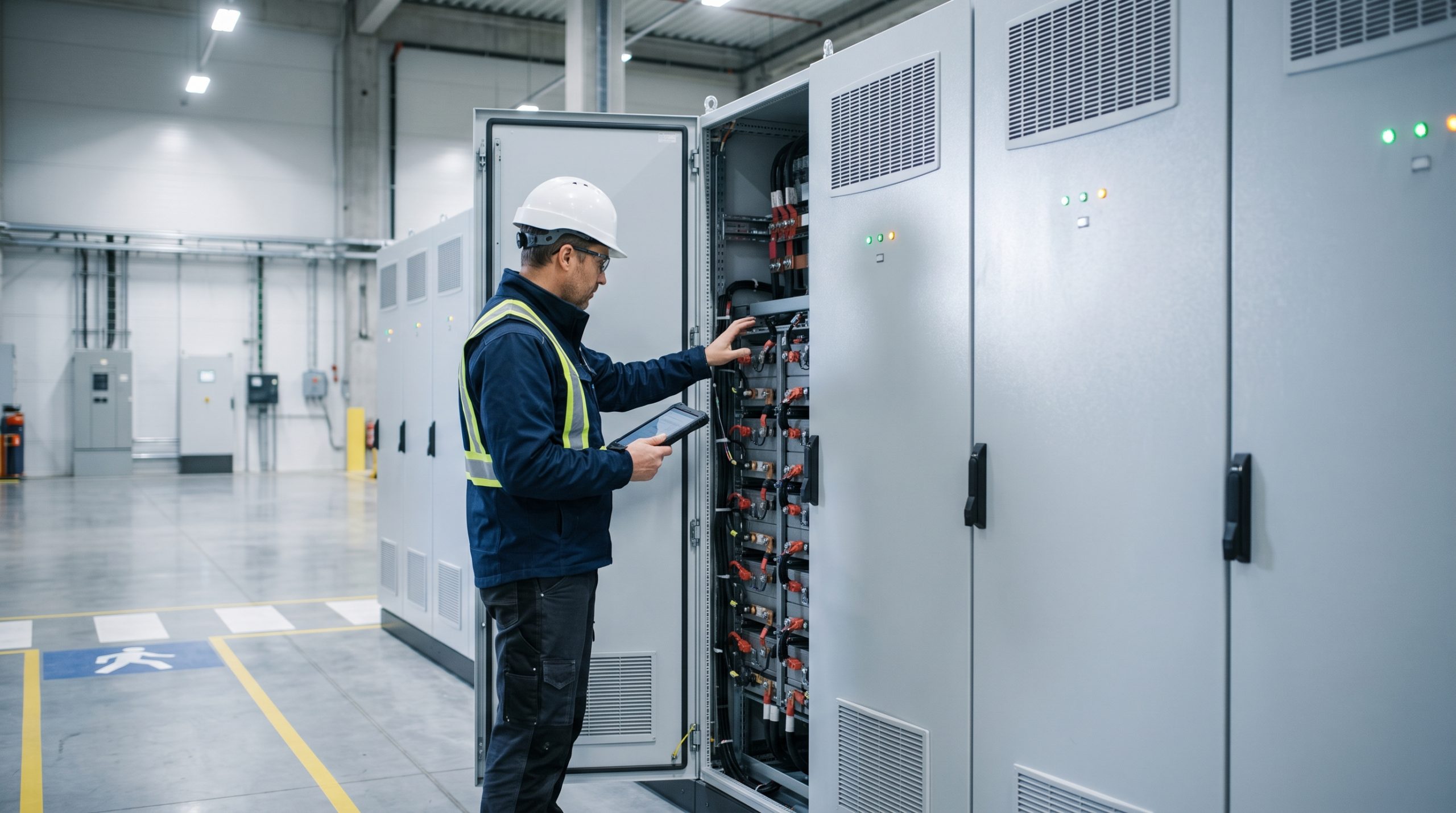
- The BMS continuously monitors cell voltage, temperature, current, and state of charge (SOC), and performs active balancing when cell voltage deviation exceeds a preset threshold. Post-sales monitoring is delivered through a cloud EMS dashboard with SNMP or Modbus TCP API integration into your SCADA system. Alarms for overvoltage, undervoltage, over-temperature, and SOC imbalance are pushed to operators in real time, with remote firmware updates for balancing algorithm improvements.
- Q7: What is the difference between grid-tie and off-grid BESS configuration for a factory?
- A grid-tie BESS operates in parallel with the utility and performs peak shaving, demand response, and power factor correction, while an off-grid BESS uses islanding mode to supply the factory independently during outages. Grid-tie configurations require anti-islanding protection and utility interconnection approval, whereas off-grid configurations require black-start capability and adequate spinning reserve sizing. Many factories deploy a hybrid configuration with seamless transfer switching to capture both arbitrage revenue and outage resilience.
- Q8: How does a factory BESS prevent fire and thermal runaway?
- Factory BESS fire prevention uses a multi-tier defense: Tier-1 LFP cells with high thermal runaway onset temperature, liquid cooling to suppress heat accumulation, cell-level fuses, and module-level gas/smoke detection. Upon detection, the system triggers HVAC shutdown, aerosol or perfluorohexanone suppression, and emergency disconnection of the DC busbar. Compliance with UL 9540, UL 9540A, IEC 62619, and NFPA 855 is mandatory for commercial and industrial installations and should be verified in the vendor’s certification package before procurement.