Overview
For facility managers and plant engineers evaluating commercial energy storage systems (BESS), operational noise is a critical yet often overlooked factor. Unlike diesel generators, modern BESS units operate with minimal sound, but the hum of bi-directional inverters (PCS) and the cycling of liquid cooling pumps still generate a measurable acoustic footprint. This FAQ addresses the most pressing pre-sales and post-sales questions regarding sound levels, mitigation strategies, and compliance, specifically tailored to ensure your installation meets local zoning and occupational health requirements.
Frequently Asked Questions
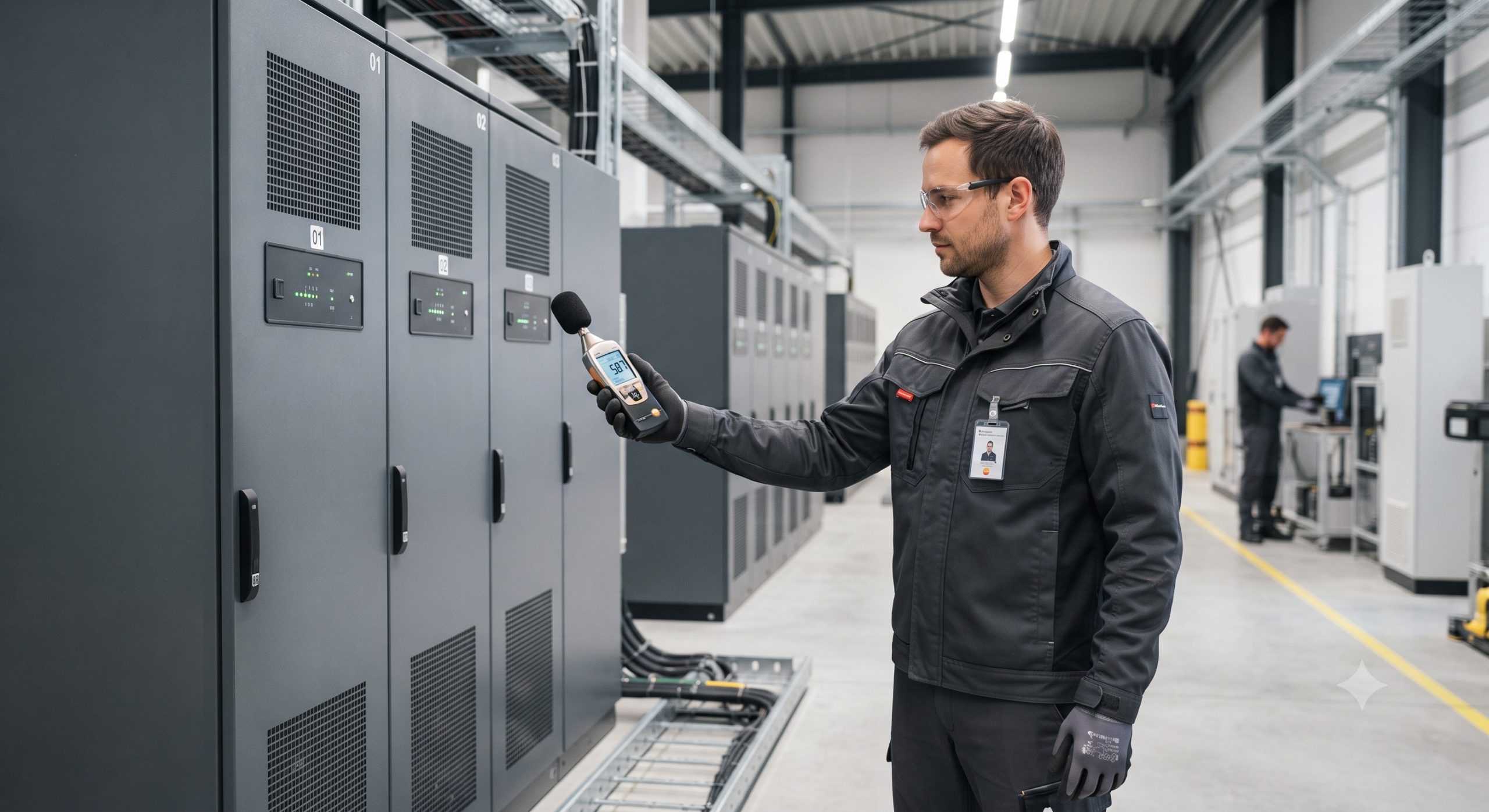
- Q1: What is the typical maximum sound pressure level (dBA) of a commercial BESS during peak charging/discharging?
- The typical maximum sound pressure level is between 65 and 75 dBA at a 1-meter distance, depending on the cooling system used. Air-cooled systems tend to be louder (approaching 75 dBA) due to high-speed fan arrays, while advanced liquid cooling systems operate quieter, often in the 60-65 dBA range, as they rely on slower pumps and larger heat exchangers. This places them roughly between a conversational level and a vacuum cleaner, making them substantially quieter than traditional backup generators which often exceed 90 dBA.
- Q2: How does the noise level change during different operational modes (e.g., standby vs. full load)?
- During standby or trickle-charge maintenance, the system is nearly silent, operating at 40-50 dBA, only powering the BMS and basic monitoring electronics. Under full-load peak shaving or rapid EV charging dispatch, the Power Conversion System (PCS) ramps up IGBT switching frequencies and liquid cooling pumps engage fully, pushing levels to the maximum rated dBA. This variable profile is critical for nighttime installations where strict local noise ordinances (e.g., <55 dBA at property boundaries) may require specific scheduling to limit high-load operations to daytime hours.
- Q3: What are the primary sources of noise in a BESS enclosure?
- The primary sources are thermal management fans/pumps and the high-frequency switching of the bi-directional inverter (PCS). Specifically, air-cooled systems generate turbulent airflow through heatsinks, while liquid-cooled systems emit a lower-frequency hum from the chiller compressor and circulation pumps. A secondary source is electromagnetic coil whine from the transformers within the PCS, which becomes more pronounced at higher loads. High-quality systems utilize variable-speed drives to soften the acoustic ramp-up, preventing abrupt, disruptive spikes in noise.
- Q4: Do I need to conduct a specific acoustic study for a utility-scale BESS deployment?
- Yes, a site-specific acoustic study is strongly recommended and often required by local municipal permitting or environmental impact assessments. Unlike residential equipment, commercial systems are classified as industrial sources. The study must measure ambient background noise (typically 30-40 dBA in suburban areas) and model the propagation of the BESS noise to the nearest sensitive receptors (neighbor properties, offices). The standard is to ensure that the *intrusive* noise (BESS + background) does not exceed local limits at the property line, often requiring setbacks or barrier installations if the site is close to residential zones.
- Q5: What physical mitigation strategies are available to reduce BESS noise?
- We recommend a tiered approach: First, specify liquid-cooled units with insulated compressor mounts, as they generate less high-frequency noise. Second, install acoustic louver panels on the enclosure to absorb fan noise without restricting airflow. Third, utilize concrete or masonry sound walls rather than standard fencing, as they provide a 10-15 dBA reduction at the property line. Additionally, orienting the exhaust vents away from sensitive areas and utilizing earth berms can further attenuate low-frequency vibrations that penetrate building structures.
- Q6: Is BESS noise a constant issue, or does it vary with grid frequency and state of charge?
- It varies significantly, which is a key consideration for dispatch algorithms. At a low State of Charge (SOC), the system absorbs maximum current, generating peak heat and therefore peak fan/pump speed. During frequency regulation (grid support), the PCS rapidly adjusts power output, causing the fans to cycle on and off aggressively. To mitigate this, modern Energy Management Systems (EMS) can be programmed with ‘Quiet Mode’ schedules, restricting specific high-noise activities to allowed hours, ensuring the facility remains a good neighbor.
- Q7: How do liquid cooling noise levels compare specifically to air-cooling in hot climates?
- In hot climates (ambient > 35°C), liquid cooling maintains a significant acoustical advantage. Air-cooled systems are forced to run axial fans at maximum RPM to compensate for the reduced temperature delta, often exceeding 75 dBA continuously. Conversely, liquid-cooled systems maintain a consistent thermal rejection rate via the radiator, allowing the pumps to run at a stable, lower RPM. This ensures that the acoustic profile remains predictable and lower (usually <65 dBA) even during heatwaves, preventing regulatory violations during summer peak periods.
- Q8: Can you provide an example ROI calculation that includes acoustic mitigation costs?
- Yes. While the base system cost is $X/kWh, failing to account for acoustic barriers can add 5-8% to the civil works budget. For a 1MWh urban installation, a concrete sound wall (approx. $15,000) is a one-time CAPEX, but it eliminates the risk of operation curtailment (lost revenue of $500/day) due to noise complaints. The ROI is realized within the first year of arbitrage if the system avoids peak-time shutdowns. This is factored into the Levelized Cost of Storage (LCOE) calculation by amortizing the wall cost over the 15-year lifespan, adding only $0.001/kWh to the total cost.