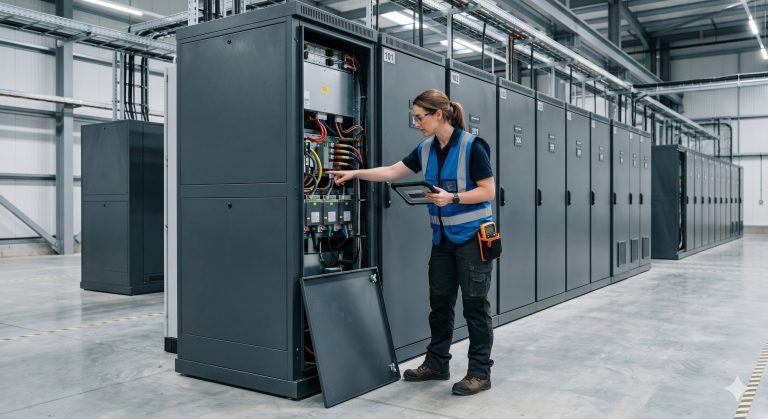
Overview
Ensuring electrostatic discharge (ESD) safety in cleanroom environments for Battery Energy Storage Systems (BESS) is critical to prevent component damage, data corruption, and potential fire hazards. This FAQ addresses common technical support queries regarding ESD protection strategies and related operational concerns.

Frequently Asked Questions
- Q1: How do you ensure electrostatic discharge (ESD) safety for BESS components in a cleanroom?
- ESD safety is ensured through a multi-layered approach including grounding, ionizers, and anti-static materials. All workstations, flooring, and personnel wear are ESD-protective, with continuous monitoring of grounding systems and environmental controls to maintain humidity levels above 40%.
- Q2: What battery chemistry is safest and most resistant to ESD-related damage?
- LFP (Lithium Iron Phosphate) chemistry is generally considered safer and more stable under ESD conditions due to its robust crystal structure. Unlike NMC, LFP minimizes thermal runaway risks and withstands voltage transients better, making it the preferred choice for sensitive environments.
- Q3: What is the standard cycle life and depth of discharge (DoD) for BESS in cleanroom applications?
- The standard cycle life for LFP-based BESS is typically 6,000 to 8,000 cycles at 80% DoD. Advanced liquid cooling and precise BMS balancing can extend this further, ensuring long-term reliability even with high-frequency charge/discharge from ESD protection equipment.
- Q4: What thermal runaway prevention measures are integrated alongside ESD protocols?
- Thermal runaway is prevented through early gas detection, inter-cell isolation barriers, and a multi-tier fire suppression system (e.g., aerosol or water mist). These systems are triggered by real-time temperature and voltage monitoring, operating independently of ESD controls for fail-safe protection.
- Q5: How does the cooling system contribute to overall ESD and operational safety?
- The liquid cooling system maintains stable operating temperatures, reducing the risk of component failure and secondary ESD events. By preventing hotspots, it ensures consistent cell balancing, which indirectly minimizes internal stress and potential for electrostatic buildup.
- Q6: How does the Battery Management System (BMS) monitor and mitigate ESD risks?
- The BMS continuously monitors cell voltages and temperatures, employing advanced filtering algorithms to detect and isolate transient voltage spikes caused by ESD. It can proactively balance cells and disconnect modules to prevent cascade failures, feeding data back to the central EMS.
- Q7: What international safety standards apply to BESS with integrated ESD protection?
- BESS units must comply with stringent standards including UL 9540, IEC 62619, and CE requirements. These standards mandate strict ESD immunity tests (IEC 61000-4-2) and require documented procedures for cleanroom handling, grounding, and periodic inspection of protective devices.
- Q8: Can you scale the BESS capacity while maintaining high ESD safety in a cleanroom?
- Yes, BESS can be scaled in a modular fashion (parallel cabinet connectivity) without compromising ESD safety. Each module incorporates independent grounding and ESD protection circuits, and the system’s EMI/EMC shielding is designed to accommodate increased capacity without increasing vulnerability.