Overview
The fundamental difference between backup power and peak shaving modes lies in their core objective: backup power is designed for grid failure scenarios to provide uninterrupted power, while peak shaving is an economic strategy to reduce demand charges by discharging stored energy during high-tariff periods. Both modes leverage the same Battery Energy Storage System (BESS) hardware but utilize distinct control logics within the Energy Management System (EMS). Understanding this distinction is crucial for system sizing, ROI calculation, and overall deployment strategy. Below, we answer the most critical pre-sales and post-sales questions from B2B engineers and procurement specialists to help you optimize your BESS investment.
Frequently Asked Questions
- Q1: What is the technical difference in how a BESS operates in backup power mode versus peak shaving mode?
- In backup power mode, the BESS is in a standby state, continuously monitoring the grid for interruptions and programmed to discharge instantly at full power upon a grid outage. In peak shaving mode, the BESS is actively dispatched daily, charging during low-tariff periods and discharging during specific peak demand windows based on a predictive EMS algorithm.
- Q2: Which battery chemistry and cooling system are best for frequent peak shaving cycles?
- Lithium Iron Phosphate (LFP) is the preferred chemistry for peak shaving due to its excellent thermal stability and high cycle life. For a system performing daily peak shaving, advanced liquid cooling is critical as it maintains optimal cell temperature (20-25°C) during the high C-rate discharge cycles, preventing accelerated degradation and ensuring consistent performance over the 10+ year lifespan.
- Q3: How does the cycle life and DoD differ between backup and peak shaving applications?
- For backup power, systems are rarely cycled but require high reliability, with a cycle life of 500-1,000 cycles at 100% Depth of Discharge (DoD) often being sufficient. Conversely, peak shaving involves daily deep cycling, requiring a minimum of 6,000-8,000 cycles at 90% DoD from Tier-1 LFP cells to maintain financial viability over the system’s lifetime.
- Q4: How do I calculate the ROI and Levelized Cost of Energy (LCOE) for a peak shaving project?
- Peak shaving ROI is calculated by analyzing your facility’s utility tariff structure, specifically the peak demand charges ($/kW) and the time-of-use (TOU) energy rates. The LCOE is calculated by dividing the total system cost (CapEx + OpEx) by the total lifetime energy throughput (kWh). A positive ROI is typically achieved when the avoided demand charges over 10 years exceed the total system LCOE.
- Q5: What are the critical safety protocols for thermal runaway prevention in both modes?
- Multi-tier fire safety mechanisms are essential for all modes. This includes early gas and smoke detection sensors within each module, cell-level fusing, and a three-level fire suppression system (aerosol, gas, and water mist). The BMS must be programmed to immediately isolate a faulty string and trigger alarms, regardless of whether the system is in backup or peak shaving dispatch, to prevent cascading thermal events.
- Q6: Can a single BESS system be configured to seamlessly switch between off-grid backup and grid-tie peak shaving?
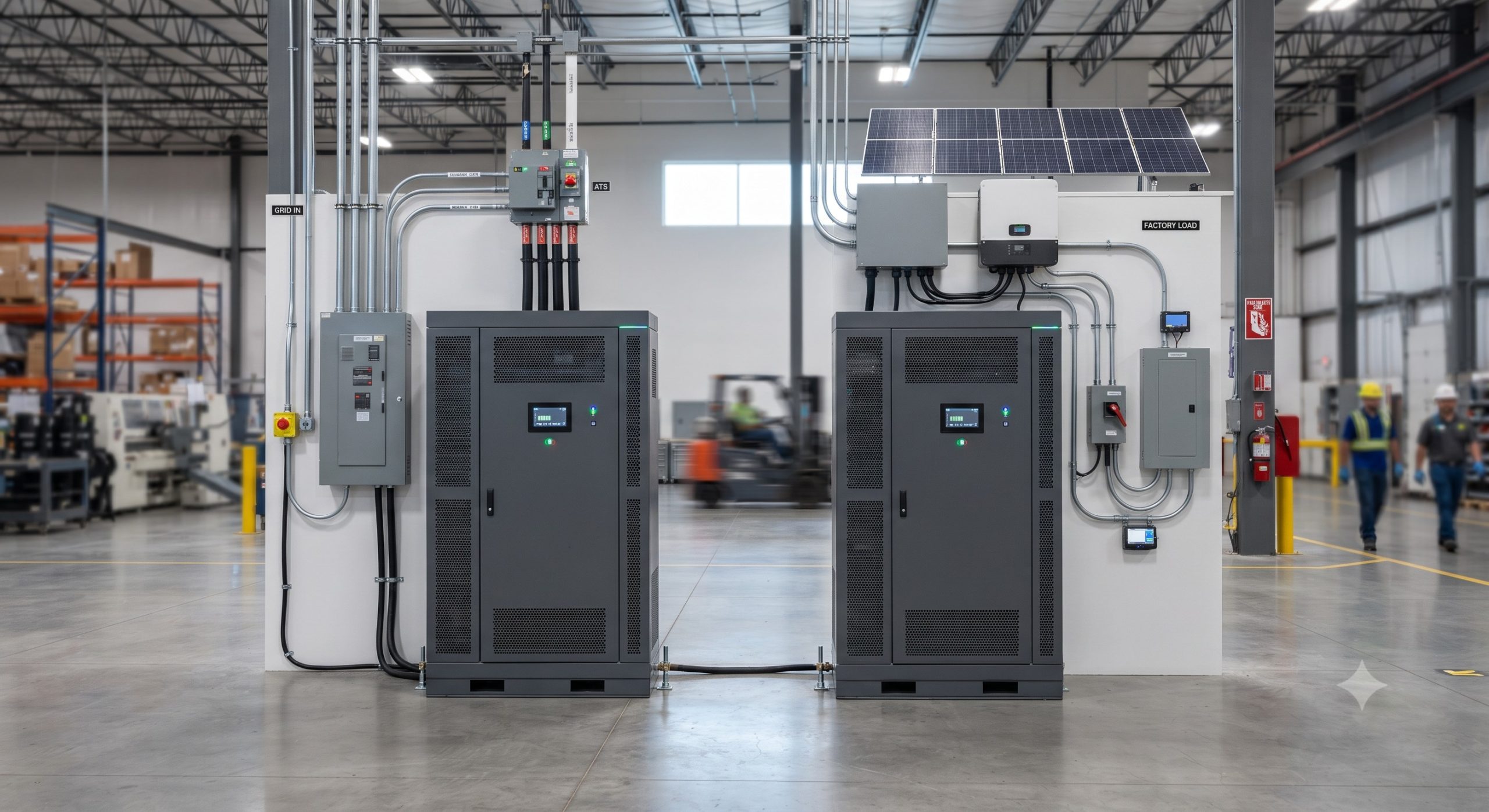
- Yes, modern BESS units are designed for seamless transition, enabled by a bi-directional Power Conversion System (PCS) with grid-forming and grid-following capabilities. This allows the system to operate in grid-tie mode for peak shaving and, upon grid failure, instantly island from the grid to provide backup power, ensuring no interruption to critical loads.
- Q7: How does the BMS monitoring and inter-cell balancing differ when a system is used daily for peak shaving?
- For daily peak shaving, the Battery Management System (BMS) must employ active inter-cell balancing to compensate for the increased stress of frequent charge/discharge cycles. This advanced BMS continuously monitors the state of charge (SoC) and state of health (SoH) of each cell, actively redistributing energy to maintain perfect balance and prevent weak cells from limiting the system’s total usable capacity.
- Q8: What are the scalability options if I start with a backup system but later want to add peak shaving capacity?
- Most BESS platforms are designed with modular expansion in mind via parallel cabinet connectivity and custom DC busbar linkage. You can start with a smaller capacity for backup and later scale up by adding more battery cabinets to the same inverter and EMS, enabling peak shaving without requiring a complete system overhaul, provided the PCS and EMS are sized for the final intended capacity.