Overview
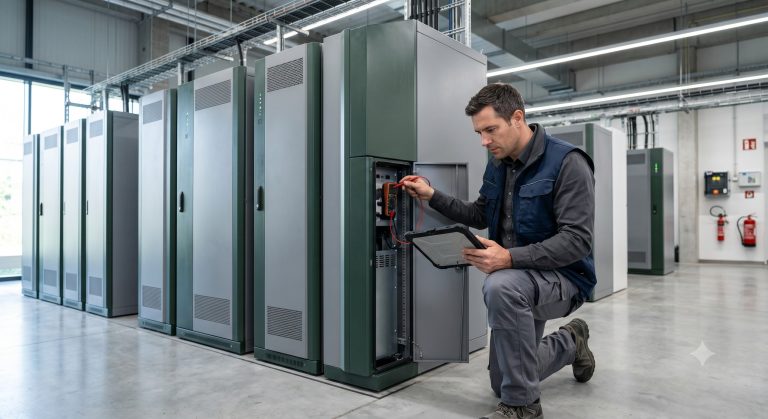
Battery Energy Storage Systems (BESS) are critical assets for commercial and industrial (C&I) facilities, and ensuring the integrity of their safety mechanisms is paramount. This FAQ addresses the most critical engineering and procurement questions, starting with the rigorous testing of short-circuit protection devices within battery modules.
Frequently Asked Questions
- Q1: How do you test the short-circuit protection of the battery modules in a BESS?
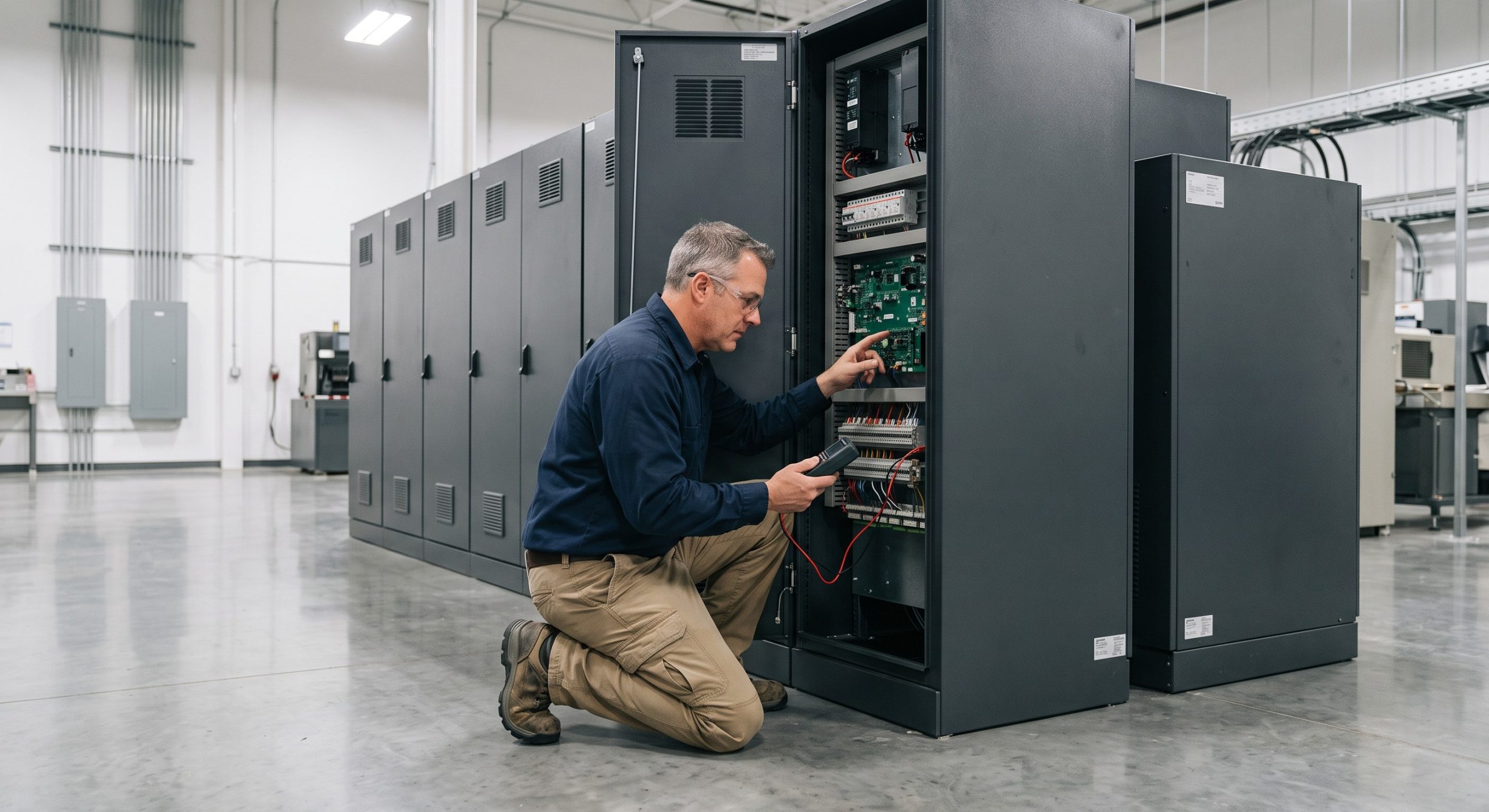
- The short-circuit protection is validated using a specialized fault-current injection tester that simulates a high-impedance or dead short across the module’s terminals. This test verifies the immediate response time of the internal fuse, contactors, and BMS to disconnect the circuit within milliseconds, ensuring no thermal runaway or arc flash occurs. The test is performed both at the module level and integrated into the full rack system to confirm coordination with the upstream DC breaker.
- Q2: What is the maximum cycle life and DoD of the LFP cells used in the BESS?
- The battery modules utilize Tier-1 LFP (Lithium Iron Phosphate) cells, which provide a standard cycle life of 6,000 to 8,000 cycles at 80% Depth of Discharge (DoD). This extended lifespan is achieved through advanced liquid cooling circuitry that maintains optimal cell temperatures and precise BMS inter-cell balancing, guaranteeing 70% capacity retention at the end of life.
- Q3: How does the liquid cooling system prevent thermal runaway in the battery cabinets?
- The integrated liquid cooling system actively removes excess heat from the cells, preventing the high-temperature conditions that can lead to thermal runaway. In conjunction with a multi-tier fire safety mechanism, the system includes early gas and smoke detection sensors that can automatically isolate a faulty module and trigger a suppression system if temperatures exceed safe thresholds, adhering to UL 9540A standards.
- Q4: How does the BMS monitor and ensure inter-cell balancing for the entire system?
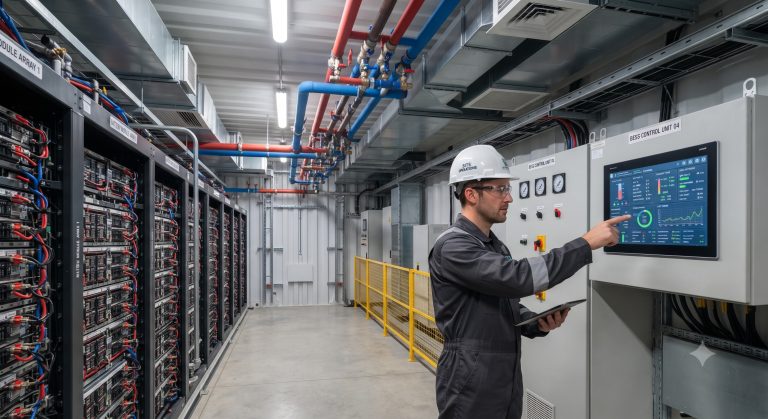
- The proprietary BMS (Battery Management System) performs continuous monitoring of voltage, current, and temperature at the individual cell level. It executes a passive or active balancing algorithm during charge and discharge cycles to equalize cell voltages, preventing premature degradation. This detailed monitoring ensures that all cells operate within their safe operating area, maximizing the system’s overall usable capacity.
- Q5: Is the system configurable for grid-tie, off-grid, and islanding applications?
- Yes, the bi-directional Power Conversion System (PCS) is designed for full grid-support functionality, including grid-tie, off-grid, and seamless islanding modes. The PCS is field-configurable to ensure a seamless transfer during grid outages, making it suitable for peak shaving, demand response, and providing backup power for critical industrial processes.
- Q6: How do I calculate the ROI and LCOE for this commercial BESS installation?
- The Return on Investment (ROI) is calculated based on peak shaving arbitrage, demand charge reduction, and potential grid service revenues. The Levelized Cost of Energy (LCOE) is typically competitive, driven by the long cycle life and high round-trip efficiency. A detailed analysis can be provided using your facility’s specific load profiles and local utility tariff structures.
- Q7: What are the international standards and certifications for this BESS?
- The system is fully compliant with critical international safety and interconnection standards, including UL 9540 for system safety, UL 9540A for thermal runaway fire propagation, and IEC 62619 for industrial battery safety. This ensures seamless deployment and compliance with local regulations and insurance requirements.
- Q8: How scalable is the system and what are the upgrade paths?
- The modular architecture allows for parallel cabinet connectivity, making the system highly scalable. You can start with a smaller kWh capacity and easily expand by adding more cabinets via a custom DC busbar linkage, enabling a seamless upgrade path to meet growing energy storage demands without significant system redesign.