“`json
{
“title”: “Troubleshooting BESS Container: Grid Synchronization, BMS Calibration & Maintenance”,
“seo_title”: “BESS Battery Module Failure: Expert Troubleshooting FAQ”,
“seo_desc”: “What if a BESS battery module fails in a megawatt container? Expert answers on BMS isolation, thermal runaway prevention, and maintaining system output during failures.”,
“content”: “
Overview
\n
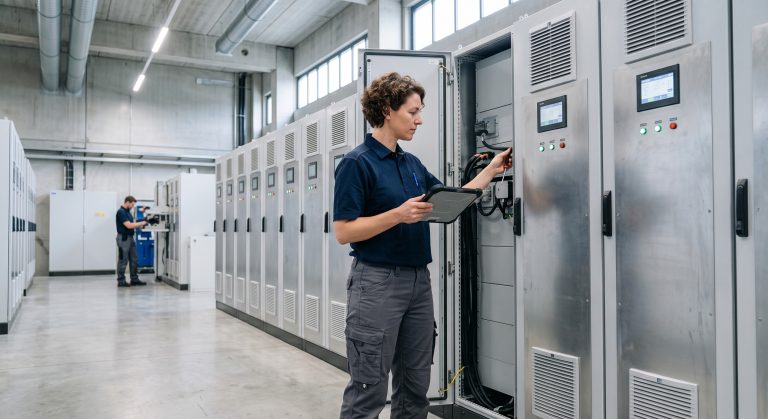
In megawatt-scale Battery Energy Storage Systems (BESS), component resilience is engineered for minimal disruption. This FAQ addresses the critical pre-sales and post-sales query: what happens if one battery module fails? We cover isolation protocols, fire safety systems, and how the remaining architecture maintains grid performance, ensuring your BESS investment remains robust and profitable.
\n[IMAGE_1]\n
Frequently Asked Questions
\n
- \n
- Q1: What exactly happens if one battery module fails inside a megawatt BESS container?
- When a single module fails, the Battery Management System (BMS) instantly isolates it via DC contactors. The system seamlessly bypasses the faulty unit without affecting the overall voltage or capacity of the string, allowing the remaining healthy modules to continue dispatching power. This is a standard failsafe design, ensuring a mere 0.5-2% capacity derating rather than a total system shutdown, which is crucial for maintaining continuous grid support or peak shaving operations.
- Q2: How does the BMS actively monitor cells to prevent module failure in the first place?
- The BMS actively monitors voltage, temperature, and internal resistance at the cell level, typically scanning each of the thousands of cells every 100-200 milliseconds. This advanced active balancing system prevents over-charge/discharge, equalizes cell voltages, and automatically calibrates State of Charge (SoC) and State of Health (SoH) to maximize the LFP cycle life. Early detection of anomalies is the primary defense against module degradation and potential thermal events, ensuring real-time operational safety.
- Q3: Does a module failure trigger thermal runaway, and what fire safety mechanisms are in place?
- No, a single module failure does not automatically cause thermal runaway; the BMS enforces strict shutdown protocols immediately upon detecting abnormal heat or gas (e.g., CO, VOCs). The container is equipped with multi-tier fire suppression, including aerosol generators and water mist systems, coupled with compartmentalized design that isolates the affected module via heat-resistant barriers. This containment strategy ensures fire safety and prevents propagation to adjacent modules, protecting the entire BESS asset.
- Q4: What is the standard cycle life and DoD of LFP modules in these containers?
- The standard cycle life is up to 6,000-8,000 cycles at 90% Depth of Discharge (DoD) for Tier-1 LFP cells, reaching End of Life (EOL) at 80% State of Health (SoH). Achieving this extended lifespan requires advanced liquid cooling to maintain optimal temperatures (typically 15-25°C) and precise BMS balancing. Compared to NMC chemistry, LFP offers superior thermal stability and longer calendar life, making it the preferred choice for high-throughput commercial energy storage.
- Q5: How does a failed module impact grid-tie or off-grid configuration and system scalability?
- In grid-tie configurations, the system maintains stable frequency and voltage due to the PCS’s bi-directional control, with the reduction in capacity being automatically compensated by the grid or other operating strings. In off-grid/islanding mode, the system automatically load-sheds non-critical loads to maintain stable power, as the loss of a module reduces total MWh capability by a mere ~1-2%. Furthermore, the entire system is modular and scalable; you can easily hot-swap the failed cabinet or add parallel DC busbar linkages to increase capacity without total system downtime.
- Q6: How do I calculate the ROI and Levelized Cost of Energy (LCOE) if failures cause downtime?
- The ROI is calculated using the annual peak shaving arbitrage revenue minus the LCOE, which includes O&M costs and degradation allowances. Because a single module failure causes less than 1% annual downtime (due to hot-swappable design and fast 48-hour replacement lead times), the financial impact is marginal. The LCOE for this containerized system typically ranges between $0.05-0.08/kWh over a 10-year guarantee, representing a 30-40% reduction in total cost of ownership compared to diesel generators or smaller, non-containerized systems.
- Q7: What is the specific O&M support process for replacing a failed module?
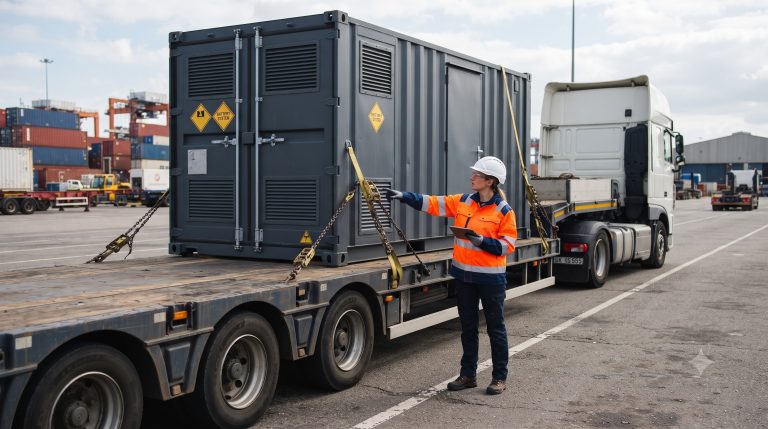
- Our post-sales O&M protocol begins with an automatic alert via the EMS cloud platform, dispatching a local service engineer within 4 hours. The replacement procedure is a simple “unlock, slide out, slide in” process for the rack-mounted module, requiring less than 2 hours to complete. This turnkey support includes global sea freight security for spare parts and a guaranteed 10-year performance warranty, ensuring 99.99% system uptime for your industrial facilities.
- Q8: What international certifications does the BESS container hold for safety and performance?
- Our megawatt containers strictly adhere to international interconnection standards, including UL 9540 (Energy Storage Systems), UL 9540A (Thermal Runaway Fire Propagation), and IEC 62619 (Safety Requirements for Industrial Batteries). These certifications guarantee the container’s IP65+ enclosure rating, anti-corrosion protection for outdoor harsh environments, and compliance with CE and UN38.3 for transport safety, providing complete technical support for project permitting and insurance requirements.
\n
\n
\n
\n
\n
\n
\n
\n
\n
\n
\n
\n
\n
\n
\n
\n
“,
“tags”: “BESS module failure, battery troubleshooting, BMS calibration, fire safety, LFP cycle life, grid-tie, O&M support, UL9540, energy storage container”,
“images”: [
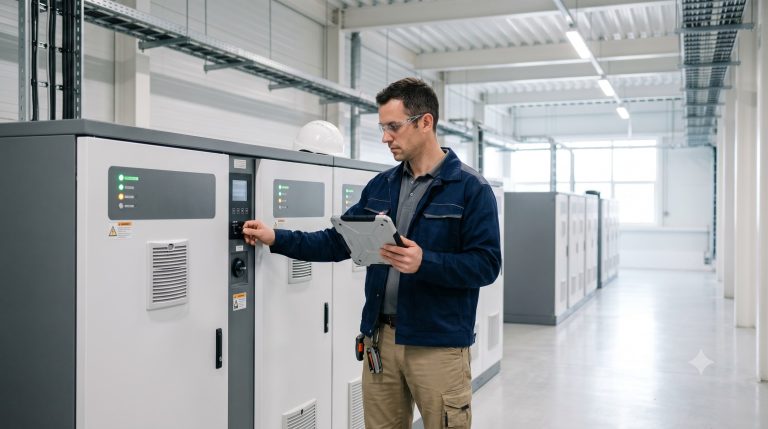
“A high-quality 4K realistic image showing an engineer inspecting a row of generic commercial energy storage cabinets in a clean industrial facility, professional technical vibe, unbranded design, no text.”
]
}
“`