Overview
Transporting a fully loaded megawatt-class containerized Battery Energy Storage System (BESS) is a complex logistical operation involving strict weight limits, international dangerous goods regulations, and specialized securing methods. This FAQ addresses critical pre-sales and post-sales questions regarding the safe and compliant shipment of these high-density units, covering everything from weight distribution and container integrity to thermal management and fire safety during transit.
Frequently Asked Questions
- Q1: What are the strict weight limits for transporting a fully loaded containerized BESS?
- The maximum gross weight is strictly governed by both road regulations and international shipping container standards, typically capped at 36 to 45.5 tons for a standard 20-foot unit. For instance, leading manufacturers like CATL design their systems to ensure each half-height unit is under 36 tonnes to comply with global transport regulations . However, larger projects have seen individual 20-foot containers weighing as much as 45.5 tons, requiring specialized heavy-lift transport and port equipment, often necessitating advanced planning to avoid overweight container penalties . The total weight combines the battery system itself (e.g., 3,250 kg for a smaller unit) with the reinforced container chassis, which must be engineered to handle concentrated loads without compromising structural integrity .
- Q2: How are megawatt batteries secured inside the shipping container to prevent movement?
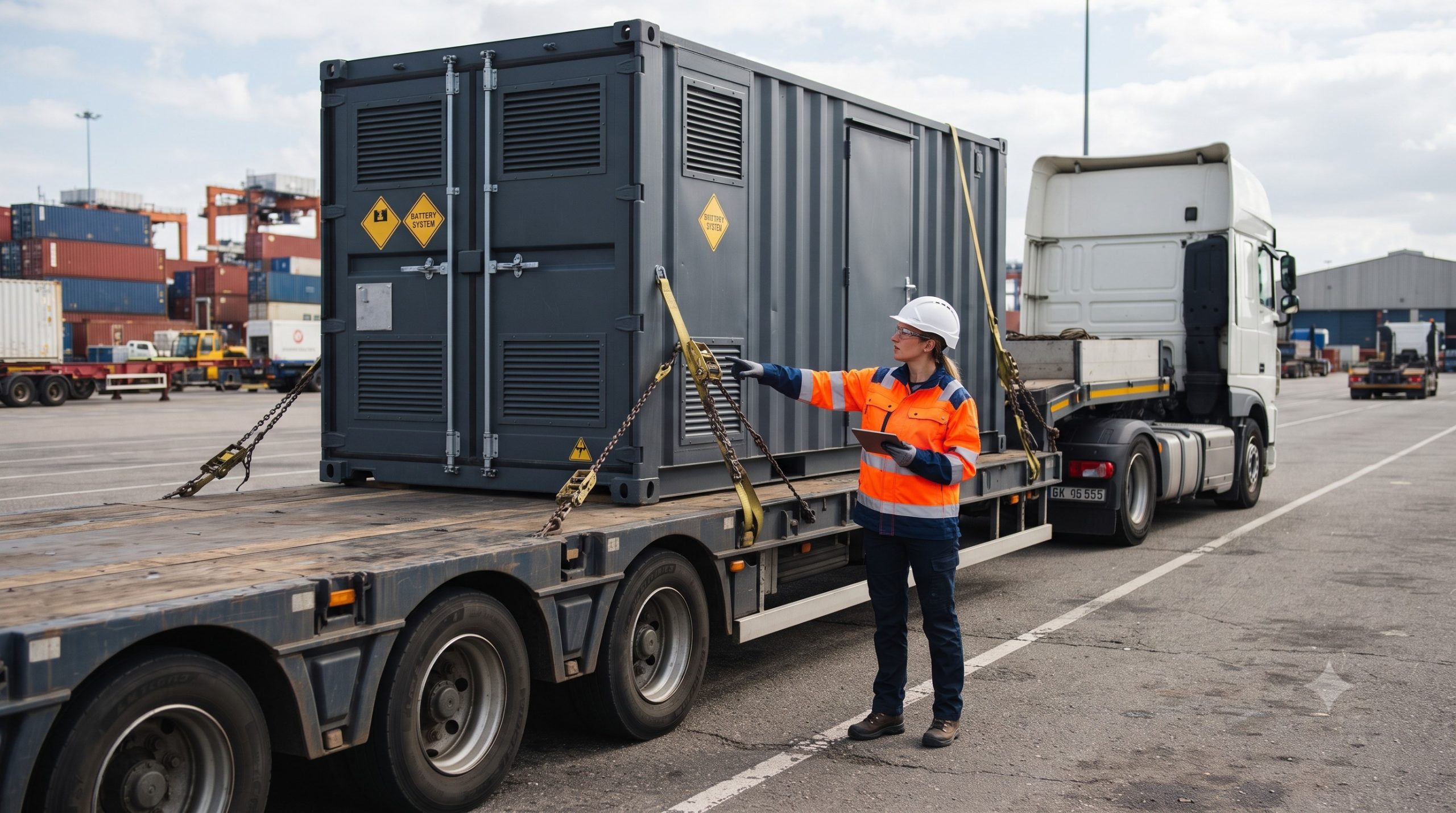
- Batteries must be securely attached to the interior structure of the cargo transport unit to prevent short circuits, accidental operation, and significant movement under normal transport shocks and vibrations . This is achieved using custom racking systems and heavy-duty lashing equipment, where modules are locked in place using guides, anti-tip pallets, and high-capacity stackable frames . For example, battery modules are often separated and locked horizontally within the container to prevent load displacement and contact damage, with the entire structure designed to distribute weight evenly .
- Q3: What dangerous goods regulations (e.g., UN3536) apply to shipping a BESS?
- Under the U.S. Hazardous Materials Regulations and the International Maritime Dangerous Goods (IMDG) Code, a containerized BESS is classified as UN3536, “Lithium batteries installed in cargo transport unit” . This classification requires the container to be specifically designed and constructed to permit lifting with its contents intact, with the batteries securely fastened . The entire cargo transport unit must be placarded on two opposing sides and display the UN number, and it is subject to rigorous testing standards, including those for vibration, shocks, and pressure . It is critical that the container meets ISO 1496-1 standards and is built with non-combustible materials and proper ingress protection .
- Q4: Is the thermal management system (cooling) required during transport?
- Yes, the thermal management system is considered necessary for the safe and proper operation of the BESS, even if it is not energized during transit. According to official interpretations of the HMR, an air conditioning or liquid cooling system is a required component and must be properly secured or installed within the cargo transport unit . The mere fact that the system is not operational during transport does not imply it is unnecessary; it is a critical safety component that would be required if the unit were operational or in the event of a thermal event . The container is also required to have a thermal management system to maintain optimal battery temperatures, as lithium-ion cells are highly sensitive to temperature extremes .
- Q5: What fire safety mechanisms are mandatory for BESS shipping containers?
- BESS containers must be equipped with a multi-tier fire safety system, including a fire detection system, an off-gas detection system for early warning of thermal runaway, and provisions for pressure relief in the event of a deflagration . The packaging itself must be designed to prevent thermal runaway propagation, often incorporating fire-resistant materials and triple-layer insulation to boost fire resistance . Additionally, the container is required to have a provision to release excess pressure that can build up if a cell vents gas . For transport, this is coupled with requirements for lifting lugs and strong points to allow for safe handling and potential isolation in an emergency .
- Q6: How does the trend toward higher energy density affect BESS logistics?
- The push toward ultra-large capacity systems (6 MWh and beyond) is creating a logistics headache as the sheer weight of these high-density units tests the limits of port infrastructure and road transport regulations . To address this, manufacturers are developing non-standard container sizes and innovative designs like CATL’s two-split container, where each half-height unit is under 36 tons to navigate global shipping routes safely . This “two-in-one” design balances high energy density with the logistical requirement to avoid overweight penalties and fit within standard lifting and handling equipment . Effective management of weight distribution and container dimensions is therefore a key competitive factor in BESS product development .
- Q7: What are the grounding and electrical safety requirements for the container?
- All electrical equipment housed inside the BESS container must be properly earthed to protect personnel from leakage currents, with a minimum of two earthing connection points to the local earth grid . Non-current carrying metallic components must also be earthed using compression-type termination accessories to prevent loosening and ensure low-impedance connections . Additionally, the container must feature a non-skid epoxy floor finish and be seal-welded to withstand pressure and maintain required ingress protection, ensuring the unit remains safe during both transport and operation .