Overview
For plant engineers and technical procurement teams evaluating a 20ft containerized energy storage system (ESS), acoustic noise is a critical operational parameter that impacts site compliance, worker safety, and community relations. While the decibel level is a key spec, it is intrinsically linked to the system’s liquid cooling architecture, power conversion efficiency, and thermal management strategy. This technical FAQ addresses the most pressing pre-sales and post-sales queries, moving beyond simple noise figures to explore the engineering trade-offs between acoustics, performance, and longevity. We answer the questions that our B2B clients ask most frequently during the specification and deployment phases.
Frequently Asked Questions
- Q1: What level of acoustic noise does a standard 20ft container ESS generate under full load, and what are the peak levels during battery cooling?
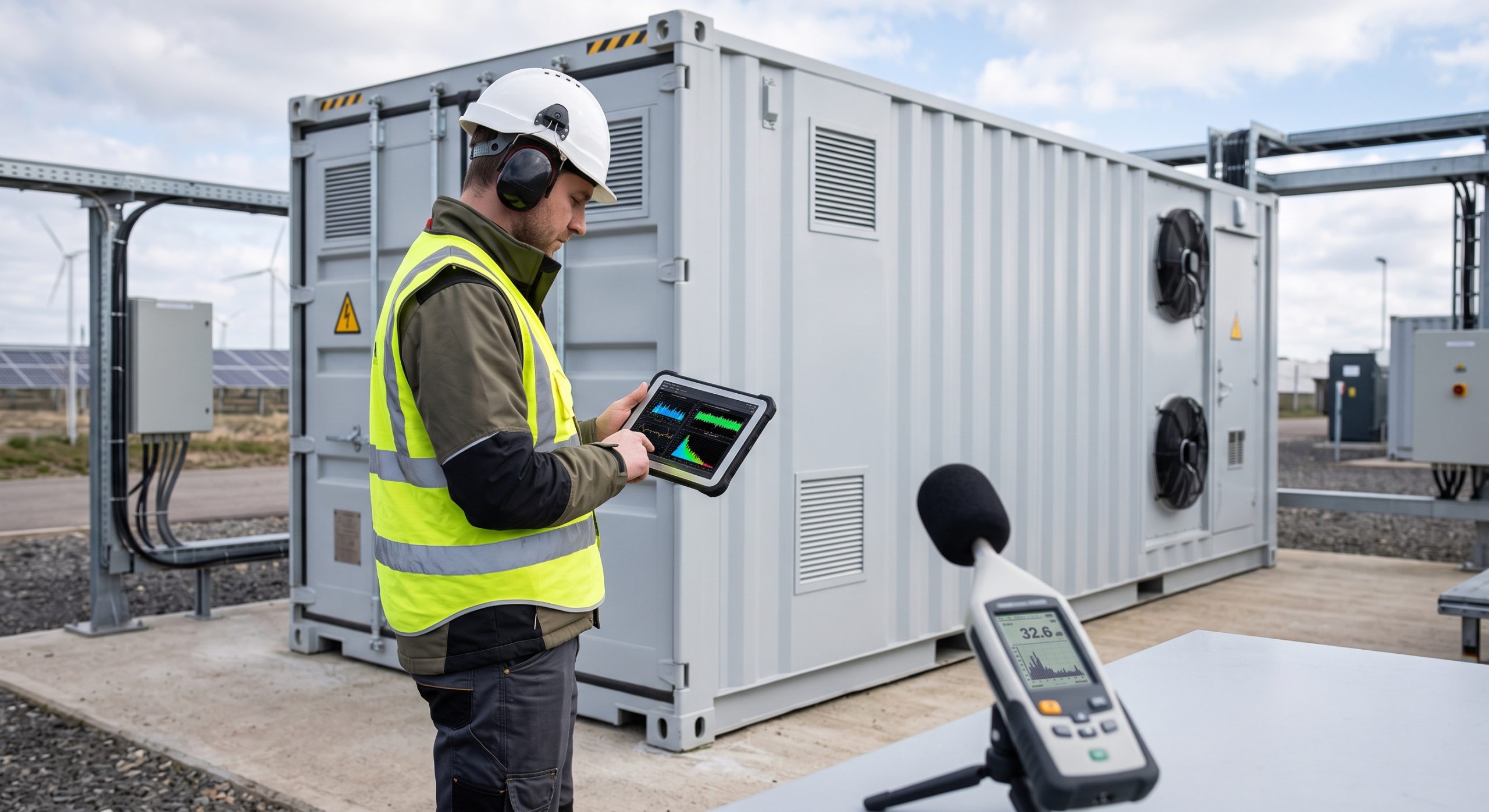
- A standard 20ft container ESS typically generates 65–75 dBA at 1 meter under full load, with peak levels reaching up to 78 dBA during high-ambient-temperature cooling events. This noise is primarily emitted from the integrated liquid cooling system’s condenser fans and the bi-directional power conversion system (PCS) inverters. At a distance of 10 meters, this attenuates to approximately 55–60 dBA, which is comparable to a conversation level. Our systems incorporate variable-speed fan controls and sound-dampening enclosures to ensure compliance with industrial workplace noise regulations (e.g., OSHA 29 CFR 1910.95) without compromising thermal performance.
- Q2: How does the liquid cooling system’s noise profile impact site selection and installation permits?
- The liquid cooling system is the dominant noise source, and its acoustic footprint directly influences setback distances for residential areas and permits for urban installations. Unlike air-cooled systems that can exceed 80 dBA, our liquid-cooled 20ft ESS operates at a lower baseline noise level. For installation permits, we provide a detailed acoustic study that maps sound pressure levels at various distances and frequencies. This allows engineers to design effective sound barriers or select locations where ambient industrial noise masks the ESS. We also offer a ‘silent mode’ software configuration for night-time operation, which reduces fan speeds by up to 30% when grid demand and ambient temperatures are lower, reducing noise to ~60 dBA.
- Q3: What is the cycle life and guaranteed DoD of LFP cells used in the 20ft container ESS?
- The LFP cells provide a standard cycle life of ≥6,000 cycles at 80% Depth of Discharge (DoD) with an end-of-life capacity of 70%, and ≥8,000 cycles at 70% DoD. This extended lifespan is guaranteed by our proprietary cell-balancing algorithms within the Battery Management System (BMS). The 20ft container typically houses a 2-2.5MWh system, and this cycle life translates to over 15 years of daily operation, ensuring a robust return on investment. We provide a performance warranty that covers capacity degradation, ensuring you achieve the projected Levelized Cost of Storage (LCOS) over the asset’s lifetime.
- Q4: How do you prevent thermal runaway and ensure fire safety in the 20ft container ESS?
- Thermal runaway prevention is achieved through a four-tier safety system: cell-level protection (pressure relief vents and shutdown separators), module-level insulation, rack-level fire suppression (aerosol or clean agent), and container-level gas detection and exhaust. Our BMS monitors individual cell voltage and temperature thousands of times per second, automatically isolating faulty modules. In the event of a detected thermal event, the system initiates an early warning, activates the fire suppression system, and provides remote alerts for immediate operator intervention. This multi-layer approach complies with UL 9540A, ensuring the container acts as a self-contained, fire-resistant barrier, minimizing risk to surrounding assets.
- Q5: What are the key parameters for BMS monitoring and inter-cell balancing in a 20ft ESS?
- The BMS continuously monitors voltage, temperature, and state of charge for each of the hundreds of cells within the container. The critical parameters include passive or active cell balancing to ensure all cells stay within a 5mV voltage differential, which maximizes usable capacity and extends cycle life. Our BMS provides real-time data via Modbus or CAN bus protocols, allowing plant engineers to track cell health, identify weak cells, and schedule proactive maintenance. The system also performs self-diagnostics and provides automated alerts for any deviations from set thresholds, ensuring operational continuity.
- Q6: How does the 20ft container ESS handle grid-tie vs. off-grid configurations, and what is the seamless transfer time?
- The 20ft container ESS is designed with a bi-directional PCS that supports both grid-tied and off-grid (islanding) configurations. In grid-tie mode, it provides peak shaving, frequency regulation, and load shifting. In the event of a grid outage, the system can transition to off-grid mode with a seamless transfer time of less than 20 milliseconds, ensuring critical loads remain uninterrupted. This is achieved through advanced synchronization algorithms that phase-match the inverter output to the grid before disconnecting, enabling a make-before-break transition that is essential for sensitive industrial equipment.
- Q7: What is the ROI calculation methodology and peak shaving arbitrage potential for a 20ft container ESS?
- The ROI for a 20ft ESS is calculated by evaluating the savings from peak shaving (reducing demand charges), energy arbitrage (buying low, selling high), and grid service payments. A typical 2.5MWh system can reduce peak demand charges by 30-50%, depending on utility tariffs. The payback period is usually 3-5 years, with a total lifetime ROI exceeding 30%. We provide a detailed financial model that factors in local utility rates, degradation curves, and operational costs (O&M) to forecast net present value and internal rate of return. This analysis is essential for securing project financing and demonstrating value to management.
- Q8: Can the 20ft container ESS be scaled for future expansion, and how is parallel connectivity implemented?
- Yes, the system is designed for modular scalability. Multiple 20ft containers can be connected in parallel on the AC or DC side to expand capacity from MWh to GWh scale. This is achieved via a custom DC busbar linkage or an AC-coupled configuration. The Energy Management System (EMS) coordinates the dispatch of multiple units, treating them as a single virtual power plant. This allows for phased investment, where you can start with a single container and add more as demand grows, without needing to re-engineer the core power infrastructure.