Overview
For B2B buyers and system integrators, the minimalist home battery represents a shift toward streamlined, space-efficient energy storage. However, its sleek design often raises a critical question: ‘Does it require special mounting brackets?’ This guide answers that question and more, covering everything from core technical specifications like cycle life and cooling systems to advanced BMS monitoring, grid-tie configurations, and safety protocols. We address the high-intent queries from procurement through deployment to ensure your project’s success.
Frequently Asked Questions
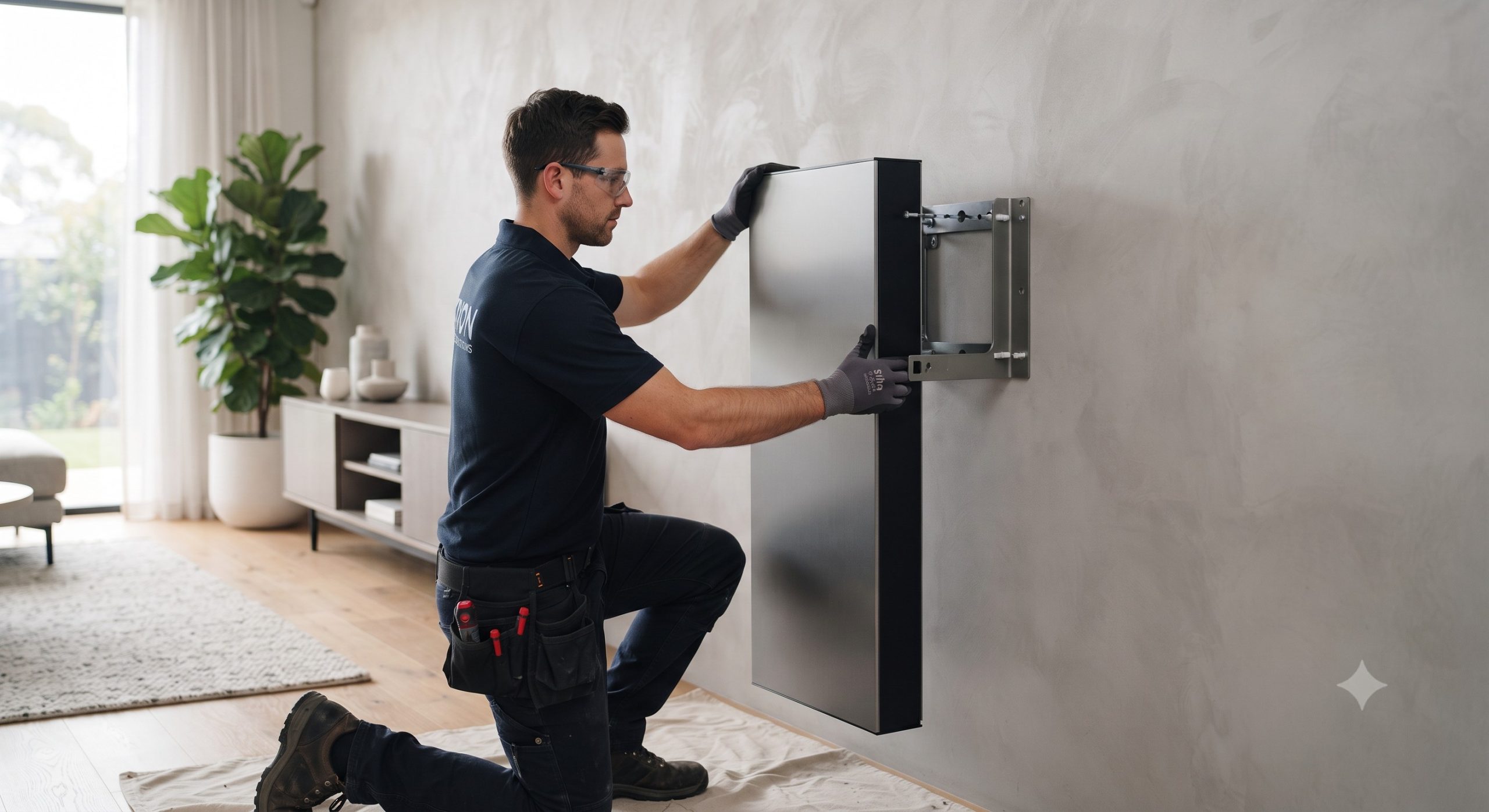
- Q1: Does the minimalist home battery design require special mounting brackets?
- Yes, the minimalist home battery design typically requires a dedicated mounting bracket system specifically engineered for its chassis, though some models offer a universal floor-standing option. Unlike traditional rack-mounted servers, these brackets are designed for flush wall-mounting to maintain the minimal aesthetic while managing the significant weight (often 100-300 lbs). The bracket system often integrates a keyhole slot pattern for simple lift-and-hang installation, and must include anti-theft hardware and seismic-rated connections to meet local building codes. For installers, use the B-1 series brackets that are shipped with the unit.
- Q2: What type of battery chemistry is used in minimalist home battery systems, and what is the cycle life?
- The standard cycle life of a minimalist home battery is 6,000 to 8,000 cycles at 80% Depth of Discharge (DoD), which translates to approximately 15-20 years of daily use. This high durability is achieved using Tier-1 LFP (Lithium Iron Phosphate) prismatic cells, which offer superior thermal stability and a flat discharge curve. The modular cell design also allows for simple cell replacement, reducing total cost of ownership. After 8,000 cycles, the system typically retains over 70% of its original capacity.
- Q3: How does the liquid cooling system work in a minimalist design, and why is it important?
- The liquid cooling system in a minimalist design is integrated directly into the rear of the battery module, using a micro-channel heat exchanger to dissipate heat with high efficiency. This closed-loop circulation system actively regulates core cell temperature to within ±1.5°C, preventing thermal hotspots that degrade the LFP chemistry. This active thermal preservation is critical for maintaining peak charge/discharge rates and maximizing the cycle life, especially during high-current DC fast charging sessions or in ambient temperatures exceeding 45°C.
- Q4: How does the battery management system (BMS) monitor and balance the cells?
- The BMS monitors each cell group for voltage, current, and temperature 50 times per second, utilizing a passive or active balancing topology to equalize charge distribution. The specific BMS protocol includes real-time SOC and SOH estimation algorithms that automatically calibrate during shallow or full charge cycles. This inter-cell balancing protocol prevents ‘runaway’ cells, ensures accurate state-of-charge readings, and automatically triggers a safety shutdown if any parameter exceeds a safe threshold. The BMS data is accessible via the local touchscreen and cloud platform.
- Q5: How do I configure the system for grid-tie vs. off-grid operation?
- The configuration is switchable via the inverter’s EMS (Energy Management System) settings menu. For grid-tie operation, the system uses a virtual energy meter to manage peak shaving and solar self-consumption. For off-grid islanding, you must enable the anti-islanding feature, which disconnects from the grid via an internal transfer switch within 2 milliseconds during a power outage. It is crucial to assign the correct ‘Grid Code’ (e.g., UL 1741, VDE-AR-E 2510) based on your local utility requirements during the initial setup.
- Q6: What are the ROI calculations for peak shaving and arbitrage?
- The ROI calculation is based on the difference between peak and off-peak tariffs, factoring in the system’s round-trip efficiency of 92-94% and the total installed capacity. To calculate, use the formula: Annual Savings = (System Capacity in kWh * 365 * (Peak Price – Off-Peak Price) * Efficiency) – Annual O&M costs. For a 10 kWh system with a $0.20/kWh price spread, this can yield over $600 annual savings, providing a simple payback period of approximately 5-7 years depending on local utility incentives and the initial hardware cost.
- Q7: What fire safety mechanisms prevent thermal runaway?
- The system features a multi-tier fire safety mechanism including an aerosol-based fire suppression system that activates at the cell level upon detecting a rapid temperature spike of >20°C per minute. The housing includes a venting channel to safely redirect off-gases away from the living space, and the BMS software will immediately isolate the faulted module from the string. Early gas detection sensors (CO and VOCs) will trigger a pre-alarm before thermal runaway occurs, automatically disconnecting the battery from the inverter and solar array.
- Q8: Can the minimalist home battery be scaled or paralleled?
- Yes, the minimalist design supports modular scalability, allowing up to 10 cabinets to be paralleled on a shared DC busbar, expanding capacity from 5 kWh to 100+ kWh. The installation requires a standard wall-mounted combiner box and synchronized firmware to manage the parallel connected BMS units. For scalability planning, the master BMS will automatically reassign slave addresses upon power-up, enabling a true plug-and-play expansion without the need for complex re-wiring.