Overview
Grid-tied inverters are the core interface between battery energy storage systems (BESS) and the utility grid, enabling peak shaving, demand response, and renewable integration. This FAQ addresses the most critical pre-sales and post-sales technical questions from B2B buyers, including battery chemistry, cooling systems, scalability, BMS monitoring, fire safety, and ROI modeling. All answers are structured to support procurement and engineering decisions.

Frequently Asked Questions
- Q1: What is the standard cycle life and recommended depth of discharge (DoD) for LFP-based grid-tied inverter BESS?
- The standard cycle life is 6,000 to 8,000 cycles at 80% depth of discharge (DoD) for Tier-1 LFP cells in grid-tied applications. At 90% DoD, cycle life typically reduces to 4,000-5,000 cycles. LFP chemistry delivers lower degradation than NMC, with calendar life exceeding 15 years. For optimal ROI, operate at 80% DoD with liquid cooling to maintain cell temperature below 35°C, which can extend cycle life by up to 25%.
- Q2: How does the liquid cooling system in a grid-tied inverter BESS prevent thermal runaway?
- Liquid cooling prevents thermal runaway by maintaining cell temperature differential below 3°C across all modules, eliminating hot spots that trigger exothermic reactions. The system continuously circulates dielectric coolant through cold plates directly contacting each battery cell. If any cell exceeds 55°C, the BMS triggers automatic current reduction; at 65°C, it initiates contactor disconnection and activates the fire suppression interface. This multi-layer protection meets UL 9540A thermal runaway propagation test requirements.
- Q3: Can a grid-tied inverter BESS scale from 100kWh to 10MWh using parallel cabinet connectivity?
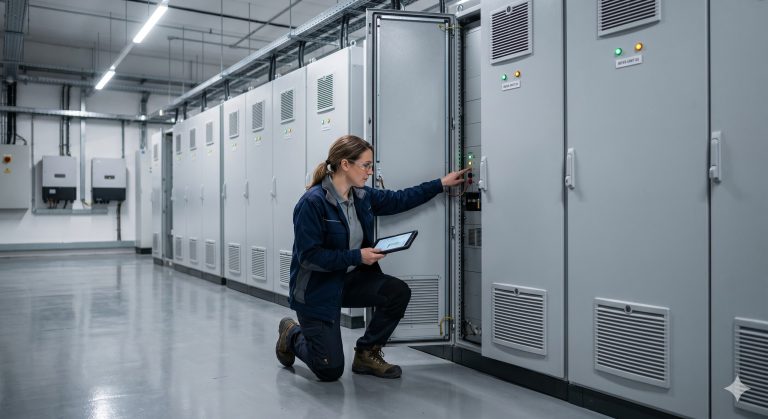
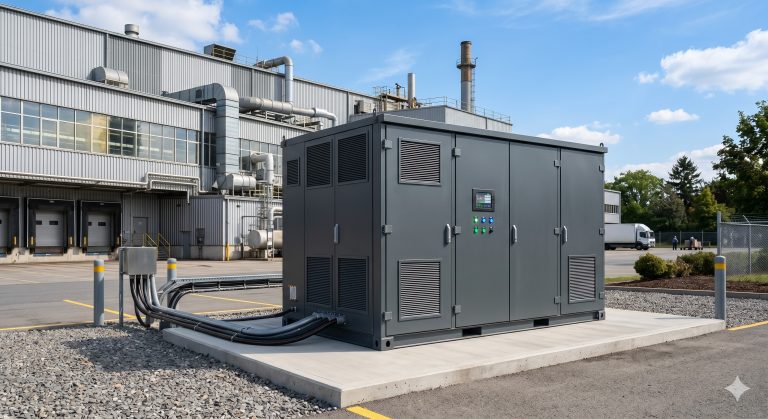
- Yes, grid-tied inverter BESS platforms support modular expansion from 100kWh up to 10MWh+ through parallel cabinet connectivity via a common DC busbar. Each cabinet (typically 200-500kWh) contains its own battery bank, BMS, and DC circuit breaker, all feeding a central bi-directional PCS (power conversion system). The EMS coordinates state-of-charge balancing across cabinets. For capacities above 2MWh, we recommend a master-slave BMS architecture with CAN or Modbus TCP communication to ensure synchronized grid-tie operation.
- Q4: How do I calculate ROI (payback period) for a grid-tied inverter BESS used in peak shaving and arbitrage?
- Calculate ROI using: Payback (years) = Total Installed Cost ÷ (Annual Arbitrage Revenue + Demand Charge Reduction + Incentives). Example: A 500kWh/250kW system at $150,000 installed can generate $30,000/year from peak shaving (shaving 200kW at $15/kW demand charge) plus $25,000/year from energy arbitrage ($0.15/kWh spread × 1 cycle/day × 500kWh × 330 days). Total annual benefit = $55,000 → payback ≈ 2.7 years. Always include degradation (1-2% annual capacity loss) and O&M (2-3% of CapEx/year) in your model.
- Q5: What real-time BMS monitoring parameters should I track for a grid-tied inverter?
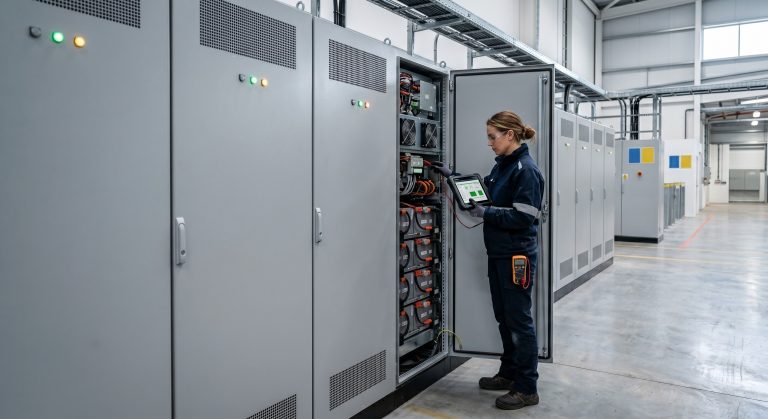
- Track seven critical BMS parameters in real-time: (1) individual cell voltage (min/max delta <50mV), (2) cell temperature (delta <5°C), (3) state of charge (SoC) with Kalman filter accuracy ±3%, (4) state of health (SoH) trended monthly, (5) DC internal resistance (increase >30% indicates end-of-life), (6) cumulative Ah throughput, and (7) contactor status. The BMS must report these via Modbus RTU/TCP or CAN 2.0 to your EMS. Alerts trigger when any cell exceeds 3.65V (LFP) or when SoC calibration drift exceeds 5%.
- Q6: What are the critical fire safety certifications for grid-tied inverter BESS (UL 9540, NFPA 855)?
- A compliant grid-tied inverter BESS must hold UL 9540 (system-level safety), with cells certified to UL 1973 and modules passing UL 9540A thermal runaway propagation testing. NFPA 855 imposes spacing requirements: for indoor installations above 50kWh, 3-foot clearance between cabinets and 20-foot separation from building openings. For outdoor units, minimum 10-foot setback from property lines. Always request the manufacturer’s Fire Hazard Assessment report and verify that the integrated fire suppression system (e.g., aerosol or clean agent) is UL listed for battery environments.
- Q7: What is the difference between grid-tied and off-grid configuration for a BESS inverter?
- A grid-tied inverter synchronizes with utility frequency (50/60Hz ± 0.5Hz) and voltage (±10%), operating in current-source mode to inject or absorb power without forming its own grid. An off-grid (islanding) inverter operates in voltage-source mode, forming a local micro-grid with strict voltage/frequency regulation. True hybrid inverters support both modes but require a grid isolation switch and anti-islanding detection (per IEEE 1547) to disconnect within 2 seconds during utility outage. For backup power, specify a grid-tied inverter with seamless islanding transfer (transition time <20ms) and a dedicated backup loads panel.
- Q8: How does the EMS optimize demand response and peak shaving in a grid-tied inverter system?
- The EMS optimizes demand response using a predictive algorithm that forecasts 15-minute demand intervals based on historical load profiles and real-time utility pricing signals. For peak shaving, the EMS sets a demand limit (e.g., 500kW) and dispatches the inverter to discharge battery power whenever facility load exceeds this threshold, with a response time <100ms. For demand response events, the EMS receives automated OpenADR 2.0b signals and ramps discharge to meet the utility's requested reduction (e.g., 100kW curtailment within 5 minutes). Advanced EMS includes self-learning load forecasting and weather-adjusted solar PV integration for maximum arbitrage value.
Technical Summary
Selecting a grid-tied inverter BESS requires evaluating cycle life at 80% DoD (minimum 6,000 cycles), liquid cooling effectiveness for thermal runaway prevention, UL 9540 certification, and BMS monitoring granularity. For ROI, prioritize applications with demand charges above $15/kW or arbitrage spreads above $0.12/kWh. Always request a factory acceptance test (FAT) report and confirm that the supplier provides on-site commissioning and remote O&M support.