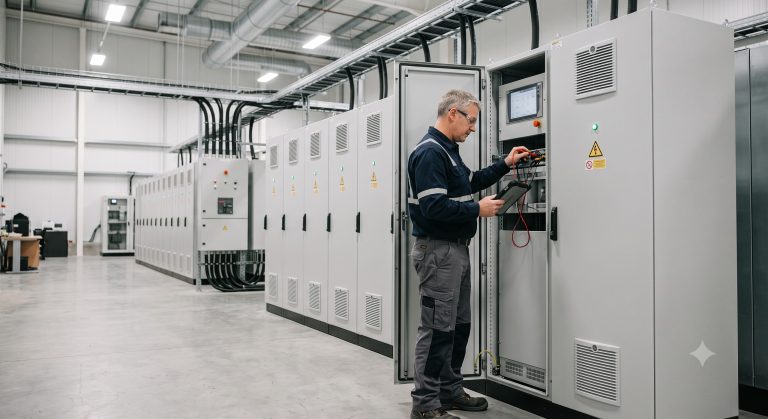
Wantage BMS Safety Limits: Hardcoded Protection & Thermal Runaway Prevention
As a B2B Energy Storage System (BESS) Technical Support Engineer, I frequently address critical safety inquiries from plant engineers, procurement managers, and EPC contractors regarding the Wantage Battery Management System (BMS). The Wantage BMS is engineered with multiple layers of hardcoded safety limits that cannot be overridden by the user, ensuring the highest level of protection for your commercial and industrial energy storage assets. These limits govern voltage, current, temperature, and state-of-charge (SoC) to prevent thermal runaway and ensure long-term system integrity. Below are expert answers to the most common pre-sales and post-sales questions about Wantage BMS safety limits, designed to help you make informed decisions for your BESS deployment.

Frequently Asked Questions
- Q1: What are the hardcoded voltage and current safety limits in the Wantage BMS?
- The Wantage BMS enforces hardcoded voltage limits of 2.5V to 3.65V per LFP cell and a maximum continuous current of 200A per rack, with instantaneous peak protection at 250A for 10 seconds. These limits are permanently programmed into the firmware to prevent overcharge, over-discharge, and short-circuit conditions. The BMS will automatically disconnect the contactors if any cell voltage exceeds 3.65V or drops below 2.5V, ensuring cell integrity and safety.
- Q2: How does the Wantage BMS prevent thermal runaway through temperature limits?
- The Wantage BMS hardcodes a maximum cell temperature of 60°C and a minimum of -20°C for operation, with a warning threshold at 55°C and a critical cutoff at 65°C. If any temperature sensor detects a reading above 65°C, the BMS immediately triggers a shutdown and activates the fire suppression system interface. Additionally, the BMS monitors temperature differentials across cells; if the delta exceeds 8°C, it initiates cell balancing and reduces charge/discharge rates to mitigate hotspot formation.
- Q3: What fire safety and thermal runaway prevention mechanisms are hardcoded into the Wantage BMS?
- The Wantage BMS integrates hardcoded fire safety protocols including multi-tier gas and smoke detection, automatic contactor disconnection, and activation of the aerosol fire suppression system within 3 seconds of detecting a thermal event. The BMS also triggers an audible alarm and sends a remote notification via the EMS. These protocols are designed to meet UL 9540 and IEC 62619 standards, ensuring rapid isolation and suppression to prevent propagation.
- Q4: Can the Wantage BMS safety limits be adjusted or overridden by the user?
- No, the core safety limits in the Wantage BMS are hardcoded and cannot be overridden by the user or integrator. This design ensures that critical protections—such as voltage, current, and temperature cutoffs—remain intact regardless of operational demands. However, certain non-critical parameters, like SoC balancing thresholds and communication timeouts, can be configured within a safe range via the EMS interface.
- Q5: How does the Wantage BMS handle grid-tie vs. off-grid configuration safety limits?
- The Wantage BMS automatically detects grid-tie or off-grid mode and applies the appropriate hardcoded safety limits for each configuration. In grid-tie mode, the BMS enforces anti-islanding protection and synchronizes with the PCS to prevent backfeed. In off-grid mode, it hardcodes a maximum frequency deviation of ±1 Hz and a voltage range of 210V to 250V per phase, ensuring stable operation and preventing damage to connected loads.
- Q6: What cycle life and depth of discharge (DoD) limits are hardcoded in the Wantage BMS?
- The Wantage BMS hardcodes a maximum DoD of 90% for daily cycling and 100% for emergency backup, with a guaranteed cycle life of 6,000 cycles at 80% DoD. The BMS tracks cumulative energy throughput and will derate the system if the cycle count exceeds the warranty threshold, protecting the LFP cells from accelerated degradation. This ensures a 10-year operational lifespan under normal conditions.
- Q7: How does the Wantage BMS monitor and balance cells to maintain safety?
- The Wantage BMS employs active cell balancing with a hardcoded balancing current of 2A and a voltage threshold of 10mV differential. It continuously monitors individual cell voltages and temperatures, and if an imbalance exceeds 50mV, it activates balancing to prevent overcharge or over-discharge of weaker cells. This proactive monitoring is critical for maintaining safety and maximizing battery pack lifespan.
- Q8: What are the hardcoded communication and isolation safety limits in the Wantage BMS?
- The Wantage BMS hardcodes a communication timeout of 500ms; if the EMS or PCS loses communication for longer than this, the BMS will disconnect the contactors to prevent uncontrolled operation. It also enforces a minimum isolation resistance of 100Ω/V, continuously monitored between the DC bus and ground. If isolation drops below this threshold, the BMS triggers a fault and shuts down the system to prevent electric shock hazards.