Introduction: The Converging Frontline of Power and Data
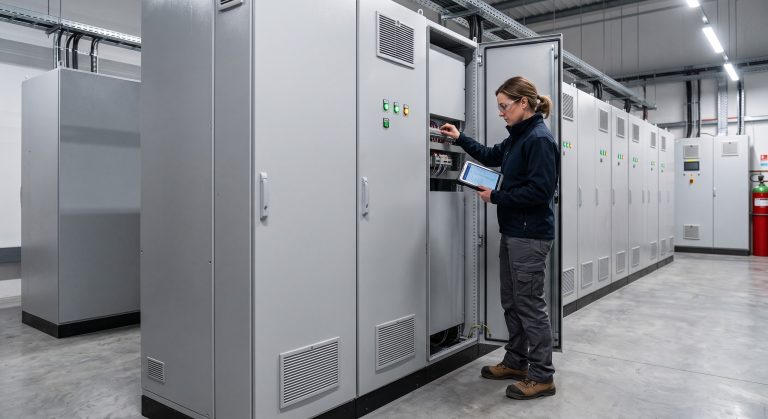
The commercial and industrial (C&I) energy storage market is undergoing a structural transformation. As BESS deployments scale from single-cabinet peak-shaving units to MWh-scale micro-grid assets, the Energy Storage Cybersecurity posture of these systems has shifted from an afterthought to a critical procurement criterion. The convergence of operational technology (OT) with information technology (IT) has exposed energy storage platforms to a threat landscape previously confined to industrial control systems (ICS).
Recent regulatory actions underscore the urgency. In North America, the revised NERC CIP framework now mandates compliance for lower-capacity BESS systems rated at 20 MVA or greater with connections at 60 kV or higher, with non-compliance fines reaching up to $1M per day . In Japan, JC-STAR ★1 conformance labeling is being enforced for grid-connected equipment including PCS, BMS, and EMS output control devices . For B2B buyers, integrators, and project developers, energy storage cybersecurity is no longer a peripheral IT concern—it is a prerequisite for grid interconnection, insurance underwriting, and long-term asset bankability.
This technical guide examines the architectural, regulatory, and operational dimensions of energy storage cybersecurity for C&I applications, providing a data-driven framework for evaluating vendor cybersecurity maturity against the specific risks facing modern BESS deployments.
Attack Surface Analysis: Where Energy Storage Systems Are Vulnerable
Port-Level Vulnerabilities in Energy Storage Control Platforms
The integrated energy storage platform (IESP) functions as the central nervous system of a BESS, coordinating battery management, power conversion, and grid interaction. Research on microgrid energy storage platforms has identified systemic weaknesses including open or misconfigured ports, weak or default credentials, insecure communication protocols, and known software vulnerabilities documented in CVE databases . These flaws are not theoretical—they represent exploitation pathways that can compromise operational integrity, induce grid instability, or enable lateral movement within critical infrastructure networks.
The bidirectional nature of BESS operations introduces unique attack vectors. An adversary with access to the EMS can manipulate charge/discharge schedules to destabilize local grid conditions or create financial losses through mistimed energy arbitrage . Unlike traditional generation assets with unidirectional power flow, energy storage systems present a two-way attack surface where data integrity manipulation can directly translate to physical system consequences.
The Legacy System Integration Challenge
A significant portion of C&I energy storage deployments involves integration with existing facility infrastructure—building management systems, SCADA networks, and legacy protection relays. These systems frequently employ obsolete protocols and data formats that create interoperability barriers while simultaneously expanding the attack surface . The challenge is compounded when third-party O&M providers require remote access for diagnostics and performance optimization, introducing additional authentication and authorization complexities.
Core Architecture: Defense-in-Depth for Energy Storage Systems
BMS and PCS as Security-Enabled Components
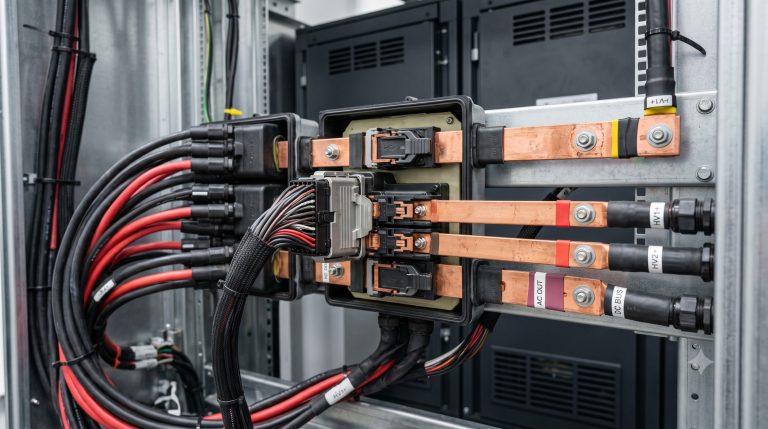
Modern energy storage cybersecurity architecture must begin at the component level. The Battery Management System (BMS) executes cell balancing, state-of-charge estimation, and protection logic that directly impacts safety. A compromised BMS could theoretically bypass overcharge protections or disable thermal management triggers, creating pathways to thermal runaway. The Power Conversion System (PCS) similarly requires hardened firmware with secure boot capabilities to prevent unauthorized modification of inverter control algorithms.
Component-level certification provides the foundation for system-level security. The BMS should demonstrate compliance with IEC 60730-1 for functional safety of control electronics, while the PCS requires IEC 62477-1 compliance for power converter safety . These certifications validate that the hardware and embedded software meet baseline security and reliability requirements.
EMS Security: The Control Plane Imperative
The Energy Management System (EMS) represents the highest-value target within the BESS cybersecurity architecture. As the orchestrator of dispatch schedules, demand response participation, and grid service delivery, the EMS holds the logical keys to system operation. The IEC 62443 series provides the most comprehensive framework for securing industrial automation and control systems, with IEC 62443-3-3 specifically addressing system security requirements and security levels .
Vendors achieving IEC 62443-3-3 certification must demonstrate capabilities across seven foundational requirements: identification and authentication control, use control, system integrity, data confidentiality, restricted data flow, timely response to events, and resource availability. For C&I deployments, Security Level 2 (SL2) is typically the minimum benchmark, providing protection against intentional violation using simple means with low resources, generic skills, and low motivation .
Network Segmentation and Communication Security
Effective energy storage cybersecurity requires strict network segmentation between the OT domain (battery systems, PCS, safety controllers) and the IT domain (cloud monitoring, enterprise ERP, billing systems). The IEC 62443 zones and conduits model provides a structured approach to defining trust boundaries and implementing defense-in-depth controls . All inter-zone communication should employ encrypted protocols—TLS 1.3 for cloud connectivity, IEC 62351 for grid-facing telemetry, and OPC UA with security profiles for internal OT data exchange.
Technical Specifications and Certification Framework
When evaluating energy storage cybersecurity posture, procurement teams should map vendor claims against specific certification evidence. The following table summarizes the critical parameters that define a security-hardened BESS deployment for C&I applications.
| Security Parameter | Technical Specification | Certification Standard |
|---|---|---|
| EMS Cybersecurity | IEC 62443-3-3 Security Level 2, role-based access control, audit logging | IEC 62443-3-3 |
| Secure Development Lifecycle | Threat modeling, vulnerability management, supply chain risk assessment | IEC 62443-2-4 |
| Device-Level Security | Secure boot, firmware integrity verification, encrypted OTA updates | UL 2941 / IEEE 1547.3 |
| Communication Security | TLS 1.3 for cloud, IEC 62351 for grid telemetry, OPC UA security profiles | IEC 62351 |
| BMS Functional Safety | Overcharge protection, thermal runaway prevention, cell balancing integrity | IEC 60730-1 / IEC 61508 |
| PCS Converter Safety | Anti-islanding, DC/AC protection coordination, ground fault detection | IEC 62477-1 / IEEE 1547 |
Understanding UL 9540 and UL 9540A Distinction
A common source of confusion in procurement specifications is the distinction between UL 9540 and UL 9540A. UL 9540 certifies that the integrated system meets safety standards for energy storage systems and equipment. UL 9540A is a test methodology that evaluates thermal runaway propagation characteristics, providing the data that fire authorities use to determine installation requirements . Both are required for code-compliant installations, and the UL 9540A test configuration—module spacing, orientation, state-of-charge at test—must match the intended installation design.
Cybersecurity Certification Landscape for BESS
The cybersecurity certification ecosystem for energy storage continues to evolve. IEC 62443-4-2 provides component-level security requirements for embedded devices, while IEC 62443-2-4 addresses the secure development lifecycle of system integrators and service providers . For North American grid-connected systems, IEEE 1547.3-2023 offers cybersecurity guidance specific to distributed energy resources, though it functions as a guideline rather than a certifiable standard . UL 2941 represents an emerging testable requirement framework for DER device cybersecurity, focusing on firmware integrity, network hardening, and vulnerability mitigation .
The EU Cyber Resilience Act, effective from 2027, will require connected products to include embedded cybersecurity protection features, ongoing security patching capabilities, and supply chain risk management—effectively making cybersecurity readiness a condition of market access for European deployments .
Commercial ROI and Grid Support Implications
Cybersecurity as a Bankability Factor
For C&I energy storage projects seeking third-party financing, cybersecurity certification directly impacts project economics. Incomplete certification portfolios often lead to project delays, increased insurance premiums, or financing challenges . Lenders and insurers increasingly recognize that a compromised BESS represents not only an operational risk but a potential liability exposure extending to grid stability consequences.
The cost of cybersecurity implementation must be evaluated against the economic value at risk. A 1 MWh C&I system deployed for peak shaving generates annual savings in the range of $50,000 to $150,000 depending on utility rate structures. The incremental cost of IEC 62443-certified EMS and hardened communication infrastructure typically represents 3-7% of total system CapEx—a modest premium for reducing tail-risk exposure to operational downtime, regulatory penalties, and insurance premium escalation.
Demand Response and VPP Participation Security
Participation in demand response programs and virtual power plant (VPP) aggregation introduces additional cybersecurity considerations. Grid operators and aggregators require secure telemetry channels, authenticated dispatch commands, and auditable event logs before granting market access. The NERC CIP-013 supply chain risk management requirements, increasingly applied to DER aggregations, mandate that vendors demonstrate software integrity verification and controlled remote access procedures .
Deployment Scenarios and Implementation Guidance
Industrial Park Micro-Grid Deployment
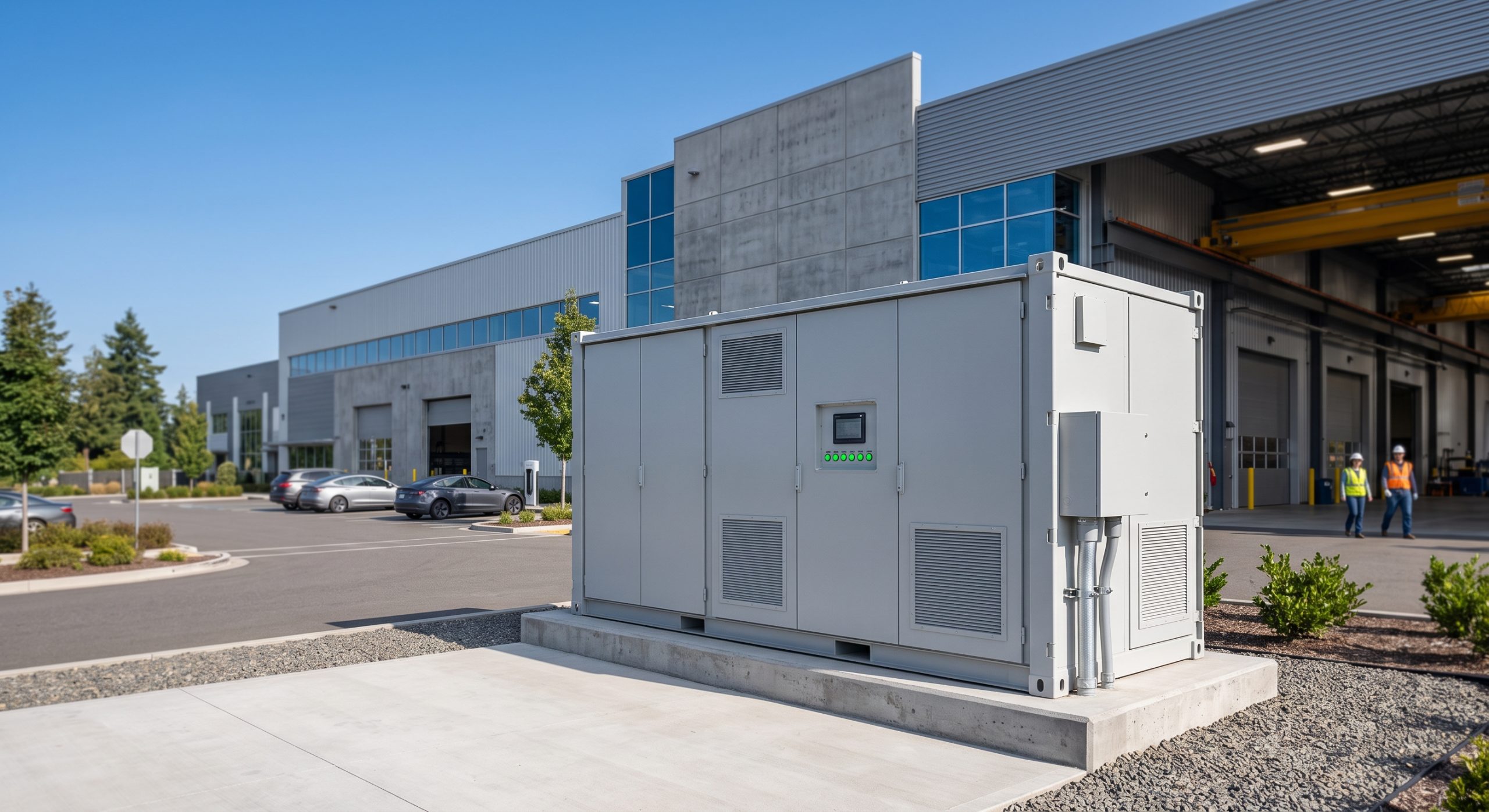
A representative C&I deployment scenario involves a 2 MWh / 1 MW BESS integrated with existing rooftop solar and facility load management. In this architecture, the cybersecurity boundary extends from the battery cabinets through the PCS and EMS to the facility network interface. Key implementation priorities include: network segmentation isolating the BESS OT network from enterprise IT, role-based access control limiting EMS configuration privileges, and secure remote access via VPN with multi-factor authentication for O&M personnel.
For deployments exceeding 20 MVA connected at 60 kV or higher, NERC CIP compliance becomes mandatory, requiring documented security policies, personnel training, electronic security perimeters, and incident response procedures .

PV-Storage-Charging Integration Security
The emerging PV-Storage-Charging (光储充) architecture for EV supercharging stations introduces additional cybersecurity complexity through the integration of EV charger communication protocols (OCPP, ISO 15118) with the BESS control plane. Payment processing and user authentication data flows create potential vectors for data exfiltration or financial fraud. The BESS cybersecurity architecture must enforce strict separation between the energy management domain and the charging transaction domain, with only authenticated, encrypted telemetry crossing the boundary.
Conclusion: Cybersecurity as a Procurement Differentiator
Energy storage cybersecurity has transitioned from a compliance checkbox to a fundamental procurement criterion for C&I BESS deployments. The regulatory trajectory—NERC CIP expansion in North America, JC-STAR enforcement in Japan, Cyber Resilience Act in Europe—indicates that the window for deploying uncertified systems is closing rapidly.
For B2B buyers and project developers, the practical implication is clear: request specific certification documentation (IEC 62443-3-3, UL 2941, IEC 62443-2-4), verify secure development lifecycle practices, and assess the vendor’s vulnerability management program before finalizing procurement decisions. The most bankable energy storage assets will be those that demonstrate security-by-design architecture, documented compliance pathways, and transparent incident response capabilities.
The convergence of power and data demands that energy storage professionals think beyond kWh and cycle life. In an increasingly interconnected grid, the cybersecurity posture of a BESS is inseparable from its operational reliability, regulatory compliance, and financial performance. Procurement decisions made today will determine whether these assets deliver their promised returns over a 15-year operational life.