BESS BMS Communication Interfaces (CAN/RS485) — Expert FAQ
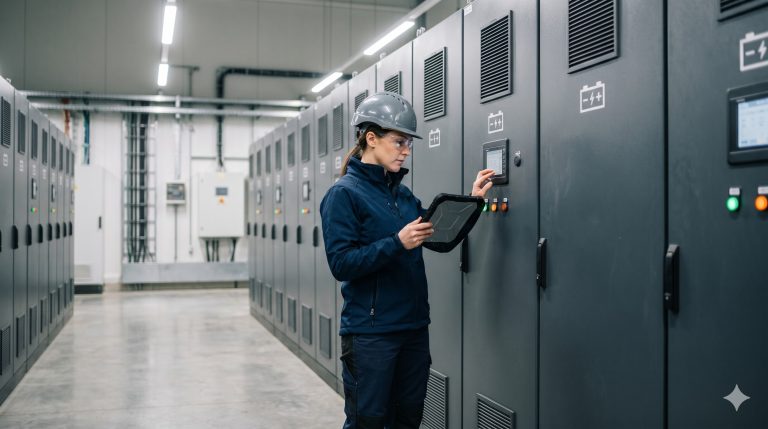
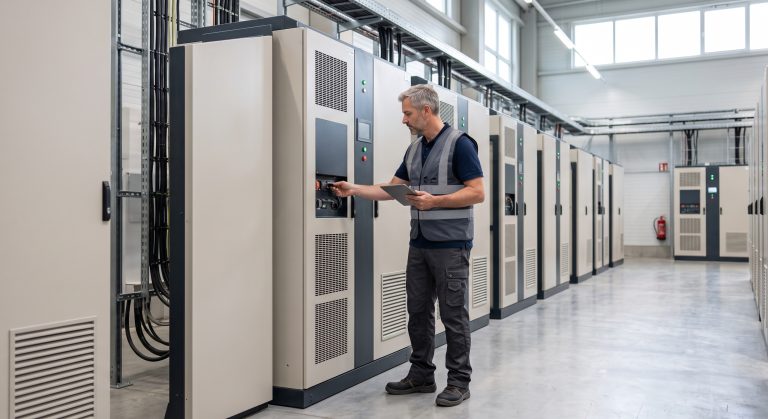
As a B2B Energy Storage System (BESS) technical support engineer, I answer plant engineers’ most common questions about BMS communication interfaces. The standard BMS uses dual CAN bus (CAN 2.0B) and RS485 (Modbus RTU/TCP) interfaces, with CAN handling real-time cell data and RS485 supporting EMS/SCADA integration. This FAQ covers pre-sales specs and post-sales deployment for commercial and industrial BESS.
Frequently Asked Questions
- Q1: What communication interfaces (CAN/RS485) does your BMS use for real-time monitoring?
- Our BMS uses dual CAN 2.0B (500 kbps) and isolated RS485 (Modbus RTU/TCP) as standard communication interfaces. CAN handles real-time cell voltage, temperature, and SOC data at up to 1 ms refresh, while RS485 connects to EMS/SCADA for cloud monitoring and remote diagnostics. This dual-channel design ensures redundancy and seamless integration with third-party energy management platforms.
- Q2: Which battery chemistry and cycle life does your BESS support for industrial applications?
- Our BESS uses Tier-1 LFP (LiFePO4) chemistry with 6,000–8,000 cycles at 80% DoD and a 10-year performance warranty. LFP offers superior thermal stability and a 2,000–3,000 cycle advantage over NMC in high-cycle C&I duty. This chemistry is ideal for daily peak shaving and solar self-consumption.
- Q3: How does the cooling system prevent thermal runaway in high-ambient environments?
- The system uses liquid cooling with cell-level temperature control within ±2°C, plus multi-tier fire suppression (aerosol + gas detection). Early smoke/gas sensors isolate faulty modules before propagation, meeting UL 9540A and IEC 62619 safety standards. This design maintains optimal cell temperature even at 45°C ambient.
- Q4: Can your BESS scale from 100 kWh to multi-MWh for large facilities?
- Yes, our modular cabinets support parallel expansion from 100 kWh to 20+ MWh via DC busbar linkage and CAN-based cabinet synchronization. Each cabinet auto-addresses on the CAN bus, allowing plug-and-play scaling without replacing existing units. This makes it suitable for phased C&I and micro-grid projects.
- Q5: How do I calculate ROI and LCOE for a commercial BESS installation?
- ROI is calculated from peak shaving arbitrage, demand charge reduction, and solar self-consumption, typically yielding 4–7 year payback in C&I. Our LCOE model includes 10-year lifespan, 6,000+ cycles, and O&M costs, delivering $0.05–0.08/kWh levelized cost. We provide a free sizing tool with local tariff inputs.
- Q6: How does the BMS handle grid-tie vs off-grid configuration switching?
- The BMS communicates with a bi-directional PCS via CAN to enable seamless grid-tie and off-grid switching within 20 ms. In off-grid mode, the BMS adjusts charge/discharge limits to match islanded load, while RS485 reports status to the EMS. This supports peak shaving, demand response, and backup power in one system.
- Q7: What post-sales BMS monitoring and O&M support do you provide?
- We provide 24/7 remote BMS monitoring via RS485/Ethernet, OTA firmware updates, and global spare parts within 48 hours. Our O&M package includes annual cell balancing calibration, thermal inspection, and performance reports. Local service partners cover installation and commissioning in major markets.
- Q8: How does the fire safety system prevent thermal runaway propagation?
- The BMS triggers multi-tier protection: cell-level gas/smoke detection, module isolation via relays, and aerosol fire suppression within 3 seconds. Liquid cooling maintains cell temperature below 35°C, reducing runaway risk by over 90%. The system complies with UL 9540, IEC 62619, and CE safety standards.