
TURNKEY HARDWARE INTEGRATION & SAFETY SPECIFICATION: OCCUPATIONAL HEALTH AND SAFETY ISO 45001
EXECUTIVE SUMMARY
This document serves as the definitive technical overview and commercial datasheet for the integration of the Occupational Health and Safety ISO 45001 management system framework within our turnkey Battery Energy Storage System (BESS) solutions. As a tier-1 global energy storage vendor, we embed occupational health and safety (OH&S) not as a compliance afterthought, but as a foundational design principle governing hardware architecture, software logic, and site deployment protocols. This specification outlines the systematic approach to hazard identification, risk mitigation, and continuous performance improvement, ensuring that every installation achieves the highest standards of worker safety, operational integrity, and regulatory alignment across all project lifecycles.

SYSTEM ARCHITECTURE & SAFETY INTEGRATION
The OH&S framework is deeply interwoven with the BESS platform architecture, creating a holistic safety ecosystem. Our engineering approach integrates multiple protective layers, starting from the cell-level LFP chemistry known for its thermal stability, extending through module and rack assemblies, and culminating in containerized enclosures designed for fail-safe operation.
– HARDWARE-LEVEL PROTECTION: The system features reinforced outdoor-rated housings (minimum IP54/NEMA 3R) with integrated fire suppression systems (aerosol or gas-based), explosion venting panels, and emergency stop (E-stop) push-buttons strategically located for rapid operator access.
– ELECTRICAL SAFETY: Comprehensive isolation monitoring, ground fault detection, and overcurrent/overvoltage protection circuits are standard. High-voltage interlocking ensures de-energization before any maintenance access.
– SOFTWARE & EMS INTEGRATION: The Energy Management System (EMS) and Battery Management System (BMS) continuously monitor cell voltages, temperatures, and insulation resistance. Proprietary algorithms predict potential faults, trigger pre-emptive cooling or derating, and initiate safe shutdown sequences before parameters breach safety thresholds.
KEY FEATURES: ISO 45001 COMPLIANCE EXCELLENCE
– Feature 1: Systematic Hazard Identification – Our pre-commissioning and operational workflows incorporate mandatory Job Safety Analysis (JSA) and Hazard and Operability (HAZOP) studies. All potential risks, from arc flash to thermal events and ergonomic strains during maintenance, are documented, assessed, and mitigated via engineered controls and administrative procedures.
– Feature 2: Comprehensive Training & Competency Assurance – The ISO 45001 framework mandates rigorous training programs for all personnel involved in installation, operation, and maintenance. Our documentation includes detailed safety operation manuals, lockout/tagout (LOTO) procedures, and emergency response drills, ensuring workforce competency is verified and recorded.
– Feature 3: Emergency Preparedness & Response – Each BESS site develops a customized emergency response plan (ERP) aligned with local fire codes and ISO 45001 guidelines. The ERP covers incident command structures, evacuation routes, first aid provisions, and specific protocols for battery-related incidents, including thermal runaway containment and communication with external emergency services.
COMPLIANCE & STANDARDS
Our OH&S management system adheres strictly to the ISO 45001:2018 standard, providing a robust framework for policy, planning, operation, support, performance evaluation, and improvement. Additionally, the hardware and system design comply with a broad array of international safety and performance standards, ensuring global project acceptance.
– CORE STANDARDS: ISO 45001:2018 (Occupational Health and Safety); IEC 62619 (Safety requirements for secondary lithium cells and batteries); UL 9540 (Standard for Energy Storage Systems and Equipment); UL 9540A (Test method for thermal runaway fire propagation).
– REGIONAL COMPLIANCE: The system is designed to meet or exceed local regulatory requirements, including NFPA 70 (National Electrical Code) and NFPA 855 (Standard for the Installation of Stationary Energy Storage Systems) in North America, and CE marking requirements in the European Union.
– CONTINUOUS IMPROVEMENT: Routine internal audits, incident investigations, and management reviews are systematically conducted to identify opportunities for enhancing OH&S performance and maintaining certification.
TECHNICAL SPECIFICATIONS
The following parameters detail the primary technical characteristics of our standard containerized BESS platform, representing the hardware foundation upon which the ISO 45001 safety protocols are applied. All specifications are nominal values at standard operating conditions (SOC 50%, 25°C ambient temperature) unless otherwise noted.
– SYSTEM CONFIGURATION: Modular, containerized design with up to 5 MWh per 20-ft container.
– NOMINAL CAPACITY RANGE: 2 MWh to 5 MWh (scalable via parallel container expansion).
– NOMINAL VOLTAGE (DC BUS): 1000 Vdc to 1500 Vdc.
– CELL CHEMISTRY: Tier-1 Lithium Iron Phosphate (LFP) prismatic cells.
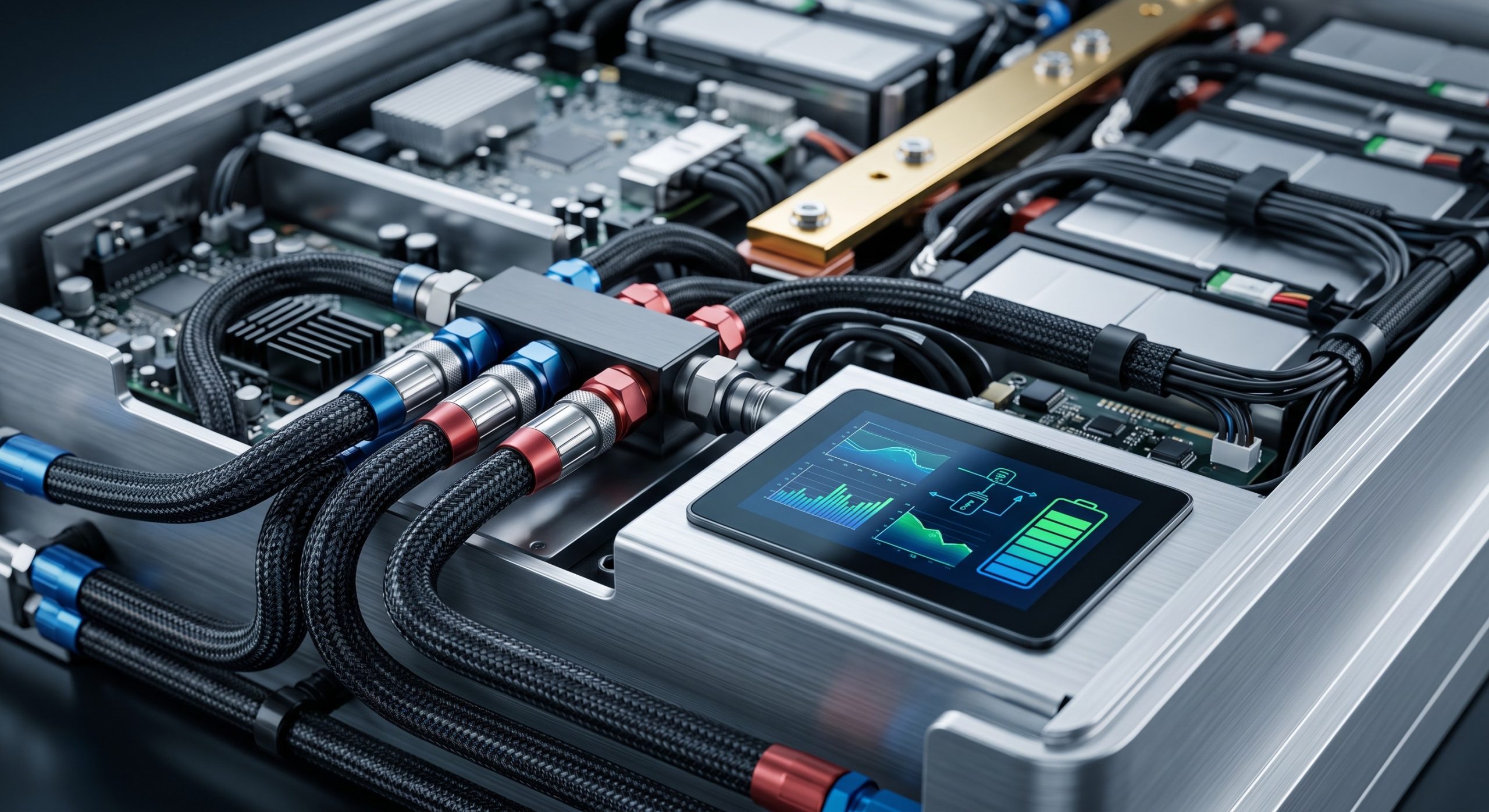
– COOLING METHOD: Intelligent liquid cooling system with isolated fluid loop and precise temperature control (± 1°C) for enhanced cell life and safety.
– ROUND-TRIP EFFICIENCY (DC): ≥ 94%.
– OPERATING TEMPERATURE RANGE: -20°C to +50°C (with derating above 45°C).
– RELATIVE HUMIDITY: 0% to 95% (non-condensing).
– ALTITUDE: ≤ 2000 m (standard), derating above.
– ENCLOSURE RATING: IP54 / NEMA 3R (standard), higher ratings available.
– FIRE PROTECTION: Integrated gas/aerosol fire suppression with thermal and smoke detection.
– COMMUNICATION PROTOCOLS: Modbus TCP/IP, IEC 61850, DNP3.
| Parameter | Specification (ISO 45001 Integrated Platform) |
|---|---|
| Nominal Capacity per System | Up to 5 MWh (20-ft container, scalable) |
| Cell Chemistry | Tier-1 Lithium Iron Phosphate (LFP) |
| Cooling Method | Smart Liquid Cooling with Isolated Fluid Loop |
| Safety Compliance | ISO 45001, IEC 62619, UL 9540 (pending) |
| Fire Protection | Aerosol-based & Gas Suppression with Early Detection |
| Communication Protocols | Modbus TCP/IP, IEC 61850, DNP3 |
| Operating Temperature | -20°C to +50°C (with derating) |
INDUSTRIAL DEPLOYMENT PROTOCOLS
Deploying our BESS with an integrated ISO 45001 framework significantly enhances project safety and operational reliability. The process involves detailed site preparation, rigorous commissioning, and structured handover procedures.
– SITE PREPARATION & INSTALLATION: Prior to installation, a comprehensive site safety plan is developed. This includes geotechnical surveys, pad preparation to specified load-bearing capacities, and establishing safe laydown areas. All lifting and installation activities are conducted under a rigorous lifting plan, with personnel trained in safe rigging and crane operations.
– COMMISSIONING & TESTING: A systematic commissioning procedure verifies all safety interlocks, communication systems, and protection settings. Function tests include emergency shutdown, fire suppression activation (simulated), and fault response sequences. All test results are documented for operational records.
– OPERATIONS & MAINTENANCE (O&M): The ISO 45001 framework is embedded in the O&M phase via a Computerized Maintenance Management System (CMMS). This system schedules preventive maintenance tasks, tracks corrective actions, and manages safety-related work permits. Remote monitoring via our cloud-based EMS provides real-time alerts for anomalies, enabling proactive intervention that minimizes risk and ensures continued safety compliance.
📥 Download Technical Specification
Click the button below to view or download the full official PDF datasheet.