Overview
Ordering spare parts for containerized energy storage systems (ESS) requires precise identification of the system architecture, component tier, and operational history to ensure compatibility and minimize downtime. This FAQ addresses the critical pre-sales and post-sales questions plant engineers, procurement managers, and O&M teams ask when sourcing replacement parts for grid-tied, off-grid, and hybrid BESS deployments.
Frequently Asked Questions
- Q1: What is the maximum cycle life and depth of discharge (DoD) of Tier-1 LFP cells used in containerized energy storage systems?
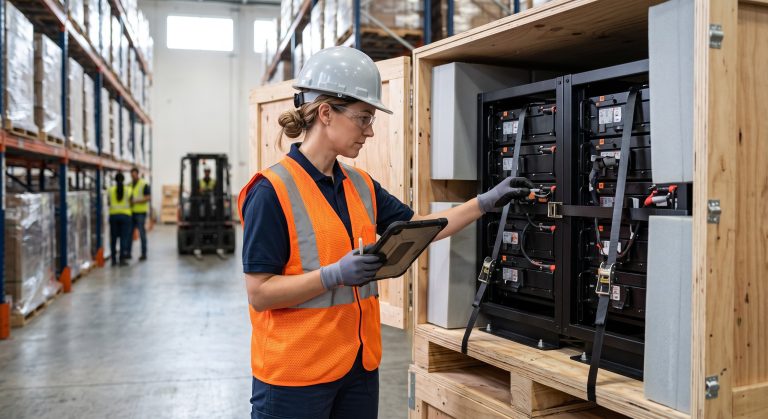
- The standard cycle life of Tier-1 LFP cells in containerized ESS is 6,000 to 8,000 cycles at 80% DoD, with a calendar life of 10 to 15 years depending on operating temperature and C-rate. This is achieved through advanced liquid cooling and precise BMS cell balancing, which maintain cell-to-cell delta within ±30 mV. When ordering replacement battery modules, always specify the original cell manufacturer, model number, and firmware version to ensure the new module matches the existing string characteristics.
- Q2: How do I order the correct BMS monitoring and balancing module for my existing containerized ESS?
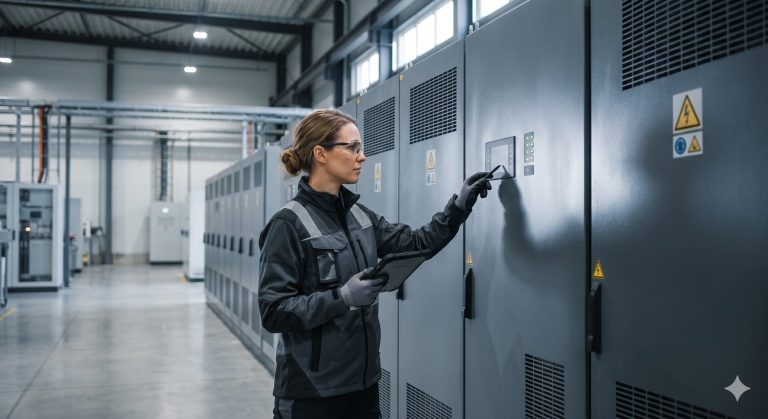
- To order the correct BMS module, provide the system serial number, BMS firmware version, and a screenshot of the current BMS topology from the EMS interface. The BMS part number is typically located on a label inside the control cabinet door. If the original BMS is discontinued, the supplier may offer a drop-in compatible replacement with an adapter harness. Always request a wiring diagram and communication protocol document (Modbus TCP/RTU or CAN) with your spare parts order to verify integration with your existing EMS.
- Q3: What spare parts should be stocked for a 1 MW / 2 MWh containerized BESS to minimize downtime?
- For a 1 MW / 2 MWh containerized BESS, the recommended critical spares kit includes: 2–4 battery modules, 1 BMS slave/BMU unit, 1 PCS power stack or gate driver board, 2–4 cooling fans, 1 liquid cooling pump, 1 set of DC contactors, 1 HVAC compressor, and 1 fire suppression agent cylinder. This kit covers 90% of common failure points. Ordering a pre-packaged spares kit with the original system purchase typically reduces lead time by 30–50% compared to individual component orders.
- Q4: How does the fire safety and thermal runaway prevention system affect spare parts ordering for containerized ESS?
- The fire safety system directly determines which spare parts are required and their lead times. Containerized ESS typically uses a multi-tier approach: aerosol or Novec 1230 suppression, per-module gas/smoke detectors, and emergency exhaust fans. When ordering spare detectors, suppression nozzles, or control panels, you must match the original system’s activation logic and certification (UL 9540, NFPA 855, or IEC 62933). Some suppression agents have a shelf life of 5–10 years; always check the expiration date and request a refill or replacement cylinder with your order.
- Q5: What is the typical lead time and shipping process for ordering spare parts for containerized energy storage systems?
- Typical lead time for containerized ESS spare parts is 2–4 weeks for stock items and 6–10 weeks for made-to-order components such as PCS stacks or custom DC busbars. For international orders, spare parts are shipped via air freight for urgent components (3–7 days) or sea freight for heavy items like battery modules and cooling units (25–45 days). Always request a proforma invoice with HS codes, and confirm whether the supplier provides door-to-door delivery, customs clearance support, and insurance for high-value parts.
- Q6: How do I calculate ROI and peak shaving savings when ordering a containerized BESS with spare parts package?
- ROI for containerized BESS is calculated by dividing annual peak shaving savings plus demand response revenue by the total installed cost, including the spare parts package. A typical C&I system in a high-demand-charge region achieves payback in 4–7 years. When ordering spare parts upfront, include the cost in the total CAPEX to avoid unplanned OPEX. Request a 10-year LCOE analysis from your supplier that factors in replacement parts, cooling maintenance, and warranty extensions.
- Q7: What grid-tie and off-grid configuration spare parts are needed for seamless switching in containerized ESS?
- For seamless grid-tie to off-grid switching, the critical spare parts are the static transfer switch (STS) or automatic transfer switch (ATS), the PCS grid-following/grid-forming control board, and the synchronization relay module. These components must be ordered with the exact voltage and frequency settings (e.g., 480V/60Hz or 400V/50Hz) and compatible with your local grid code (IEEE 1547, EN 50549, or AS/NZS 4777). Keep at least one spare STS and one PCS control board on site for mission-critical applications.
- Q8: How do I ensure spare parts compatibility when upgrading or expanding an existing containerized ESS?
- To ensure compatibility, always order spare parts using the original system’s bill of materials (BOM) and revision number. If the original component is obsolete, request a compatibility matrix from the supplier that maps old part numbers to new replacements, including any firmware or wiring changes. For parallel cabinet expansion, verify that the new battery modules have matched capacity, internal resistance, and cycle count within 5% of the existing strings to avoid imbalance and reduced system efficiency.