Overview
Ensuring the structural integrity of Battery Energy Storage Systems (BESS) during global shipping is critical to preventing costly damage, cell imbalances, and fire safety risks. This FAQ addresses our rigorous vibration testing protocols, including ISTA 3E standards, random vibration profiles, and dynamic shock tests, to guarantee your system arrives in perfect working order. We combine engineering expertise with robust packaging to mitigate transport-induced stresses on sensitive battery modules, power conversion systems, and liquid cooling loops.
Frequently Asked Questions
- Q1: What specific vibration testing is performed to ensure BESS structural integrity during shipping?
- We perform comprehensive vibration testing that strictly follows ISTA 3E (International Safe Transit Association) standards for unitized loads, which simulates the random vibration profiles of truck, rail, and ocean freight. This includes a 3-hour random vibration test at 1.15 Grms (overall G-force level) across a frequency range of 1-200 Hz, combined with dynamic shock tests of 15g for 11ms and 25g for 6ms to replicate handling drops and impacts, ensuring all welded seams, bolted connections, and internal cell interconnects remain intact.
- Q2: How do vibration tests validate the stability of the battery racking system and welded frames?
- Vibration tests validate stability by attaching tri-axial accelerometers to the BESS racking and outer frame to measure resonant frequencies and structural deflection during simulated transport. The test evaluates the entire assembly’s ability to withstand vertical and lateral forces without permanent deformation or loosening of torque-critical fasteners, ensuring the racking system maintains proper cell spacing and module alignment to prevent internal short circuits.
- Q3: Does vibration testing include the impact on liquid cooling lines and electrical connections?
- Yes, all test prototypes undergo a 90-minute endurance sweep with the liquid cooling system pressurized to operating levels, monitoring for pressure drops, leaks at fittings, and micro-fractures in coolant manifolds. Simultaneously, we monitor electrical contact resistance on high-voltage DC connectors and BMS signal harnesses to ensure they remain within specification, preventing intermittent faults from connector fretting or loosening.
- Q4: What packaging and internal bracing are validated through these vibration tests?
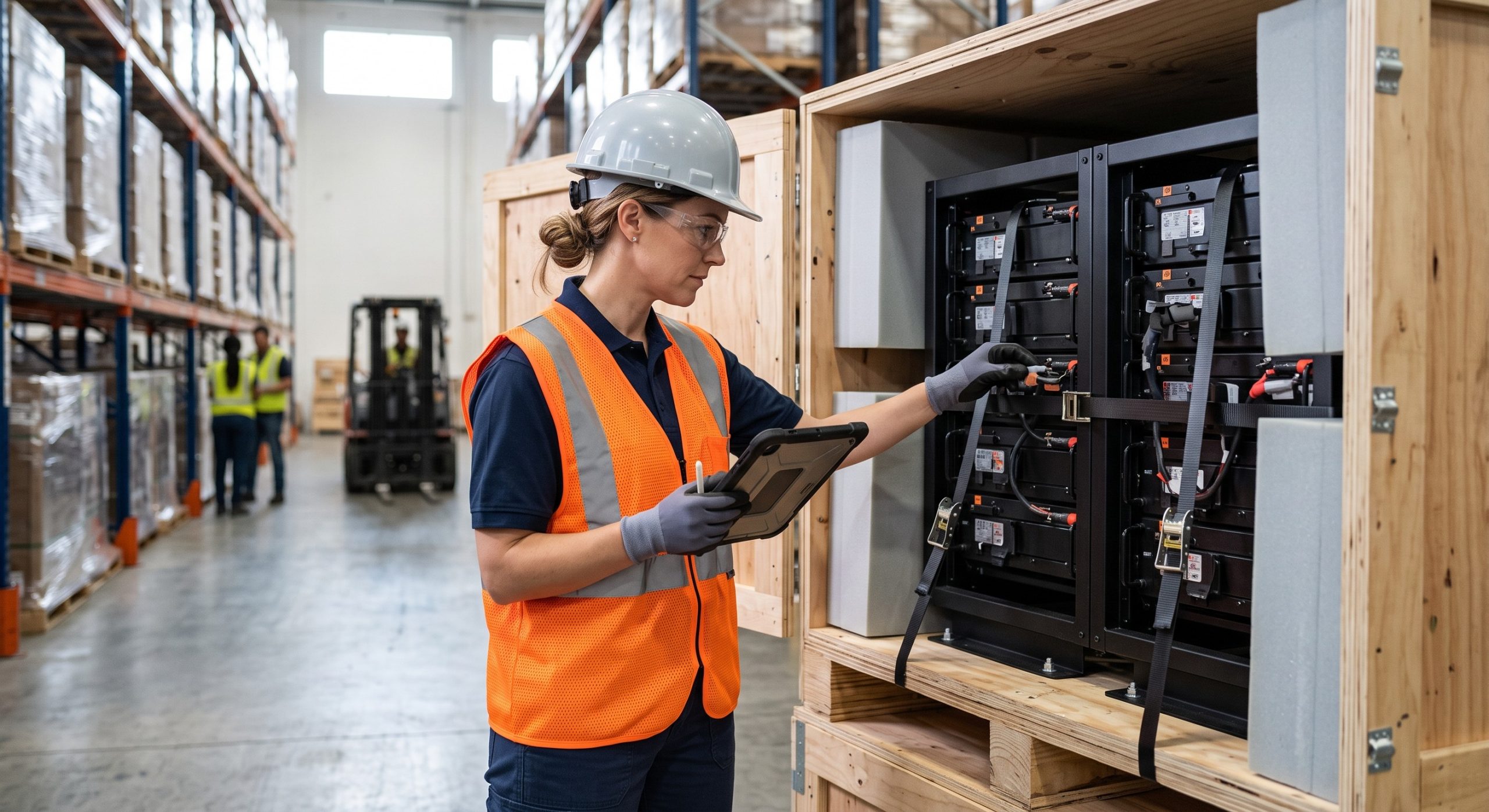
- Our custom-engineered packaging includes a heavy-duty steel skid base, air-ride shock pallets, and integrated foam-in-place bracing that are all validated via vibration testing to absorb and dissipate road shock energy. The validation ensures the packaging’s natural frequency is detuned from the truck’s suspension frequency, preventing resonance amplification, and that internal bracing keeps the BESS center of gravity low and stable, preventing tip-over during cornering or sudden braking.
- Q5: What standard or procedure do you follow for the BESS vibration test?
- We adhere to a rigorous internal test procedure that exceeds ISTA 3E, using a 6-degree-of-freedom vibration table to simulate real-world transport profiles, including sinusoidal dwells at identified resonant frequencies to stress-test structural integrity. This is complemented by an ASTM D4169-16 DC-13 ‘Truck/Rail’ assurance level II test schedule, ensuring comprehensive simulation of varied transport environments.
- Q6: How is the structural integrity test verified post-shipment for quality assurance?
- Post-test, we perform a 100% visual inspection by certified technicians for cabinet deformation, weld integrity, and seal integrity, alongside a comprehensive electrical safety test (hi-pot) and a 24-hour BMS health check to verify all cells remain balanced and within voltage limits. We also conduct a torque audit on all critical bolted connections using a calibrated torque wrench to ensure values remain within ±3% of specification, confirming no structural degradation.
- Q7: Does the BESS include a structural warranty covering shipping-related damage?
- Yes, every system is backed by a comprehensive 5-year structural warranty that covers defects in materials and workmanship, including manufacturing-induced structural failures. We also provide a dedicated shipping damage claim procedure with priority replacement parts and on-site support, ensuring minimal disruption to your project timeline.