Overview
During a grid failure, a commercial BESS must transition from grid-tied operation to islanded mode within milliseconds while ensuring that only the most critical loads remain powered. This FAQ explains how the Energy Management System (EMS) ranks and dispatches power to critical loads, and covers the pre-sales and post-sales technical details that plant engineers, EPCs, and procurement teams ask most often.
Frequently Asked Questions
- Q1: How does the EMS prioritize critical loads during a grid failure?
- The EMS prioritizes critical loads by using a pre-configured load hierarchy that ranks circuits based on operational necessity, then isolates non-essential feeders within 10–100 ms of grid loss. It monitors grid status via the PCS and a transfer switch, and when voltage or frequency deviates beyond IEEE 1547 limits, it opens the grid-tie breaker and energizes only the priority bus. Loads are typically tiered as Tier 1 (life safety, BMS, fire suppression, controls), Tier 2 (process-critical HVAC, servers, refrigeration), and Tier 3 (deferrable or non-essential loads), with Tier 3 shed first when state-of-charge or power output is constrained.
- Q2: What battery chemistry and cycle life should I specify for a BESS that must support critical loads?
- Tier-1 LFP (lithium iron phosphate) is the standard chemistry for critical-load BESS, delivering 6,000–8,000 cycles at 80% DoD with a 10-year or 25 MWh throughput warranty. LFP is preferred over NMC because its higher thermal runaway onset temperature (approximately 250°C vs. 150–200°C) and lower cobalt content improve safety and supply-chain stability. For daily cycling in peak-shaving plus backup duty, specify a system rated for at least 6,000 cycles at 0.5C and confirm the warranty defines end-of-life as 70–80% of beginning-of-life capacity.
- Q3: How does the EMS calculate ROI and peak shaving savings for a commercial BESS?
- EMS ROI is calculated by combining demand-charge reduction, time-of-use energy arbitrage, and outage avoidance value, typically yielding a 4–7 year payback for C&I systems in high-demand-charge markets. The EMS logs 15-minute interval data, identifies the monthly peak demand baseline, and dispatches the battery to cap demand at a configured setpoint; in parallel it charges during off-peak windows and discharges during peak windows. A typical 500 kW / 1 MWh LFP system in a region with $20/kW demand charges and $0.15/kWh peak-to-off-peak spread can save $120,000–$180,000 per year, before incentives.
- Q4: What BMS monitoring and cell balancing does the EMS perform after a grid event?
- The active BMS continuously monitors cell voltage, temperature, current, and SOC at the module level, and performs active or passive inter-cell balancing to keep cell delta below 30–50 mV. After a grid failure, the BMS re-estimates SOC and SOH, checks for cell imbalance caused by uneven discharge, and reports any fault codes to the EMS and cloud platform. Post-event diagnostics should include insulation resistance, contactor state, and thermal sensor verification before the system returns to grid-tied operation.
- Q5: How does the EMS switch between grid-tie and off-grid mode, and what happens to non-critical loads?
- The EMS commands the PCS and static transfer switch to island the critical bus within one cycle (16–20 ms), and non-critical loads are dropped or deferred until the grid returns or SOC recovers above a set threshold. Grid-tie mode provides peak shaving, demand response, and reverse-power control, while off-grid mode uses voltage-source control to form a stable 50/60 Hz reference for critical loads. Seamless transfer requires the PCS to support islanding detection, anti-islanding per UL 1741 SB, and a closed-transition or open-transition transfer scheme matched to the site’s UPS and generator topology.
- Q6: What fire safety and thermal runaway prevention features protect a critical-load BESS?
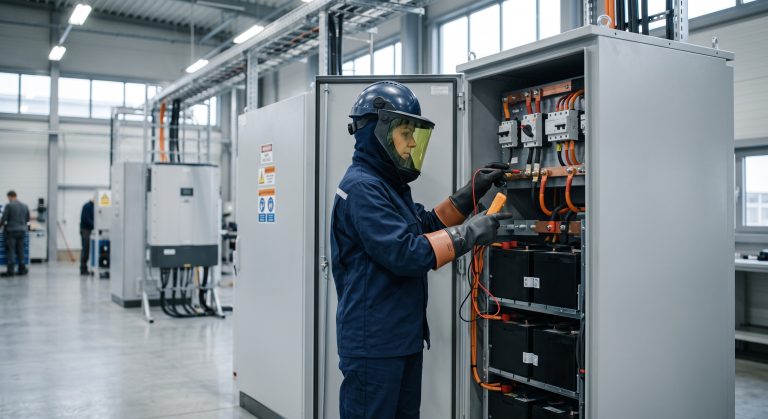
- Multi-tier protection combines UL 9540A-tested cell-to-cell propagation resistance, liquid cooling, early gas and smoke detection, and clean-agent or aerosol fire suppression with emergency ventilation and isolation. The BMS triggers a tiered response: level 1 alarms at elevated temperature or gas detection, level 2 disconnects the affected module, and level 3 activates suppression and isolates the enclosure. Systems should comply with NFPA 855, UL 9540, UL 9540A, IEC 62619, and local fire codes, with deflagration venting and 3-hour fire-rated separation where required.
- Q7: Can the BESS scale from a single cabinet to multi-MWh capacity, and how does the EMS manage parallel units?
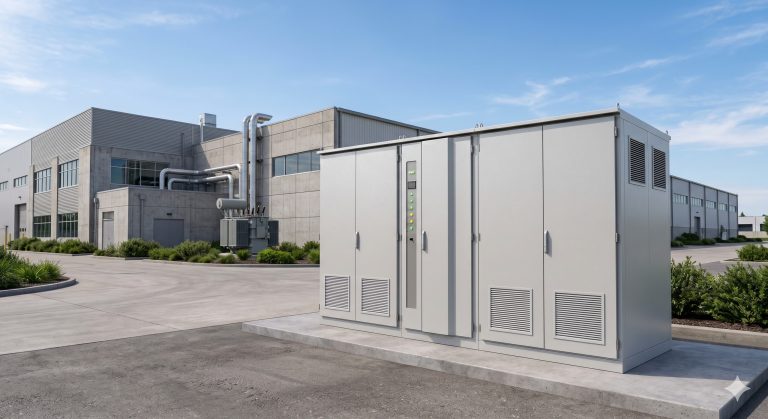
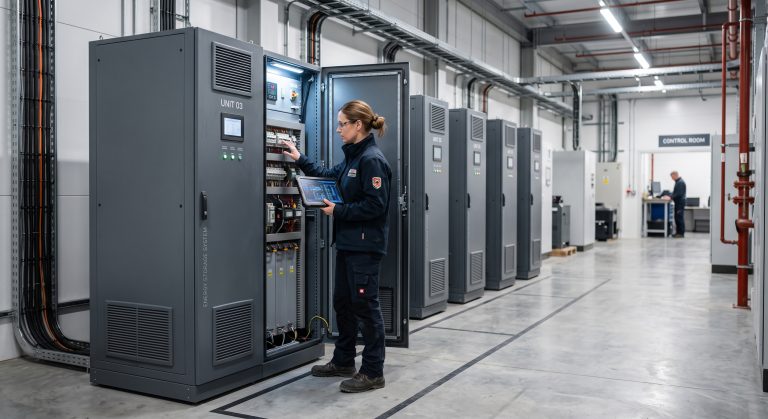
- Yes, modular BESS platforms scale from 100 kWh to 10+ MWh by paralleling identical cabinets on a shared DC busbar or AC bus, with the EMS acting as a master dispatcher. The EMS coordinates SOC balancing across cabinets, allocates power setpoints by available capacity and SOH, and prevents circulating current between parallel PCS units. For expansion, confirm the EMS supports at least 16–32 parallel units, Modbus TCP or CAN communication, and firmware-compatible cabinet revisions.
- Q8: What post-sales O&M and warranty support should a BESS vendor provide for critical-load applications?
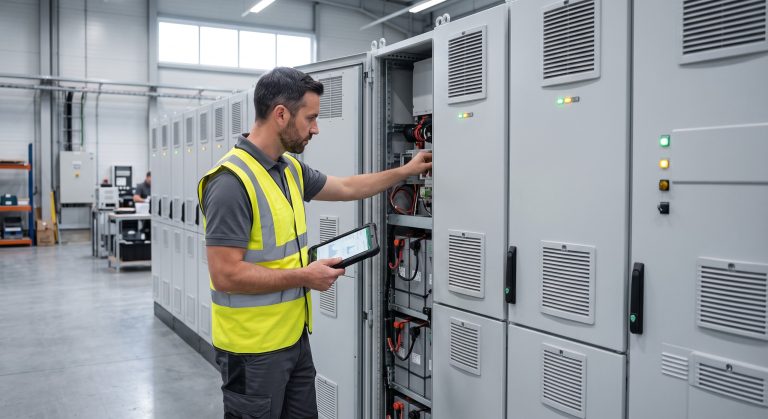
- A critical-load BESS warranty should cover 10 years or 25 MWh throughput, with 24/7 remote monitoring, annual on-site preventive maintenance, and guaranteed spare-parts availability for at least 10 years. The EMS cloud platform should provide SOC/SOH dashboards, fault logs, firmware updates, and API access for SCADA or building management integration. Confirm response-time SLAs (e.g., 4-hour remote diagnosis, 48-hour on-site for critical faults) and whether performance guarantees include capacity retention and round-trip efficiency above 85–90%.