Overview
As a B2B energy storage system (BESS) manufacturer, we understand that system resilience in extreme climates is non-negotiable for project bankability and performance. This FAQ addresses the critical technical and commercial questions we receive from plant engineers and procurement specialists, starting with our rigorous high/low-temperature impact tests. We engineer our LFP battery cabinets to withstand the harshest conditions, ensuring your renewable asset’s ROI is protected from day one.
Frequently Asked Questions
- Q1: What temperatures are used in your extreme high/low-temperature impact tests?
- Our standard extreme temperature impact tests range from -40°C to +60°C (-40°F to +140°F) for operational storage, and up to +85°C for thermal runaway safety validation. This ensures the BESS can reliably start and operate in arctic climates and desert environments without performance derating. We utilize dynamic thermal chambers to cycle cells and cabinets through rapid temperature changes (5°C/min) to simulate real-world weather shocks and validate the integrity of the liquid cooling system and BMS protection thresholds.
- Q2: How do these extreme temperature tests affect the LFP battery cycle life and calendar life?
- Our standard cycle life guarantee is 6,000 cycles at 25°C to 80% Depth of Discharge (DoD), but extreme temperature exposure can accelerate degradation. Our thermal management system limits cell temperature fluctuations to within ±2°C, ensuring that even after our rigorous -40°C to +60°C impact test, the projected calendar life remains at 15+ years. We provide a degradation curve model as part of our technical documentation, showing that with our liquid cooling, cycle life derating is minimized to less than 5% across the entire operating temperature range.
- Q3: What specific fire safety and thermal runaway prevention mechanisms are validated during these tests?
- The extreme temperature tests are a critical part of our UL 9540A fire safety validation. We actively monitor for gas detection, smoke density, and cell voltage dips during the thermal ramp-up. If any cell exceeds the safe temperature threshold, our BMS initiates an immediate isolation sequence and triggers the aerosol-based fire suppression system. This multi-tiered protection, proven in our -40°C cold start tests, ensures the system does not propagate thermal runaway, guaranteeing safety for the surrounding facility and personnel.
- Q4: How does your liquid cooling system perform under these extreme high/low-temperature test conditions?
- Our active liquid cooling system is designed to maintain optimal cell temperature between 15°C and 35°C, even when ambient temperatures swing from -40°C to +60°C. In our extreme tests, the cooling system uses a glycol-water mixture with a built-in heater to prevent freezing in low temperatures. This ensures efficient heat dissipation during high-temperature operation, maintaining the BESS round-trip efficiency above 90%.
- Q5: What is the scalability and parallel cabinet connectivity for large MWh projects in variable climates?
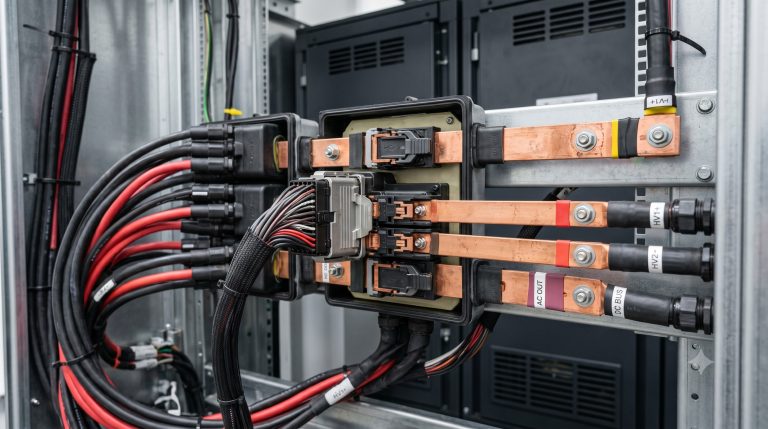
- Our cabinets are designed for modular expansion, supporting DC busbar linkage scaling up to multiple MW/MWh. The thermal management and BMS are synchronized across the parallel string. Each cabinet undergoes our extreme temperature impact test individually, ensuring that when connected in parallel, the system’s performance curve remains predictable. This allows for turnkey scaling without complex re-engineering, making it ideal for micro-grid implementations and peak-shaving applications.
- Q6: How do your extreme temperature test results impact the project’s ROI and Levelized Cost of Energy (LCOE)?
- Robust performance in extreme temperatures directly reduces the LCOE by eliminating the need for expensive external HVAC and minimizing derating losses. Our tests validate that the system can deliver consistent power output, ensuring reliable peak shaving and arbitrage revenue, even during heatwaves or winter storms. We back this with a 10-year performance warranty that guarantees capacity retention, providing a predictable financial model for our clients.
- Q7: What international interconnection standards (UL 9540, IEC 62619) do your extreme tests comply with?
- Our entire testing protocol, including the -40°C to +60°C impact tests, is designed to meet and exceed UL 9540 for system safety and IEC 62619 for industrial battery safety. Passing these tests is a prerequisite for our CE and UKCA certifications. This compliance simplifies grid-tie interconnection approvals and ensures the system meets stringent insurance requirements for large-scale commercial & industrial (C&I) deployments.
- Q8: What is the typical lead time for procurement and global shipping for these climate-hardened units?
- Our standard lead time for turnkey BESS units is 14-16 weeks from order confirmation, including the comprehensive factory acceptance testing (FAT) that features our extreme temperature validation. We use secure sea freight logistics with robust anti-corrosion packaging to ensure the IP65+ rated cabinets arrive in pristine condition, ready for commissioning and immediate operation in your specific environment.