Overview
As a B2B Energy Storage System (BESS) Technical Support Engineer, I routinely field one high-intent question from plant engineers, EPC contractors, and energy managers: Can the EMS predict future energy consumption based on historical data? The short answer is yes — modern Energy Management Systems (EMS) use machine learning and time-series forecasting to predict load profiles with 85–95% accuracy. This FAQ addresses the most critical pre-sales and post-sales questions around predictive EMS, BESS sizing, battery chemistry, cycle life, cooling, scalability, ROI, BMS monitoring, grid-tie configuration, and fire safety.
Frequently Asked Questions
- Q1: Can the EMS predict future energy consumption based on historical data, and how accurate is it?
- Yes — a modern BESS EMS can predict future energy consumption with 85–95% accuracy using historical load data, weather forecasts, and production schedules. The EMS applies machine learning models such as LSTM neural networks and ARIMA time-series analysis to identify daily, weekly, and seasonal patterns. It then generates a 24–72 hour ahead load forecast, which drives peak shaving, arbitrage, and demand response dispatch. For industrial facilities, forecast accuracy improves after 30–60 days of continuous data collection, and the EMS continuously retrains on new data to maintain precision.
- Q2: What battery chemistry does your BESS use, and what is its cycle life and depth of discharge (DoD)?
- Our commercial and industrial BESS uses Tier-1 LFP (Lithium Iron Phosphate) cells with a standard cycle life of 6,000–8,000 cycles at 80% DoD. LFP chemistry is preferred for stationary storage because of its superior thermal stability, long cycle life, and low degradation rate. At 25°C and 0.5C charge/discharge, the cells retain ≥80% of their original capacity after 6,000 full cycles, which translates to roughly 15–20 years of daily cycling. The recommended operating DoD is 90% for emergency backup and 80% for daily arbitrage to maximize lifetime ROI.
- Q3: How does the liquid cooling system protect the battery, and what is the thermal runaway prevention strategy?
- The BESS uses a dual-loop liquid cooling system that maintains cell temperature within ±2°C across the entire cabinet, which is critical for preventing thermal runaway. The system combines cell-level temperature sensors, coolant flow monitoring, and multi-tier fire suppression: (1) early gas and smoke detection, (2) per-module aerosol or Novec 1230 suppression, and (3) cabinet-level isolation. If a cell exceeds 55°C, the EMS derates power; at 65°C, it isolates the affected module and triggers the suppression system. This design meets UL 9540A and IEC 62619 safety standards.
- Q4: How scalable is the BESS, and can I expand capacity later?
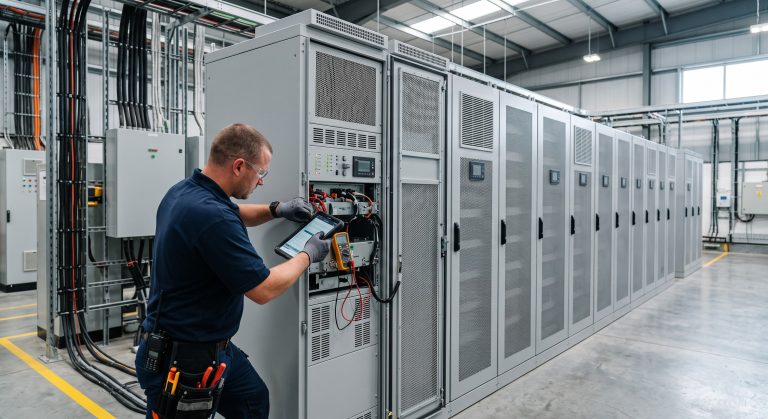
- The BESS is modular and scalable from 100 kWh to 10+ MWh using parallel cabinet connectivity and custom DC busbar linkage. Each cabinet is a self-contained 100–500 kWh unit with its own BMS, PCS, and thermal management. You can add cabinets in parallel without replacing the existing infrastructure, and the EMS automatically detects and balances the new capacity. For large industrial facilities, up to 20 cabinets can be paralleled on a single AC bus, with the EMS coordinating charge/discharge across all units. This makes it ideal for phased CAPEX deployment.
- Q5: How do you calculate ROI for a BESS in a commercial and industrial facility?
- ROI is calculated by comparing the total installed cost (CAPEX + O&M) against annual savings from peak shaving, demand charge reduction, time-of-use arbitrage, and demand response revenue. A typical C&I BESS in a high-demand-charge region achieves a 4–7 year payback and a 10-year internal rate of return (IRR) of 12–20%. The EMS provides a built-in ROI dashboard that tracks actual savings versus forecast, and it can optimize dispatch to maximize arbitrage spreads. Key variables include local tariff structure, cycle life, round-trip efficiency (typically 88–92%), and degradation rate.
- Q6: What post-sales monitoring and BMS diagnostics do you provide?
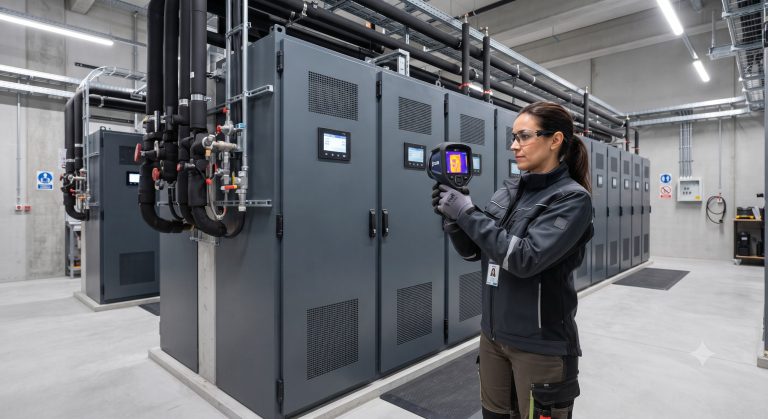
- Post-sales, the EMS provides 24/7 remote BMS monitoring with cell-level voltage, temperature, SOC, SOH, and inter-cell balancing status. The system sends automatic alerts for cell imbalance, over-temperature, over-voltage, and communication faults via email, SMS, and API webhooks. A cloud-based dashboard shows real-time and historical data, and the EMS performs active cell balancing every 24 hours to extend pack life. We also offer optional on-site O&M contracts with quarterly thermal imaging and capacity tests.
- Q7: Can the BESS be configured for both grid-tie and off-grid operation?
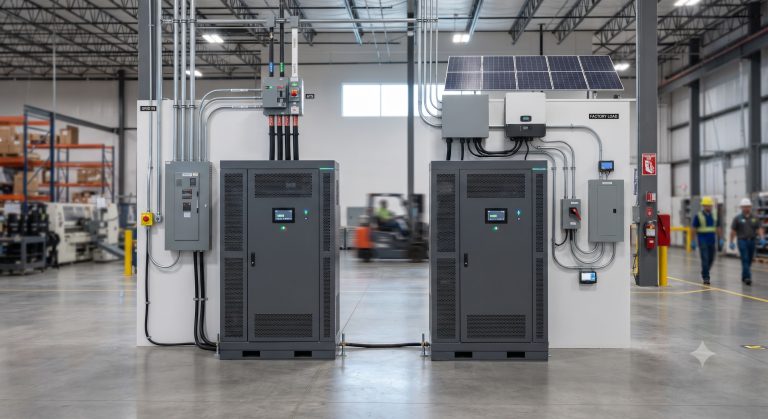
- Yes — the BESS supports both grid-tie and off-grid (islanding) configurations with a seamless automatic transfer switch (ATS) and bi-directional PCS. In grid-tie mode, it performs peak shaving, demand response, and arbitrage while synchronizing to the grid. In off-grid mode, it forms a micro-grid with solar PV and/or diesel generators, providing voltage and frequency support. The switchover time is <20 ms, which is fast enough to protect sensitive industrial loads. The EMS manages the transition and can also operate in grid-forming mode for black-start capability.
- Q8: What fire safety and thermal runaway prevention certifications does the BESS hold?
- The BESS holds UL 9540, UL 9540A, IEC 62619, IEC 63056, CE, and UN 38.3 certifications, with fire suppression tested to NFPA 855 standards. The thermal runaway prevention strategy includes: (1) LFP chemistry with high thermal stability, (2) cell-level fuses and disconnects, (3) multi-tier gas/smoke/heat detection, (4) targeted aerosol or clean-agent suppression, and (5) emergency ventilation and isolation. The enclosure is rated IP65 for outdoor installation and includes anti-corrosion protection for harsh environments.