EXECUTIVE SUMMARY
The European Market Energy Storage Compliance Dossier represents a comprehensive, OEM-authored technical and regulatory compendium designed to expedite the deployment of commercial and industrial (C&I) battery energy storage systems (BESS) across the European Union and associated markets. This document serves as a single-source reference for project developers, EPC contractors, and asset owners, consolidating the full spectrum of compliance evidence, hardware specifications, and grid-interfacing prerequisites required for successful permitting and grid connection. It is engineered to meet the rigorous demands of European grid codes, fire safety regulations, and environmental directives, ensuring that every deployed system achieves the highest standards of safety, reliability, and performance.
This dossier is structured to provide both a high-level executive overview for strategic decision-makers and a granular technical register for engineering teams. It encapsulates the essential documentation required by notified bodies, distribution system operators (DSOs), and transmission system operators (TSOs) for the certification of grid-connected storage assets.
SYSTEM ARCHITECTURE & SAFETY
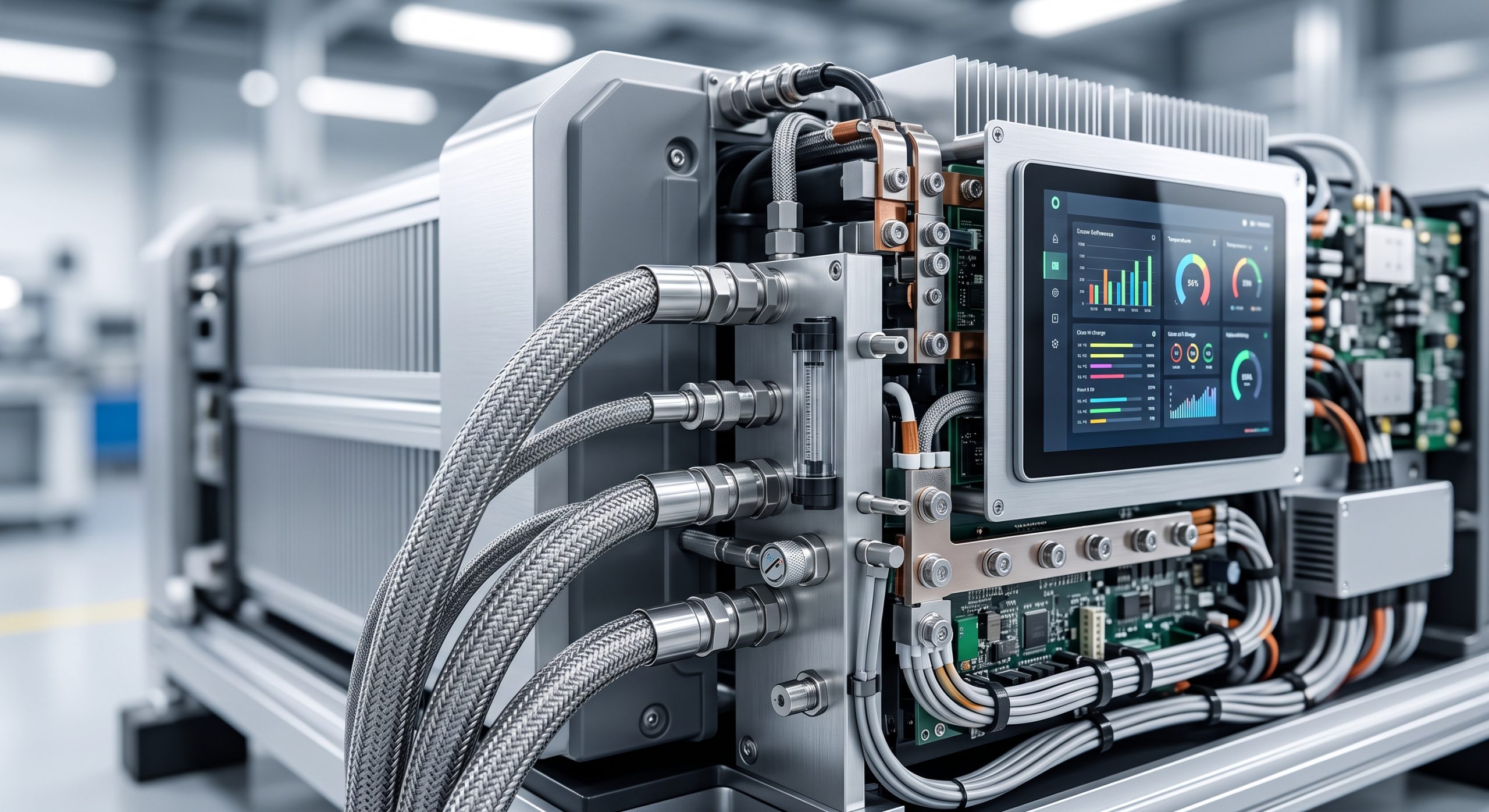
The underlying BESS platform is architected around a high-voltage, liquid-cooled, modular design utilizing Tier-1 Lithium Iron Phosphate (LFP) cell chemistry. This architecture is deliberately selected to maximize thermal stability, cycle life, and round-trip efficiency while minimizing spatial footprint and maintenance overhead. Each storage cabinet integrates a dedicated Battery Management System (BMS) that performs active cell balancing, state-of-charge (SoC) and state-of-health (SoH) estimation, and real-time fault diagnostics.
Safety is engineered into every layer of the system, from the cell level through to the container level. The multi-level safety architecture includes:
– Cell-level: Ceramic-coated separators and pressure relief valves in Tier-1 LFP cells.
– Module-level: Aerosol-based fire suppression agents and thermal barriers.
– Rack-level: Per-rack gas detection, temperature sensors, and DC disconnection units.
– System-level: Containerized fire suppression (Novec 1230 or FK-5-1-12), deflagration venting, and emergency stop interlocks.
The system is designed to comply with the European Union’s Battery Regulation (EU) 2023/1542, the Construction Products Regulation (CPR), and the Low Voltage Directive (LVD) 2014/35/EU, alongside the electromagnetic compatibility (EMC) Directive 2014/30/EU.
KEY FEATURES
– Full Compliance Suite: Pre-assembled dossier including UL 9540, IEC 62619, IEC 63056, and IEC 62477-1 test reports and certificates for streamlined grid connection and permitting.
– Grid Code Adherence: Verified compliance with EN 50549-1/-2, VDE-AR-N 4105, VDE-AR-N 4110, and other national grid codes for seamless DSO approval.
– Advanced Safety Systems: Multi-level fire suppression and deflagration venting meeting NFPA 68/69 and European fire safety guidelines (e.g., VdS 3103).
– Tier-1 LFP Chemistry: High-cycle-life, cobalt-free LFP cells with enhanced thermal runaway suppression characteristics.
– Intelligent Liquid Cooling: Smart liquid cooling system maintaining optimal cell temperature (ΔT ≤ 3°C) for maximized lifespan and performance.
– Modular Scalability: From 215 kWh to multi-MWh configurations, enabling tailored capacity for peak shaving, load shifting, and demand response applications.
– Cybersecurity Resilience: Compliant with IEC 62443 and EU NIS2 Directive requirements for critical infrastructure protection.
– End-to-End Traceability: Full digital product passport (DPP) readiness in accordance with EU Battery Regulation 2023/1542.
COMPLIANCE & STANDARDS
The European Market Energy Storage Compliance Dossier provides a consolidated register of all applicable standards, directives, and certifications. This includes, but is not limited to:
– Product Safety: IEC 62619, IEC 63056, UL 9540, UL 1973, IEC 62477-1.
– Grid Connection: EN 50549-1/-2, VDE-AR-N 4105, VDE-AR-N 4110, VDE-AR-N 4120, CEI 0-16, CEI 0-21.
– EMC: EN 61000-6-2, EN 61000-6-4, EN 61000-3-2, EN 61000-3-3.
– Environmental: EU Battery Regulation 2023/1542, RoHS 2011/65/EU, REACH.
– Fire Safety: NFPA 68, NFPA 69, VdS 3103, EN 45545-2 (rail applications).
– Transportation: UN 38.3, ADR/RID compliance.
– Cybersecurity: IEC 62443, EN 303 645, NIS2 Directive readiness.
TECHNICAL SPECIFICATIONS
The following table summarizes the core technical parameters of the standard C&I BESS cabinet platform referenced in this dossier. Values are representative and may vary based on final configuration and project-specific requirements.
| Parameter | Specification |
|---|---|
| Nominal Capacity | 215 kWh / 372 kWh per cabinet |
| Cooling Method | Smart Liquid Cooling |
| Cell Chemistry | Tier-1 LFP |
| DC Voltage Range | 600 V – 1500 V |
| Round-Trip Efficiency | ≥ 95% |
| Cycle Life | ≥ 8000 cycles @ 80% DoD, 25°C |
| Operating Temperature | -20°C to +55°C (derated above 45°C) |
| Ingress Protection | IP55 / IP66 (optional) |
| Communication | Modbus TCP/IP, IEC 61850, CAN 2.0B |
| Certifications | IEC 62619, UL 9540, CE, EN 50549-1/-2 |
| Dimensions (W x D x H) | 1200 x 1100 x 2200 mm (approx.) |
| Weight | ~2500 kg per cabinet |
INDUSTRIAL DEPLOYMENT
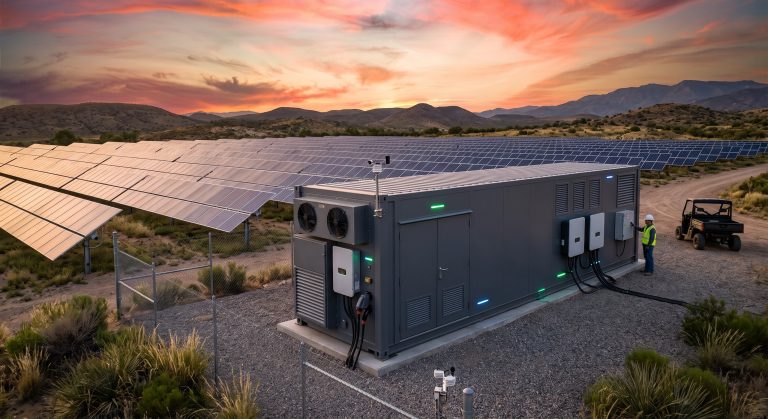
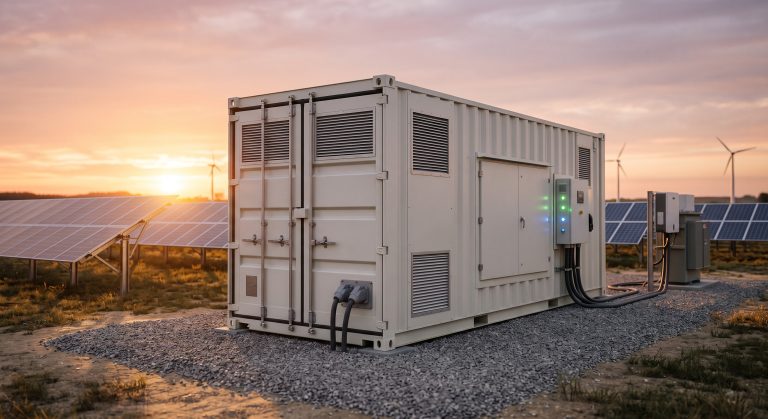
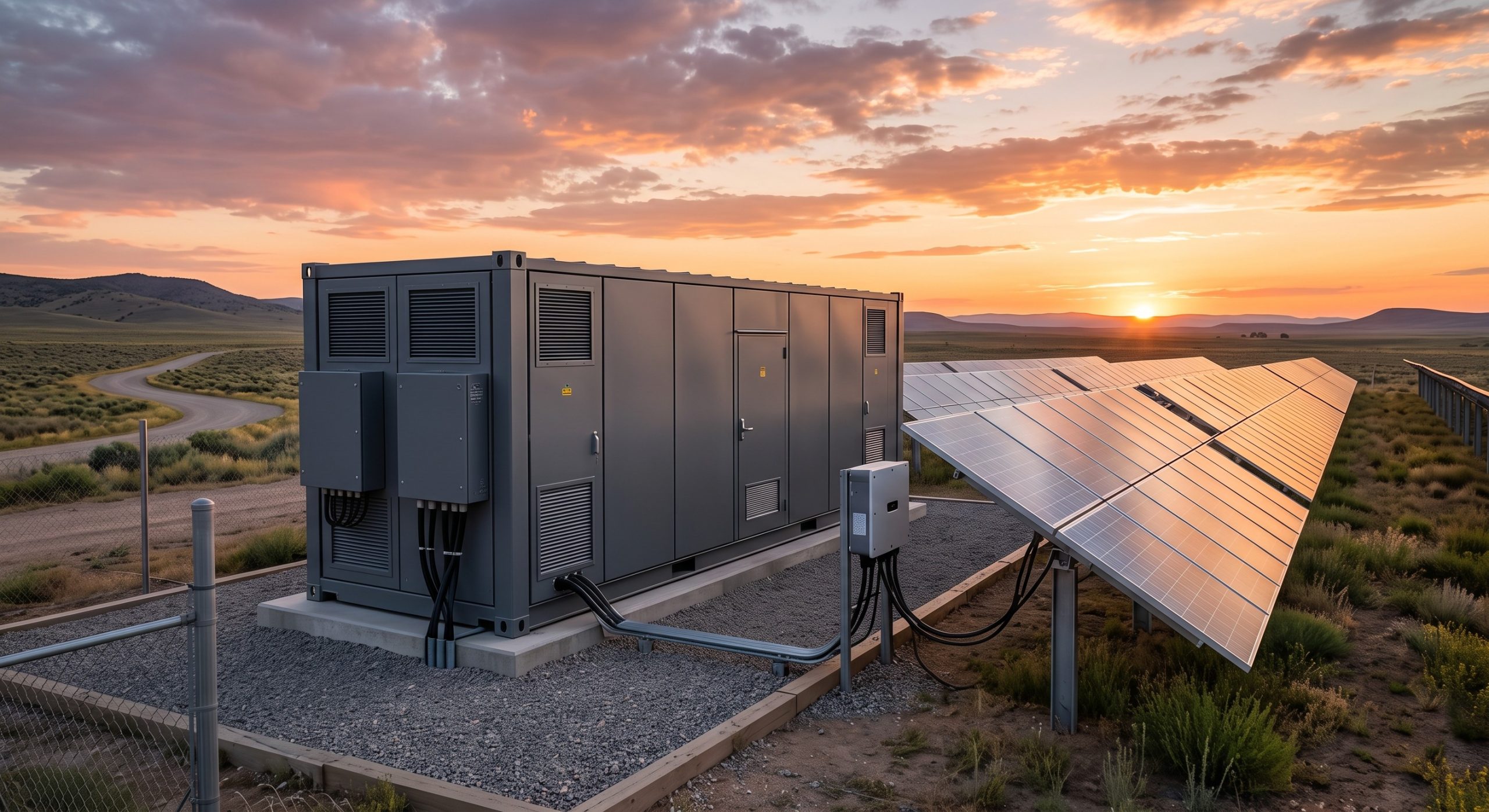
The dossier provides detailed guidance for industrial deployment scenarios, including site preparation, pad mounting, electrical interconnection, and commissioning protocols. It outlines the recommended clearances, grounding requirements, and communication interfaces (Modbus TCP/IP, IEC 61850) necessary for integration with existing facility management systems and SCADA networks. Deployment use cases covered include peak shaving, photovoltaic self-consumption optimization, EV charging buffering, and participation in demand-side response (DSR) markets.
📥 Download Technical Specification
Click the button below to view or download the full official PDF datasheet.