Overview
Ensuring the longevity and reliability of an Energy Storage System (BESS) in outdoor or harsh industrial environments depends heavily on its resistance to environmental ingress. Dust and water penetration are primary causes of electrical faults, corrosion, and thermal runaway events. This FAQ addresses the rigorous testing standards and engineering protocols used to validate the dust and waterproof capabilities of modern energy storage modules, ensuring your investment is protected against the elements.
Frequently Asked Questions
- Q1: What specific IP rating standard is used to test the dust and waterproof capability of a BESS module?
- The BESS module is tested against the international standard IEC 60529 to determine its Ingress Protection (IP) rating, specifically focusing on dust (first digit) and water (second digit) resistance. For outdoor grid-scale and C&I applications, we typically certify to IP65 or IP66, ensuring complete protection against dust ingress and protection against powerful water jets or heavy seas. This standard involves subjecting the enclosure to a vacuum test for dust and a pressurized water spray test for waterproofing.
- Q2: How is the ‘Dustproof’ test (IP6X) actually performed on a large energy storage cabinet?
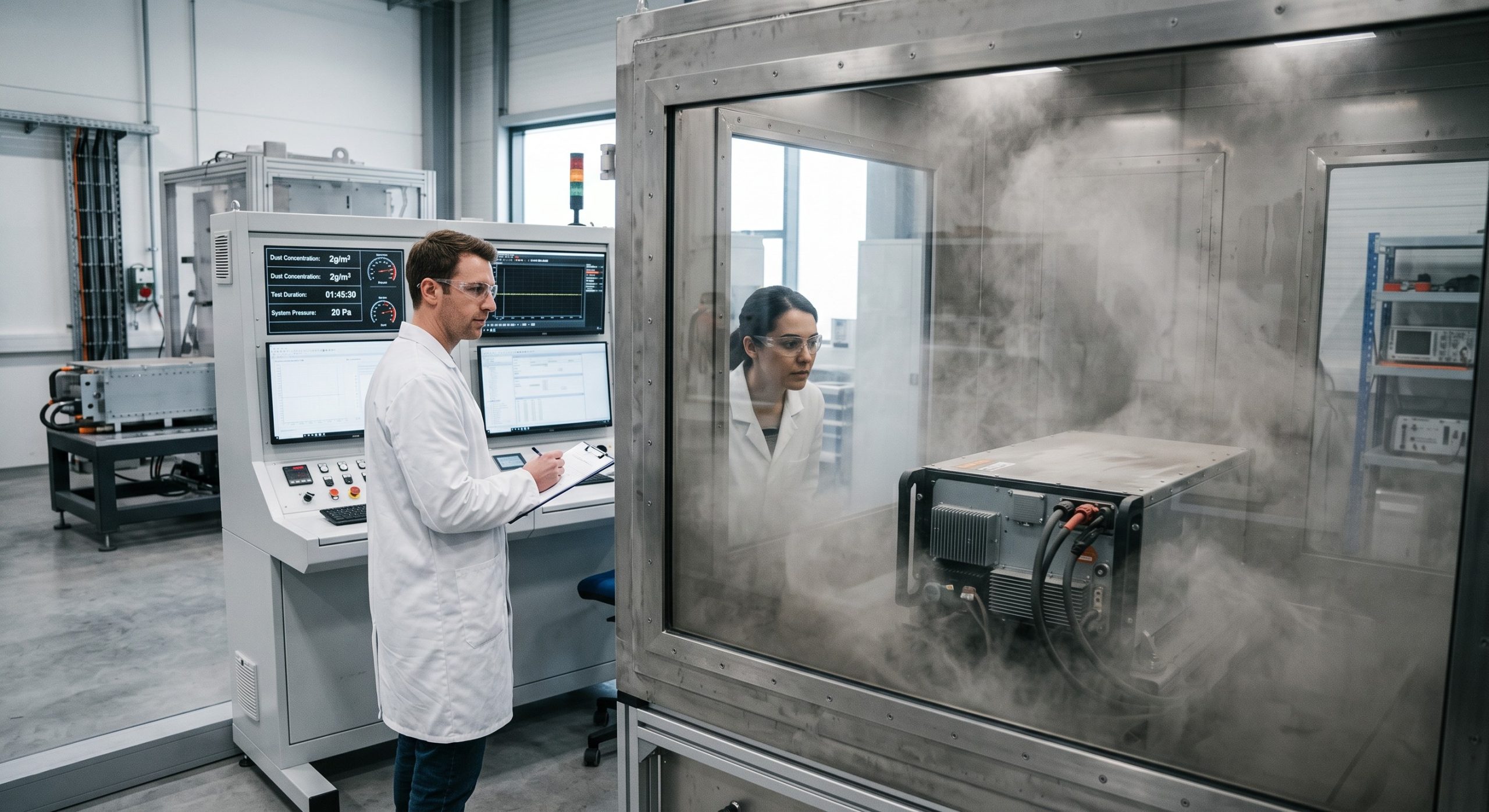
- The dustproof test (IP6X) is conducted by placing the fully assembled BESS cabinet inside a sealed dust chamber filled with talcum powder at a specific concentration. A vacuum pump is connected to the cabinet to simulate negative pressure, replicating real-world thermal cycling that can suck particles inside. The test runs for 8 hours, after which the cabinet is inspected internally; to achieve IP6X (dust-tight), absolutely zero dust particles must enter the enclosure.
- Q3: What does the ‘Waterproof’ test (IPX5 or IPX6) involve for an energy storage module?
- The waterproof test involves spraying the BESS enclosure from a specified distance with a high-pressure water jet at a defined flow rate. For IPX5, it undergoes a 12.5mm nozzle spray at 12.5 L/min for at least 3 minutes. For IPX6, a more intense 100 L/min jet is used. The module is monitored for water leakage; passing requires that water ingress does not reach critical electrical components, preventing short circuits and ensuring system safety.
- Q4: Why is an IP65 rating critical for BESS cooling systems, particularly liquid cooling?
- An IP65 rating is critical for liquid-cooled systems to protect the cooling circuitry and power electronics from ambient moisture and conductive dust. Even a small amount of dust accumulation on liquid cooling radiators or condensation ingress into pumps can degrade thermal management efficiency or cause leaks. The rating ensures that the dry cooling fins and electrical connections remain isolated from environmental contamination, maintaining the system’s ability to dissipate heat.
- Q5: How does a Tier-1 LFP cell’s internal design contribute to the module’s overall waterproof capability?
- While the overall module IP rating is determined by the external enclosure, Tier-1 LFP cells feature highly robust laser-welded aluminum housings with hermetically sealed vents. These cells are tested to prevent electrolyte leakage and moisture ingress under IP67 conditions. To achieve module-level IP65, we combine these sealed cells with custom-designed silicone gaskets and compression plates on the doors that prevent water from reaching the cell terminals.
- Q6: Are there specific tests for ‘Harsh Outdoor Enclosure Ratings’ beyond IP standards?
- Yes, beyond IP testing, modules are subjected to a combined environmental test that includes UV resistance, salt spray corrosion (ASTM B117), and temperature/humidity cycling (IEC 60068). This ensures the external paint, seals, and gaskets do not degrade under direct sunlight or coastal conditions. This dual-validation prevents the IP rating from degrading over the system’s 15-year lifecycle.
- Q7: How do I verify the IP rating during a factory acceptance test (FAT) or on-site deployment?
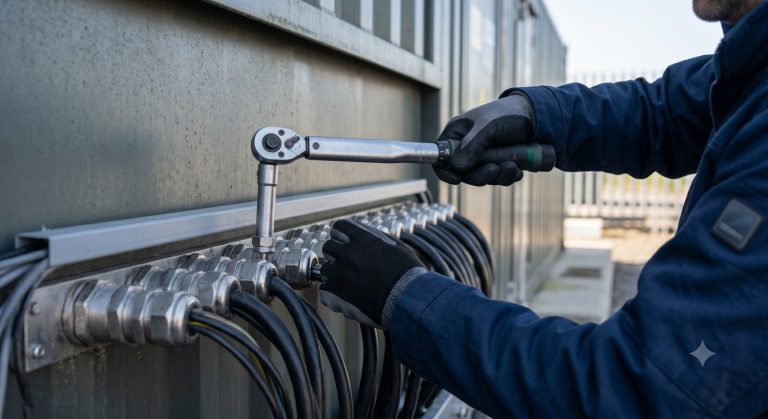
- During FAT, we provide an IP test certificate from a third-party lab confirming compliance. On-site, you can visually verify the integrity of the cabinet seals, cable gland tightness, and door gaskets. Additionally, we perform an acoustic leak detection test or a simple water hose test on a non-energized cabinet to ensure sealing integrity hasn’t been compromised during shipping. This post-sales maintenance step is crucial for preserving the warranty.