Overview
In the high-stakes world of Battery Energy Storage System (BESS) manufacturing, automated barcode scanning is a critical but often misunderstood process. For plant engineers, quality control managers, and procurement specialists, this technology is the backbone of traceability, quality assurance, and regulatory compliance. This FAQ addresses the most common technical and operational questions about how barcode scanning systems are integrated into a modern manufacturing line, specifically tailored for the rigorous demands of LFP battery cell and module production.
Frequently Asked Questions
- Q1: How exactly does an automated barcode scanning system ensure end-to-end traceability for BESS battery cells in the manufacturing line?
- The system creates a digital twin for each battery cell by scanning a unique 2D Data Matrix or QR code at the very start of production, linking it to a central Manufacturing Execution System (MES). This unique identifier is then automatically scanned at every critical station—from electrode coating and cell stacking to electrolyte filling, formation, and final module assembly—creating an unbroken chain of custody. Consequently, if a quality issue arises, engineers can instantly trace the defect back to the specific raw material batch, production machine, and even the operator on shift.
- Q2: What specific data parameters are captured by the barcode scanner during the BESS module assembly phase?
- The scanner captures the cell’s unique serial number and synchronizes with the MES to pull and log a comprehensive dataset for that specific unit. This data typically includes the cell’s internal resistance (ACIR), open-circuit voltage (OCV), capacity grading results, and thermal imaging profiles from formation. During module assembly, the system logs torque values for busbar connections, weld integrity metrics, and the results of the high-potential (Hi-Pot) insulation test. This granular data collection is vital for predicting long-term cell degradation and ensuring balanced performance across the entire 1MWh+ system.
- Q3: How does the automated barcode scanning system improve quality control (QC) and reduce the risk of thermal runaway in BESS?
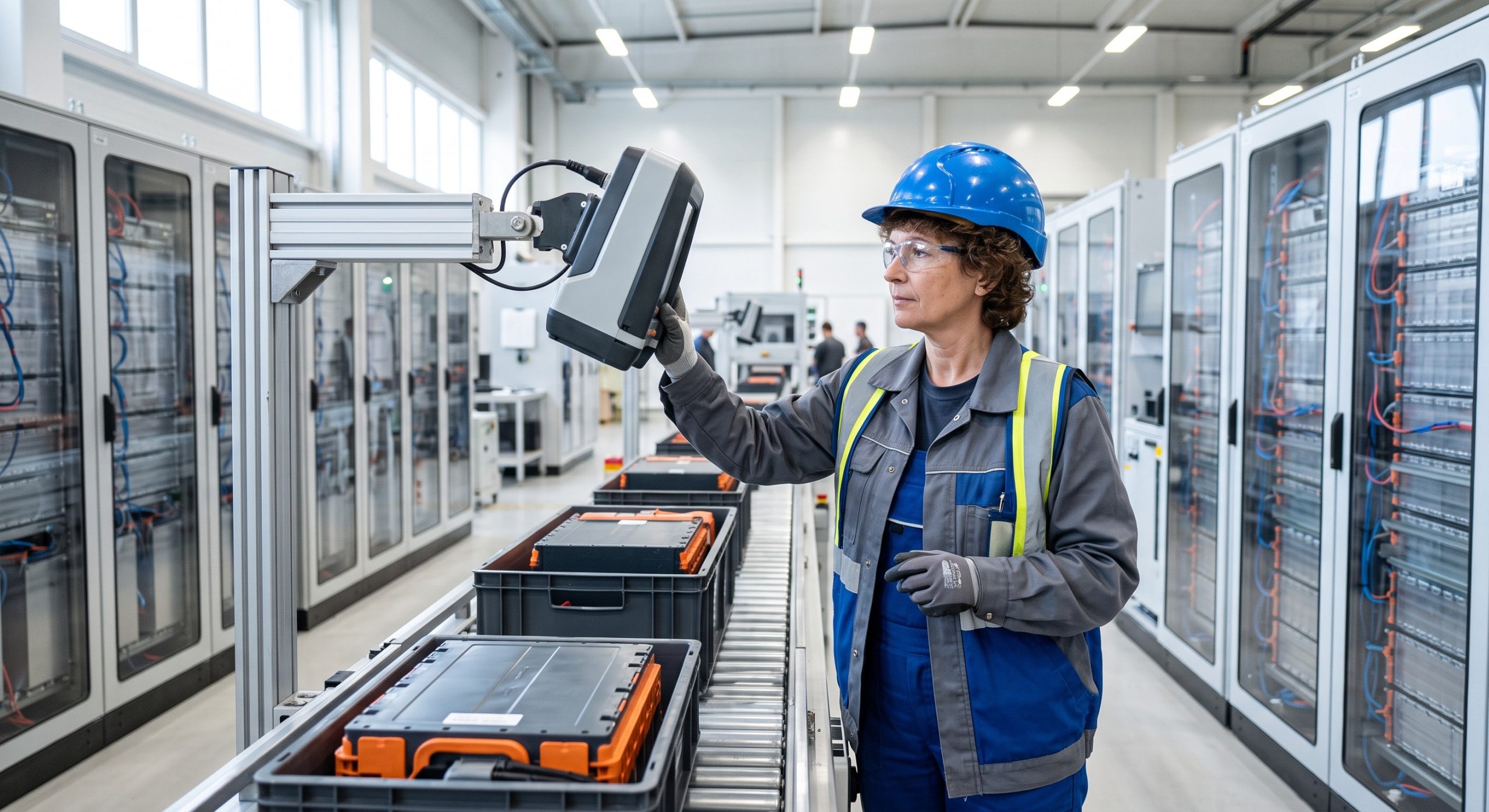
- The scanning system acts as a gatekeeper, automatically cross-referencing scanned cell IDs against a ‘pass’ list from the MES. If a cell that failed initial capacity or impedance testing is accidentally introduced to the assembly line, the scanner will detect the mismatch and immediately halt the conveyor, preventing a potentially defective cell from being integrated. By ensuring that only cells with healthy voltage and resistance profiles are assembled, the system proactively reduces the risk of internal short circuits and the subsequent thermal propagation that can lead to a catastrophic fire event, directly supporting fire safety protocols.
- Q4: What is the technical integration process for a new barcode scanning system with our existing BESS production line and legacy MES?
- Integration typically involves three phases: hardware deployment, middleware configuration, and software API synchronization. First, industrial-grade fixed-mount barcode readers (like Cognex or Keyence) are installed at key conveyor stations. Second, a middleware application is configured to translate the scanner’s raw data into a format compatible with your MES database. Finally, a RESTful API or OPC UA connection is established for real-time data exchange with your legacy ERP/MES systems. The goal is a ‘plug-and-produce’ setup where the scanning system adapts to your existing workflow without requiring a full overhaul of your core software.
- Q5: How does this automated traceability system impact the lifecycle guarantee and warranty claims for large-scale BESS projects?
- It provides the irrefutable data backbone for warranty fulfillment. The detailed production history—including formation curves, initial capacity, and internal resistance—serves as a verified baseline for the performance guarantee. In the event of a premature capacity fade (e.g., within the 10-year warranty period), the data log can definitively prove whether the cell was manufactured to spec, isolating the root cause to either a manufacturing flaw or external operating conditions. This drastically reduces disputes, streamlines the warranty claims process, and reinforces the overall reliability of the BESS asset.
- Q6: Can the barcode scanning system handle the high-throughput demands of a large-scale gigafactory producing multiple BESS cabinet variants?
- Yes, modern systems are engineered for high-speed, automated production, capable of reading hundreds of codes per minute with a read rate exceeding 99.9%. They utilize advanced algorithms and high-resolution cameras to decode even damaged or low-contrast codes. To manage multiple product variants (e.g., 280Ah vs. 314Ah cells), the MES is configured with a ‘master recipe’ that defines the specific scanning sequence and data requirements for each SKU. This ensures the correct parameters are applied and verified for every module and cabinet, regardless of the model being produced on the same line.
- Q7: What are the common hardware challenges with barcode scanning in a dusty BESS manufacturing environment, and how are they mitigated?
- Dust, ambient light fluctuations, and the reflective surfaces of battery terminals are primary challenges. To mitigate these, manufacturers deploy scanners with specialized high-intensity illumination (e.g., polarized or strobed lighting) to reduce glare. Additionally, the scanners are housed in IP67-rated enclosures to protect against particulate ingress and fitted with air-purging nozzles or wiper systems to keep the optics clear. Regular calibration checks and preventative maintenance schedules are implemented to ensure the system maintains peak performance in harsh industrial conditions.
- Q8: How does the data from the automated barcode system support predictive maintenance and overall equipment effectiveness (OEE) in the BESS factory?
- By tracking the throughput and defect rates at each scanning station, the system provides real-time data on line bottlenecks and machine performance. If a specific station shows a sudden increase in ‘scan no-read’ errors, it can signal a failing lighting unit or a misaligned camera, enabling proactive maintenance before a full breakdown occurs. This data-driven approach allows plant engineers to calculate OEE, identify root causes of downtime, and optimize the manufacturing process for greater yield and efficiency, ultimately reducing the levelized cost of storage (LCOE) for the end customer.