Overview
As a B2B Energy Storage System (BESS) Technical Support Engineer, I address the most critical questions about integrating the Energy Management System (EMS) with third-party Building Management Systems (BMS). Whether you are a plant engineer, procurement manager, or EPC contractor, these answers cover pre-sales specifications, post-sales monitoring, and safety protocols to ensure seamless interoperability.
Frequently Asked Questions
- Q1: Can the EMS be integrated with third-party building management systems?
- Yes, the EMS can be fully integrated with third-party building management systems via open communication protocols such as Modbus TCP/IP, BACnet, and OPC UA. This enables bidirectional data exchange for real-time monitoring, demand response, and dispatch optimization. Integration is typically achieved through an API gateway or a local edge controller, ensuring no disruption to existing BMS operations.
- Q2: What battery chemistry is used, and what is the expected cycle life and depth of discharge (DoD)?
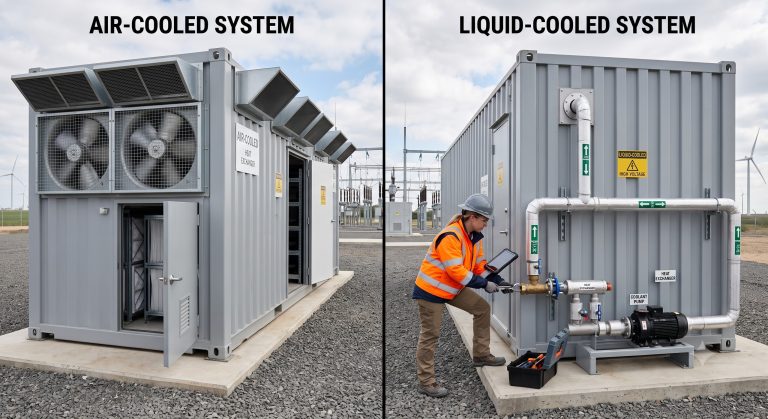
- The system uses Tier-1 LFP (Lithium Iron Phosphate) cells, offering a cycle life of 6,000–8,000 cycles at 80% DoD. This chemistry provides superior thermal stability and longevity. With active BMS balancing and liquid cooling, you can expect over 10 years of operational life under standard C&I duty cycles.
- Q3: How does the cooling system ensure thermal runaway prevention and fire safety?
- The BESS employs a multi-tier fire safety architecture: liquid cooling maintains cell temperatures within ±2°C, while early gas/smoke detection triggers isolation and suppression. The system meets UL 9540 and IEC 62619 standards. Integrated aerosol or Novec 1230 suppression is activated within seconds of detecting abnormal thermal events.
- Q4: Can the system be scaled for larger industrial facilities, and what are the parallel cabinet limits?
- Yes, the modular design allows parallel cabinet connectivity up to 20 units, delivering over 10 MWh of installed capacity. Custom DC busbar linkages ensure efficient current sharing. Scalability is managed by the EMS, which automatically balances load across all connected cabinets without manual reconfiguration.
- Q5: How is ROI calculated for peak shaving and demand response applications?
- ROI is calculated based on energy arbitrage (peak vs. off-peak tariffs), demand charge reduction, and frequency regulation revenues. Typical payback is 4–6 years. The EMS provides built-in ROI dashboards that track kWh shifted, peak demand savings, and LCOE, enabling precise financial reporting.
- Q6: What post-sales BMS monitoring and grid-tie vs off-grid configuration options are available?
- Post-sales, the EMS offers 24/7 remote BMS monitoring via a secure cloud portal, including cell voltage, temperature, and SOC. For grid-tie, the bi-directional PCS synchronizes with the grid for peak shaving and demand response. For off-grid, the EMS manages seamless islanding transitions within 20 ms, ensuring uninterrupted power to critical loads.
- Q7: What international standards and certifications does the BESS comply with for interconnection?
- The BESS complies with UL 9540, IEC 62619, CE, and IEEE 1547 for grid interconnection. These certifications ensure safety, performance, and grid compatibility. Local grid codes (e.g., UL 1741 SA) are also supported for demand response and ride-through capabilities.
- Q8: How does the EMS handle API integration for third-party smart dispatch and optimization?
- The EMS exposes a RESTful API and supports Modbus/BACnet for third-party smart dispatch. This allows external platforms to send charge/discharge schedules, read real-time data, and participate in virtual power plant (VPP) programs. API documentation and sandbox access are provided during pre-sales for seamless integration testing.