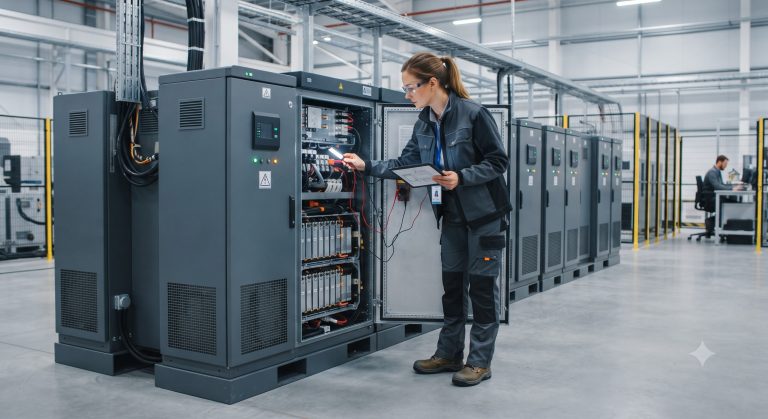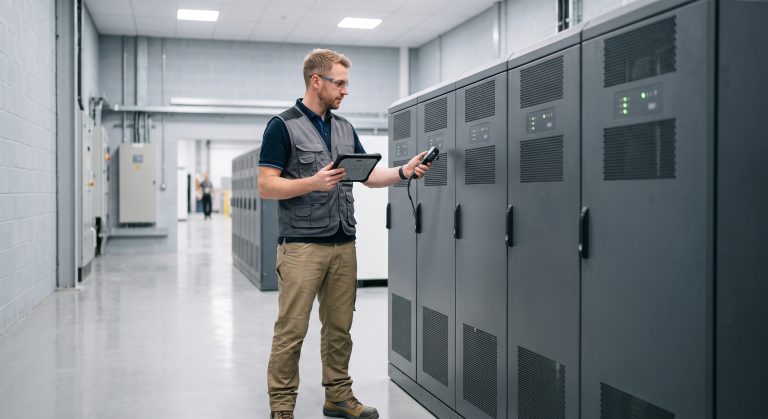
Overview
For commercial and industrial (C&I) energy storage systems, the efficiency of the Power Conversion System (PCS) is the single most critical factor determining your financial return. Our C&I BESS utilizes a bi-directional, modular PCS with a peak efficiency of 98.5%, ensuring minimal conversion losses between AC and DC power. This FAQ addresses the top technical and financial questions from our clients, covering everything from system performance to long-term ROI and safety protocols.
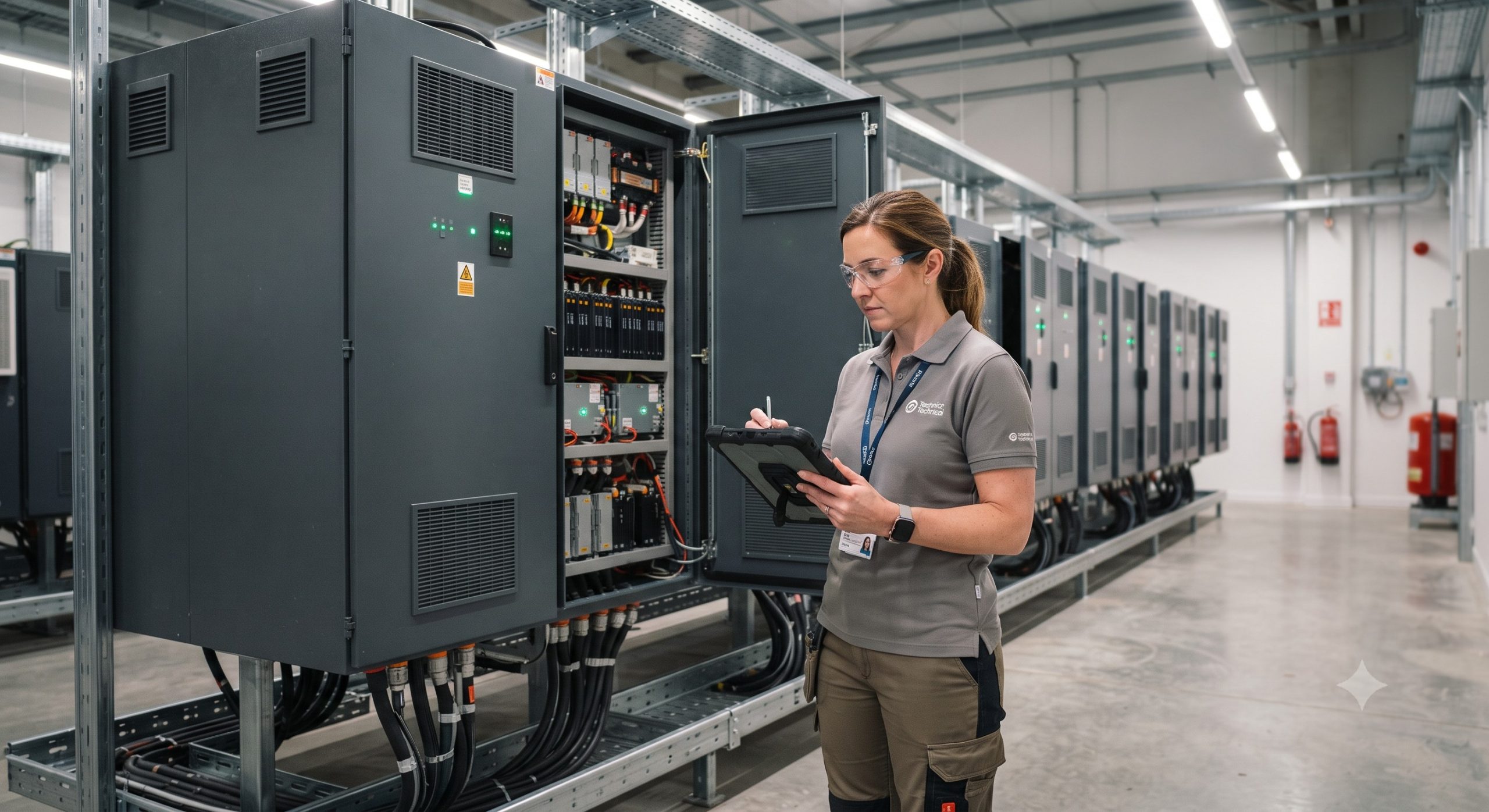
Frequently Asked Questions
- Q1: What is the actual round-trip efficiency (RTE) of the PCS in your C&I BESS, and how does it impact ROI?
- The actual round-trip efficiency (AC-to-AC) of our PCS is consistently above 92%, driven by a peak conversion efficiency of 98.5%. This high RTE directly reduces the Levelized Cost of Energy (LCOE) by maximizing the usable energy per cycle, ensuring your peak shaving and arbitrage strategies deliver the highest possible ROI over the system’s lifetime.
- Q2: How does the liquid cooling system contribute to overall system efficiency and cycle life?
- The advanced liquid cooling circuit is pivotal for maintaining optimal battery temperatures between 15-35°C. This thermal preservation prevents efficiency-robbing thermal runaway and ensures a standard cycle life of 8,000 cycles at 80% DoD, compared to standard air-cooled systems which may degrade faster under heavy load.
- Q3: What safety features are integrated to prevent thermal runaway in the battery cabinets?
- We employ a multi-tier fire safety mechanism that includes early gas/smoke detection, per-module isolation, and a dedicated fire suppression system. This proactive approach ensures any anomaly is isolated instantly, mitigating risk and guaranteeing compliance with UL 9540A standards without interrupting the overall system’s operation.
- Q4: What are the BMS monitoring protocols for active cell balancing and state-of-health reporting?
- Our sophisticated Battery Management System (BMS) conducts active inter-cell balancing at the pack level. It provides detailed State-of-Charge (SoC) and State-of-Health (SoH) reports in real-time, enabling predictive maintenance and ensuring that all Tier-1 LFP cells perform uniformly, maximizing usable capacity across the entire 10-year service life.
- Q5: Is the system designed for both grid-tie and off-grid (islanding) configurations?
- Yes, the PCS is engineered for seamless bi-directional grid support. It enables peak shaving in grid-tie mode and automatic islanding for off-grid applications, ensuring 24/7 power reliability for critical industrial loads and micro-grid implementations, with a seamless transition time of less than 20ms.
- Q6: How scalable is the system for future expansion and parallel DC busbar linkage?
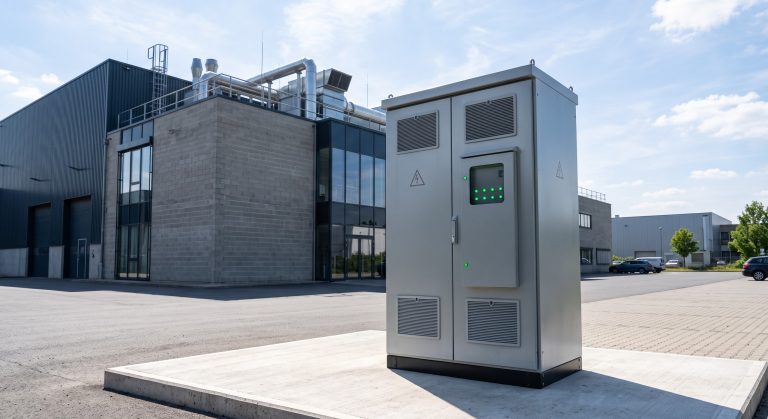
- The system features a modular cabinet design that supports parallel connectivity for easy expansion. You can scale your storage capacity by adding cabinets to a shared DC busbar, offering a flexible upgrade path to meet growing energy demands without costly overhauls.
- Q7: How do I calculate ROI and the payback period for my commercial facility?
- Our standard ROI calculation factors in energy arbitrage, demand charge reduction, and grid service revenues. Using a 1MWh system with an average peak-to-off-peak spread of $0.15/kWh, customers typically see a payback period of 3-5 years. We provide a detailed financial model tailored to your local utility rates.
- Q8: What international standards do these systems comply with and what is the lead time?
- All systems are strictly certified to IEC 62619, UL 9540, and CE standards. Standard lead time for a full turnkey system (including sea freight) is 45-60 days, with comprehensive O&M support available to ensure seamless deployment and long-term performance.