Overview
High-current connectors are the critical interface between battery racks, power conversion systems (PCS), and grid-tie equipment in any BESS deployment. Poor connector selection leads to energy loss, thermal events, and unplanned downtime. This FAQ answers the most common technical and procurement questions from plant engineers, system integrators, and procurement managers.
Frequently Asked Questions
- Q1: What is the standard current rating and IP protection level for a high-current connector in utility-scale BESS?
- A high-current connector for utility-scale BESS typically carries a continuous current rating of 200A to 500A per contact, with peak overload capacities up to 600A for 3 minutes. The minimum IP protection level is IP65 (dust-tight and water-jet resistant) for outdoor cabinet integration. For underground or submerged conduit applications, IP67 or IP68 is recommended. These ratings ensure safe operation in ambient temperatures from -40°C to +85°C without derating when paired with proper cable lugs.
- Q2: How does a high-current connector prevent thermal runaway and arc flash events?
- High-current connectors prevent thermal runaway through three independent safety layers: first, silver-plated or nickel-plated copper contacts with spring-loaded hyperboloid or multi-louver band technologies that maintain stable contact force under vibration; second, integrated thermistor sensors that communicate with the BMS to trigger current reduction at 90°C and full disconnection at 105°C; third, arc-quenching chambers filled with ceramic or glass-fiber reinforced nylon that extinguish DC arcs within 5ms. For UL 9540A compliance, connectors must also pass a 1500V DC dielectric withstand test for 60 seconds without tracking or flashover.
- Q3: What is the recommended maintenance interval and end-of-life indicator for high-current connectors?
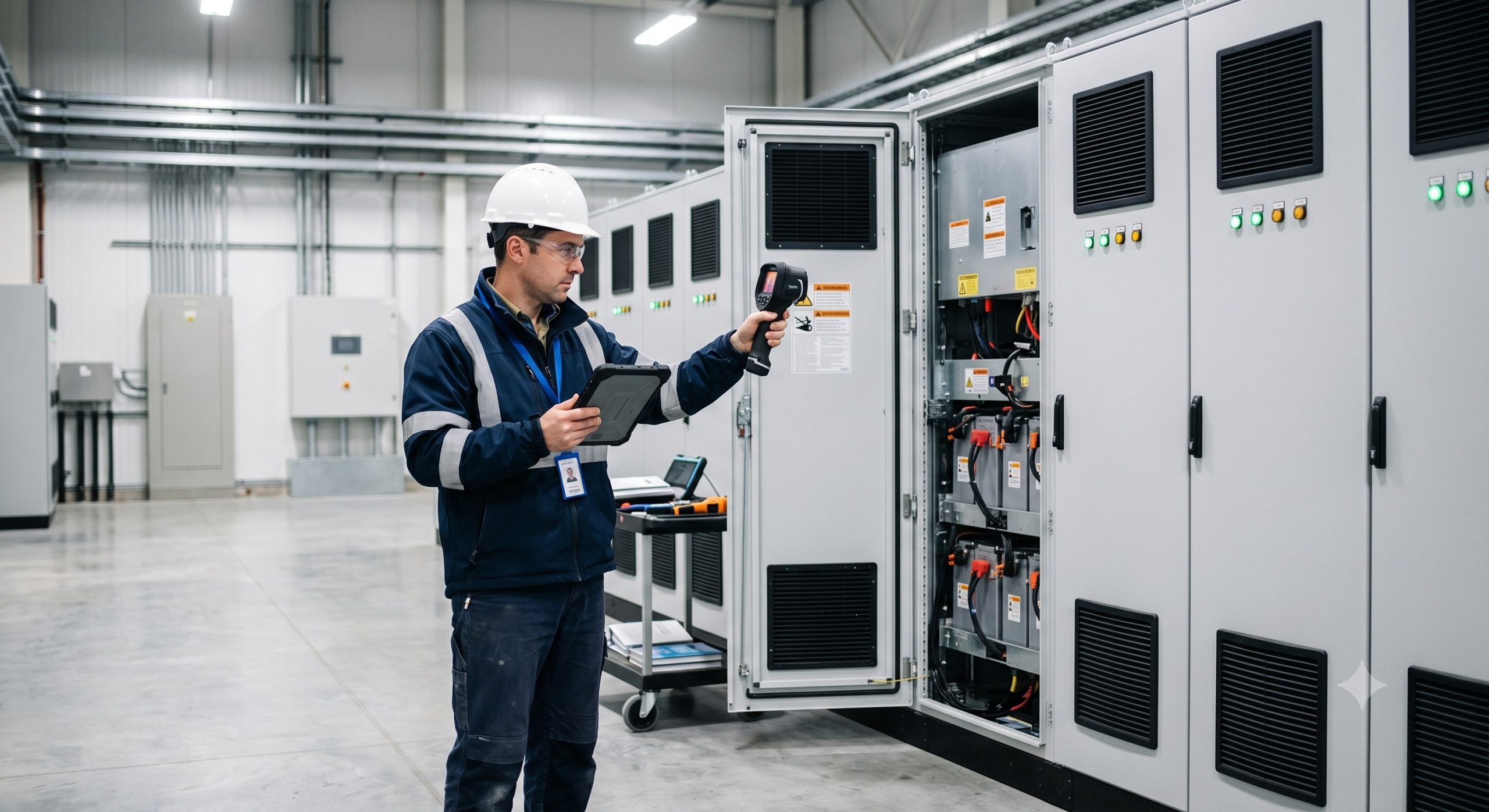
- The recommended maintenance interval is every 12 months or after 500 full-load cycles, whichever comes first. End-of-life is indicated by a contact resistance increase exceeding 20% above initial factory value (measured via micro-ohm meter), visible pitting or blackening on contact surfaces, or a temperature rise above 55°C at rated current during thermal imaging. Replacement is mandatory when any single indicator is observed. Field data shows premium connectors achieve 10,000 mating cycles or 15 years of service life under normal operating conditions.
- Q4: What international standards and certifications must a high-current connector have for BESS integration?
- For BESS integration, a high-current connector must hold UL 4128 (energy storage connector standard), IEC 61984 (connector safety requirements), and UL 94 V-0 (flame rating for housing materials). Additionally, the complete connector assembly requires IEC 60529 IP rating certification, UL 1977 for current-carrying components, and for European projects, CE marking under Low Voltage Directive 2014/35/EU and RoHS 3 compliance. For marine or offshore BESS, DNV-GL type approval is also mandatory. Always request third-party test reports, not just supplier self-declarations.
- Q5: How do I calculate ROI when upgrading from lug-and-bolt connections to a high-current connector system?
- ROI calculation follows the formula: (Annual maintenance savings + Downtime cost avoidance + Energy loss reduction) ÷ Total upgrade investment. A typical 10MWh BESS using lug-and-bolt connections incurs $8,000/year in manual torque checks and thermal scans, plus $15,000/year in energy loss from 1.5% higher contact resistance, and $50,000 per unplanned outage (average 1.5 outages/year). Switching to a high-current connector system costs $12,000 one-time, reduces energy loss to 0.3%, cuts maintenance to $1,500/year, and eliminates outage risk, yielding a 4.2x first-year ROI and sub-8 month payback period.
- Q6: Can high-current connectors support both grid-tie and off-grid islanding configurations?
- Yes, a single high-current connector family can support both grid-tie and off-grid configurations when specified with dual-voltage insulation (1000V DC for grid-tie, 1500V DC for off-grid islanding with longer feeder runs). For seamless switching between modes, select connectors with integrated auxiliary contacts that signal the BMS and PCS about connector mating status. For off-grid microgrids, additional ingress protection (IP67 minimum) and salt-spray corrosion resistance (ISO 9227: 720 hours) are required due to often harsher environmental placement outside climate-controlled buildings.
- Q7: What BMS monitoring parameters are accessible through a smart high-current connector interface?
- A smart high-current connector provides real-time BMS access to four critical parameters: contact temperature (via embedded NTC thermistor, ±2°C accuracy), current flow (via hall-effect sensor integrated into connector housing, ±1% accuracy), total cumulative energy throughput (in MWh, non-resettable), and mating cycle count (hall-effect switch detecting full insertion). These parameters are transmitted via CANbus 2.0 or RS-485 Modbus RTU protocol on dedicated low-current auxiliary pins, enabling predictive maintenance alerts when temperature trends exceed historical norms by 15% or when 80% of rated mating cycles are reached.
- Q8: What are the lead times and O&M support terms for wholesale high-current connector orders?
- Wholesale lead times for high-current connectors range from 2 weeks (standard 200A-350A models, stock orders over 500 units) to 8 weeks (custom cable lengths, IP68 versions, or 500A+ ratings). Turnkey O&M support includes a 10-year performance warranty (contact resistance remains within 110% of initial value), 48-hour advanced replacement for any connector showing thermal or electrical anomalies, and quarterly remote monitoring reports when integrated with BMS data. For global deployment, suppliers must provide local stocking hubs in North America, Europe, and Southeast Asia to avoid sea freight delays exceeding 5 business days.