Overview
When evaluating a Ring Terminal Battery Energy Storage System (BESS) for C&I or utility applications, procurement engineers and financiers need precise technical answers—not marketing fluff. This FAQ addresses pre-sales sizing, post-sales BMS diagnostics, thermal runaway prevention, and total cost of ownership (LCOE) to support your investment case.
Frequently Asked Questions
- Q1: What is the guaranteed cycle life and maximum DoD for Ring Terminal LFP cells?
- The standard cycle life of Ring Terminal LFP cells is ≥6,000 cycles at 90% depth of discharge (DoD) under 25°C ±2°C ambient, extending to 8,000 cycles at 80% DoD. This is achieved via tier-1 prismatic LFP chemistry with ≤2% annual capacity fade when paired with active liquid cooling that maintains cell deltas below 3°C.
- Q2: How does the Ring Terminal liquid cooling system prevent thermal runaway?
- Thermal runaway prevention relies on three layers: (1) individual cell voltage/temp sensors reporting every 100ms to the BMS, (2) dielectric coolant circulating through aluminum cold plates that extract heat at ≤0.5°C/sec rise, and (3) per-module aerosol fire suppression with exhaust ducts. UL 9540A testing confirms no propagation between adjacent modules after cell rupture.
- Q3: Can Ring Terminal cabinets scale from 500kWh to 10MWh without replacing the PCS?
- Yes. Parallel cabinet connectivity uses a common DC busbar link supporting up to 20 cabinets per 2MW PCS. The EMS automatically redistributes charge/discharge commands via CAN 2.0 communication. For expansion, you add cabinets with identical voltage windows (600-1500Vdc) and the existing bi-directional inverter adjusts current limits via firmware—no hardware rip-and-replace.
- Q4: What BMS parameters can I monitor remotely for post-sales diagnostics?
- Remote monitoring via Modbus TCP/RTU or optional 4G gateway provides real-time visibility into: cell min/max voltage (accuracy ±5mV), state of charge (SOC) with coulomb counting, internal resistance deviation %, contactor weld detection, insulation resistance (threshold <1MΩ triggers alarm), and per-string thermal gradient maps. Historical logs export in CSV for predictive maintenance models.
- Q5: How do I calculate ROI and LCOE for a peak shaving application with Ring Terminal?
- Use: LCOE ($/kWh) = (CAPEX + 10-year OPEX) / (cycle life x DoD% x nameplate capacity x round-trip efficiency). For a 1MWh Ring Terminal system at $300/kWh CAPEX, 6,000 cycles, 90% DoD, 92% RTE, and $25/kWh annual O&M: total lifetime throughput = 1,000kWh x 0.90 x 6,000 x 0.92 = 4,968,000 kWh. LCOE = ($300k + $25k*10) / 4.968M = $0.110/kWh. Compare to local peak demand charges (often $15-25/kW) and arbitrage spreads.
- Q6: What grid-tie certifications and off-grid islanding capabilities does Ring Terminal provide?
- Ring Terminal cabinets are UL 9540 (2023 edition) and UL 1973 certified, IEC 62619, and CE. For grid-tie, the PCS includes IEEE 1547-2018 frequency-watt and volt-var functions. Seamless off-grid islanding (transfer time <40ms) requires an external automatic transfer switch (ATS) and a genset or renewable source to form the grid reference; the BESS can then operate in voltage source mode (VF) supporting 100% unbalanced loads.
- Q7: What fire safety protocols activate before thermal runaway?
- Three progressive stages: (1) Gas detection (CO, H2, VOC) at 50ppm triggers ventilation and BMS current limit to 0.2C. (2) Smoke detection within any module disconnects the contactor and activates per-module aerosol generators (Novec 1230 or equivalent) within 2 seconds. (3) If cell voltage drops >0.5V/sec, the central controller sends remote alarm plus local strobe and closes fire dampers per NFPA 855.
- Q8: What does the 10-year warranty cover, and what local service support is included?
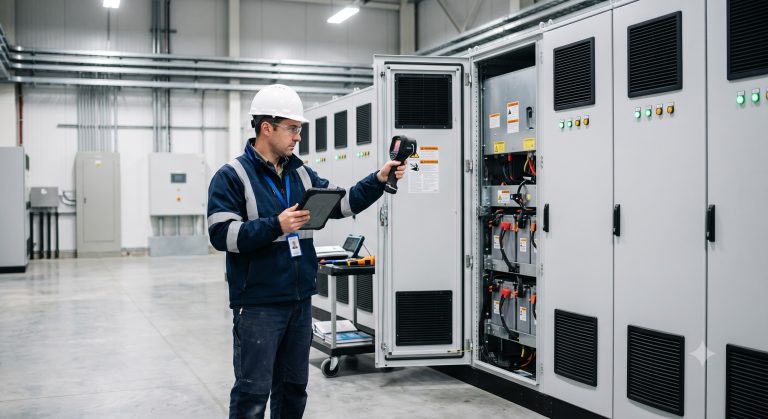
- The standard warranty covers: ≥70% remaining nameplate capacity after 10 years or 6,000 cycles (whichever first), replacement of any cell with >20% internal resistance increase, and BMS/PCS electronics defects. Local lifecycle service includes an on-site annual inspection (thermal imaging of terminals, torque check on ring lugs, firmware updates) and 48-hour remote technical support with a regional spare parts depot. Extended O&M contracts are available for 24/7 NOC monitoring.