Introduction: The Compliance Imperative in Global BESS Deployment
The commercial and industrial (C&I) energy storage market has reached an inflection point where regulatory compliance is no longer a checkbox exercise but a fundamental pillar of project bankability and operational safety. According to industry data, over 160 safety incidents have been recorded in electrochemical energy storage facilities globally, prompting regulators across North America, Europe, and Asia to tighten certification requirements for Battery Energy Storage Systems (BESS).
For B2B procurement professionals, EPC contractors, and system architects, understanding the intricate landscape of international energy storage standards is essential for mitigating risks, securing insurance coverage, and ensuring seamless grid interconnection. This comprehensive guide examines the critical standards governing lithium-ion battery safety, thermal runaway propagation prevention, transportation compliance, and grid-tie requirements that define the modern C&I energy storage ecosystem.
Core Architecture: Understanding the Standards Hierarchy
The Three-Tier Standards Framework
International energy storage standards operate across three distinct but interconnected levels: cell-level safety, system-level integration, and installation-level fire protection. This hierarchical approach ensures comprehensive risk mitigation from the fundamental electrochemical unit through to the complete deployed system.
At the foundation lies IEC 62619:2022, which specifies requirements and tests for the safe operation of secondary lithium cells and batteries used in industrial applications, including stationary energy storage systems. This standard addresses critical safety considerations such as thermal abuse tolerance, overcharge protection, and mechanical integrity under foreseeable misuse conditions.
Moving up the hierarchy, UL 9540 serves as the primary North American safety standard for energy storage systems and equipment, encompassing the complete assembly including battery modules, Power Conversion Systems (PCS), and Battery Management Systems (BMS). This standard is complemented by UL 9540A, which specifically evaluates thermal runaway fire propagation characteristics and generates data used to determine separation distances and fire protection requirements.
Regional Regulatory Divergence
The global standards landscape reveals significant regional variations that B2B buyers must navigate. In the United States, NFPA 855 (Standard for the Installation of Stationary Energy Storage Systems) provides prescriptive requirements for system spacing, ventilation, and fire suppression. Meanwhile, the European Union has introduced the EU Sustainable Batteries Regulation (EU) 2023/1542, which mandates carbon footprint declarations and recycled content disclosure for industrial batteries exceeding 2 kWh capacity.
China has recently implemented GB/T 51048-2025, the updated design standard for electrochemical energy storage stations, which explicitly prohibits lithium-ion battery facilities from being located underground or semi-underground, and mandates automatic fire suppression systems with gas detection integration.
Safety Standards Deep Dive: IEC 62619 and UL 9540A
IEC 62619:2022 Testing Protocols
The second edition of IEC 62619, published in May 2022, represents a significant evolution from the 2017 version, incorporating lessons learned from field deployments and laboratory testing. The standard encompasses a comprehensive test regime including:
- Thermal Abuse Test: Cells are subjected to elevated temperatures to evaluate thermal stability and venting behavior
- Overcharge Protection: Verification that battery systems safely interrupt charging when voltage limits are exceeded
- Internal Short Circuit: Assessment of cell-level protection mechanisms
- Mechanical Abuse: Drop, impact, and vibration testing to simulate transportation and installation stresses
For C&I applications, the standard requires that battery systems incorporate multi-level protection architectures, including cell-level fusing, module-level monitoring, and system-level disconnect capabilities.
UL 9540A Thermal Runaway Evaluation
The ANSI/CAN/UL 9540A:2026 standard provides the definitive test methodology for evaluating thermal runaway fire propagation in battery energy storage systems. This large-scale fire testing generates critical data that informs:
- Minimum separation distances between individual BESS units
- Fire suppression system design requirements
- Deflagration (explosion) prevention measures
- Emergency response planning documentation
The test methodology progresses through cell-level, module-level, unit-level, and installation-level evaluations, with the option to extrapolate results if lower-tier testing demonstrates adequate containment. For liquid-cooled BESS systems, the thermal management architecture plays a critical role in limiting propagation potential.
Technical Specifications
The following specification matrix represents current industry benchmarks for tier-1 commercial and industrial energy storage systems, incorporating the latest LFP (Lithium Iron Phosphate) cell technology and thermal management innovations.
| Key Parameter | Technical Specification |
|---|---|
| Battery Chemistry | Tier-1 LFP (Lithium Iron Phosphate) |
| Nominal Capacity | 255 kWh – 313 kWh (modular scalable to 5+ MWh) |
| Cycle Life | >8,000 cycles @ 90% DoD (standard); >12,000 cycles (ultra version) |
| Round-Trip Efficiency | >90% |
| Depth of Discharge (DoD) | 95% on-grid / 90% off-grid |
| Thermal Management | Fully liquid-cooled architecture |
| Operating Temperature | -30°C to +50°C ambient |
| Ingress Protection | IP55 (enclosure/PCS), IP67 (battery pack) |
| Certification | IEC 62619, UL 9540, UL 9540A, UN 38.3, CE |
Transportation Compliance: UN 38.3 and Global Logistics
The UN 38.3 Testing Regime
Lithium batteries are classified as dangerous goods for transportation purposes, requiring compliance with UN Manual of Tests and Criteria, Sub-section 38.3. This standard applies to all modes of transport including air, sea, and ground, with the following critical test protocols:
- T1 Altitude Simulation: Low-pressure testing at 11.6 kPa to simulate unpressurized aircraft cargo holds
- T2 Thermal Test: Cycling between +72°C and -40°C for 10 cycles to assess temperature resilience
- T3 Vibration: Sine sweep testing from 7Hz to 200Hz across three perpendicular axes
- T4 Shock: Half-sine pulse testing at 150G/6ms for small cells and 50G/11ms for large cells
- T5 External Short Circuit: Terminal shorting at +55°C with pass criteria requiring case temperature below +170°C
- T7 Overcharge: Charging at 2x recommended current for 24 hours with 7-day monitoring period
For B2B procurement, it is essential to verify that the UN 38.3 test summary references the specific cell design used in production, as cell substitution without updated documentation represents a significant compliance risk.
Documentation Requirements
Complete transportation compliance requires four essential documents originating from the manufacturing facility:
- UN 38.3 Test Summary: Standardized format with authorized signatory
- Safety Data Sheet (SDS): Finished-product SDS in destination market language
- Battery Specification Sheet: Documenting chemistry, energy content, voltage, and dimensions
- UN Packaging Marking: Class 9 label and compliant outer packaging
Grid-Tie Compliance and Fire Safety Integration
Electrical Grid Interconnection Standards
Beyond battery safety, grid-connected BESS must comply with electrical interconnection requirements. In North America, IEEE 1547 and UL 1741 define the requirements for distributed energy resources interconnection. These standards address:
- Voltage and frequency ride-through capabilities
- Anti-islanding protection requirements
- Power quality and harmonic limits
- Communication and control interfaces
For grid-forming applications, emerging standards are defining requirements for black start capability, frequency regulation, and voltage support functions. Testing protocols developed by NERC in the United States and ESO in Europe provide frameworks for validating these advanced grid support functions.
Fire Suppression System Design
Modern C&I energy storage systems incorporate multi-layer fire protection strategies that align with both UL 9540A test data and NFPA 855 installation requirements. Typical protection architectures include:
- Temperature Detection: Distributed sensors monitoring cell and module temperatures
- Smoke Detection: Early warning systems for off-gassing detection
- Combustible Gas Detection: Hydrogen and volatile organic compound sensors
- Aerosol Suppression: Dual-level aerosol fire suppression systems
- Water-Based Firefighting: Integrated water mist or deluge connections
- Explosion Venting: Pressure relief mechanisms for deflagration prevention
These systems must be validated through large-scale fire testing per UL 9540A to ensure effectiveness under realistic thermal runaway conditions.
Deployment Scenarios and Compliance Strategy
Industrial Park and Manufacturing Facility Integration
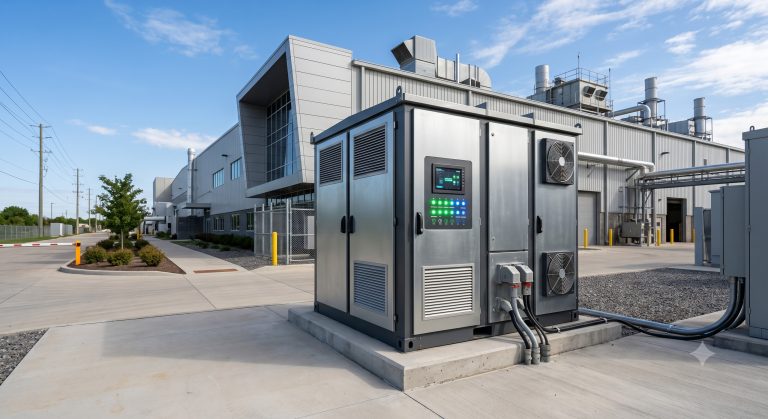
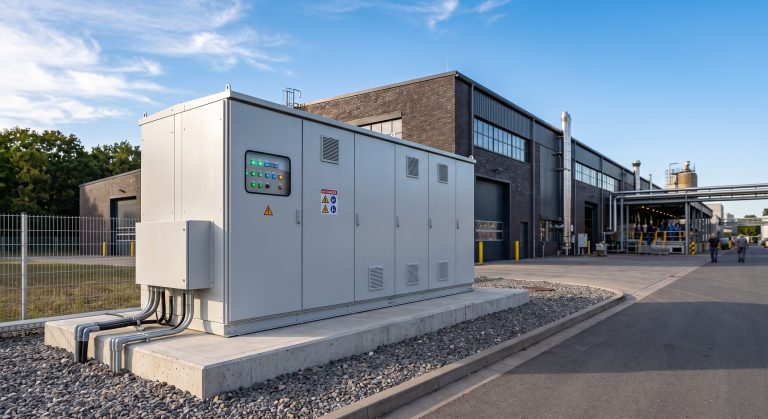
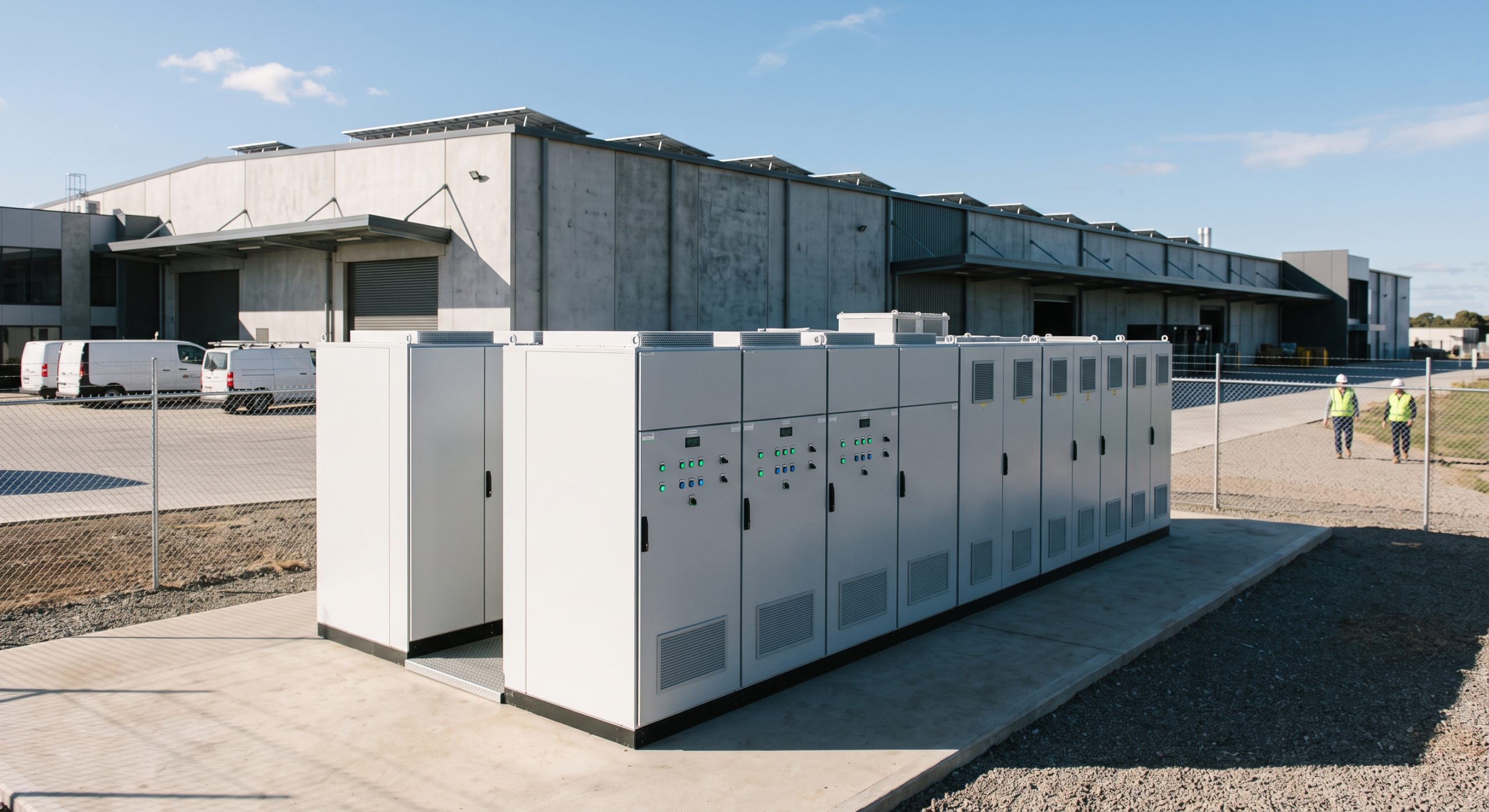
For industrial parks deploying modular BESS configurations, compliance strategy must address the specific regulatory environment of the installation jurisdiction. Key considerations include:
- Local Fire Code Adoption: Verification that the AHJ (Authority Having Jurisdiction) has adopted NFPA 855 or equivalent
- Separation Distance Calculation: Based on UL 9540A test data for the specific system configuration
- Water Supply Requirements: Fire flow calculations for suppression system demand
- Emergency Response Planning: Documentation and training for facility personnel
EV Supercharging Station Integration
The integration of BESS with EV supercharging infrastructure introduces additional compliance considerations. The emerging Chinese standard T/CES 398-2025 specifically addresses “PV-Storage-Charging-Detection-Discharge” integrated energy stations, requiring:
- Energy storage system rated power ≥ 100 kW and capacity ≥ 200 kWh
- Cycle life ≥ 6,000 cycles
- Response time ≤ 100 milliseconds
- Three-level battery safety protection with thermal runaway warning
- Automatic charge power limitation when battery State of Health (SOH) falls below 80%
These requirements ensure that BESS-integrated charging infrastructure maintains safety and reliability under the high-cycling demands of commercial EV charging operations.

Factory Acceptance Testing and Quality Assurance
Critical FAT Protocols
Before shipment, C&I energy storage systems should undergo comprehensive Factory Acceptance Testing (FAT) to verify compliance with applicable standards. Essential tests include:
- Short Circuit and Insulation Testing: Verification of protection against electrical faults
- Performance Testing: Confirmation of rated capacity, round-trip efficiency, and response time
- Ingress Protection Testing: IP rating verification through water spray testing
- BMS Functionality Testing: Cell balancing, SOC/SOH estimation, and protection activation
- Thermal Management Validation: Liquid cooling system pressure and flow verification
Third-Party Certification
For B2B procurement, requiring third-party certification from recognized testing organizations such as TÜV, UL, or Intertek provides independent verification of compliance claims. Certificates should be verified for:
- Currency and validity period
- Specific product model coverage
- Test laboratory accreditation (ISO 17025)
- Scope alignment with intended application
Conclusion: Strategic Compliance for Global Market Access
Navigating the complex landscape of international energy storage standards requires a strategic approach that integrates compliance planning from project inception. The convergence of IEC 62619 for cell-level safety, UL 9540 for system-level certification, UL 9540A for thermal runaway evaluation, and UN 38.3 for transportation compliance creates a comprehensive safety framework that protects assets, ensures insurability, and facilitates global market access.
For B2B buyers and system integrators, prioritizing standards compliance is not merely a regulatory obligation but a competitive advantage. Certified systems command higher resale values, qualify for enhanced warranty terms, and demonstrate the engineering rigor that institutional investors and insurers demand. As the energy storage industry matures, adherence to international standards will increasingly differentiate tier-1 suppliers from commodity providers.
The future of commercial energy storage lies in harmonized standards that enable seamless deployment across borders while maintaining the highest safety and performance benchmarks. Organizations that invest in understanding and exceeding these requirements will be positioned to capture the enormous opportunities presented by the global energy transition.