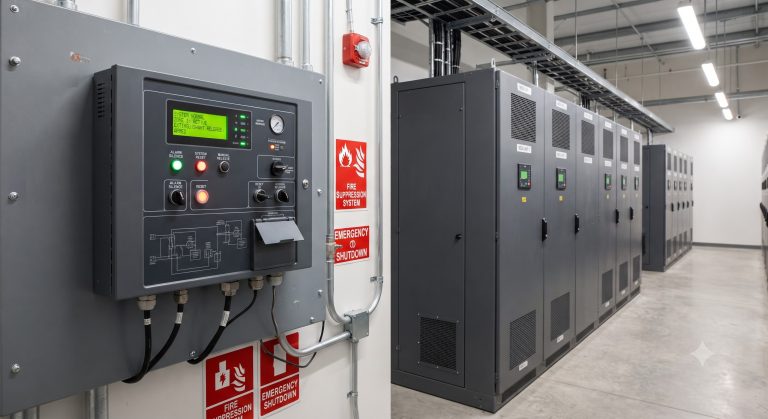
Overview
Battery terminal lugs are the most failure-critical mechanical junction in any BESS (Battery Energy Storage System). A single high-resistance lug can cause thermal runaway, BMS misreading, or string imbalance. This FAQ covers pre-sales engineering specs (tinning, plating, ampacity) and post-sales field support (corrosion, torque, UL 486A-B standards) for commercial & industrial energy storage deployments.
Frequently Asked Questions
- Q1: What tin plating thickness on a battery terminal lug prevents galvanic corrosion in a BESS?
- Minimum 8 microns (316 µ-in) of pure matte tin plating is required for BESS battery terminal lugs when mating with aluminum or copper busbars. Thinner plating (3-5 microns) cracks under thermal cycling (daily -20°C to +55°C), exposing copper to aluminum and triggering galvanic corrosion within 6 months. For marine or coastal BESS, specify 12+ microns with nickel underplating.
- Q2: How do I calculate the required lug ampacity for a 200Ah LFP cell string?
- Multiply continuous charge/discharge current by 1.25 (NEC 125% safety factor). For a 200Ah LFP cell with 1C rate (200A), spec a battery terminal lug rated at 250A at 90°C insulation class. For 2-hour peak shaving (200A/400A surge), the lug must handle 500A for 10 seconds without exceeding 105°C terminal rise. Always use NEC Table 310.15(B)(16) copper lug ampacity derated for 75°C column.
- Q3: What crimp force and die indentation depth ensures UL 486A-B compliance for BESS power cables?
- UL 486A-B requires a crimp force of 10-15 tons for 4/0 AWG copper battery terminal lugs, with die indentation depth between 0.040-0.060 inches. The pull-out force must exceed 1,100 lbf (4/0 AWG) without conductor breakage. For BMS sensing wires (18-12 AWG), use parallel indent crimpers at 0.020-0.035 depth. Always perform a micro-ohm resistance test post-crimp: target below 50 µΩ for main power lugs.
- Q4: Why do my BMS over-temperature alarms trigger at the lug terminal but not the cell core?
- This indicates a high-resistance battery terminal lug joint. Common root causes: under-torqued bolt (spec torque 12-15 Nm for M8 lugs), missing Belleville washer (no vibration retention), or improper wire strand seating inside the barrel. Measure voltage drop across the lug interface: >15mV at 200A confirms bad crimp. Field fix: re-torque to spec, apply antioxidant paste (Noalox), and retest with thermal camera (max delta T <8°C above ambient).
- Q5: What’s the difference between standard copper and bi-metallic battery terminal lugs for LiFePO4 systems?
- Bi-metallic lugs have an aluminum pad (for battery post) friction-welded to a copper barrel (for tinned copper cable). They are mandatory when connecting copper cables to aluminum battery terminals (common in prismatic LFP cells over 280Ah). Standard copper lugs on aluminum cause galvanic corrosion within 12-18 months. For tier-1 BESS, always use bi-metallic lugs with ISO 9001:2015 traceability and 1,000-hour salt spray certification (ASTM B117).
- Q6: How often should battery terminal lug torque be re-checked in grid-tie energy storage?
- Re-torque at 72 hours, 30 days, then annually for grid-tie BESS with daily cycling (1 cycle/day). Vibration from contactors and thermal expansion loosens M8-M10 lug bolts by 20-30% Nm within first week. Use a calibrated torque wrench at 75% of dry torque value (lubricated: 10 Nm for M8). For off-grid solar-storage with genset backup, re-torque quarterly due to wider temperature swings (-10°C to +60°C).
- Q7: Do battery terminal lugs require UL 4128 or UL 486A-B listing for fire safety?
- UL 486A-B (Wire Connectors & Soldering Lugs) is the minimum standard for BESS battery terminal lugs. However, for BESS racks over 50 kWh (UL 9540A fire testing), specify UL 4128 (Battery Connectors) which adds 1,000-amp fault current withstand, 500-cycle thermal stress, and flame retardance V-0 per UL 94. No UL listing = voided insurance and interconnection agreement.
- Q8: Can I mix tin-plated and bare copper lugs on the same BESS DC busbar?
- Never mix bare copper with tin-plated battery terminal lugs on the same busbar. Dissimilar metals (Cu vs Sn) accelerate galvanic corrosion, especially in high-humidity enclosures (>70% RH). Always standardize on matte tin-plated lugs (8+ microns) for all battery connections. For nickel-plated cells (rare), use nickel-plated lugs only. Mixed plating voids warranty from all tier-1 BMS and PCS manufacturers.