Introduction: The Economic Imperative of Energy Storage
In the current landscape of volatile energy markets and escalating commercial electricity tariffs, the financial case for deploying a Commercial and Industrial (C&I) Battery Energy Storage System (BESS) has never been more compelling. For facility managers and energy procurement directors, the core question is no longer if they should adopt storage, but how to accurately quantify the return on investment. A robust Energy storage ROI calculation transcends simple payback periods; it demands a comprehensive Total Cost of Ownership (TCO) analysis that evaluates granular factors such as system architecture, thermal management efficiency, operational dispatch strategies, and long-term degradation patterns. This guide provides a system architect’s blueprint for financial success.
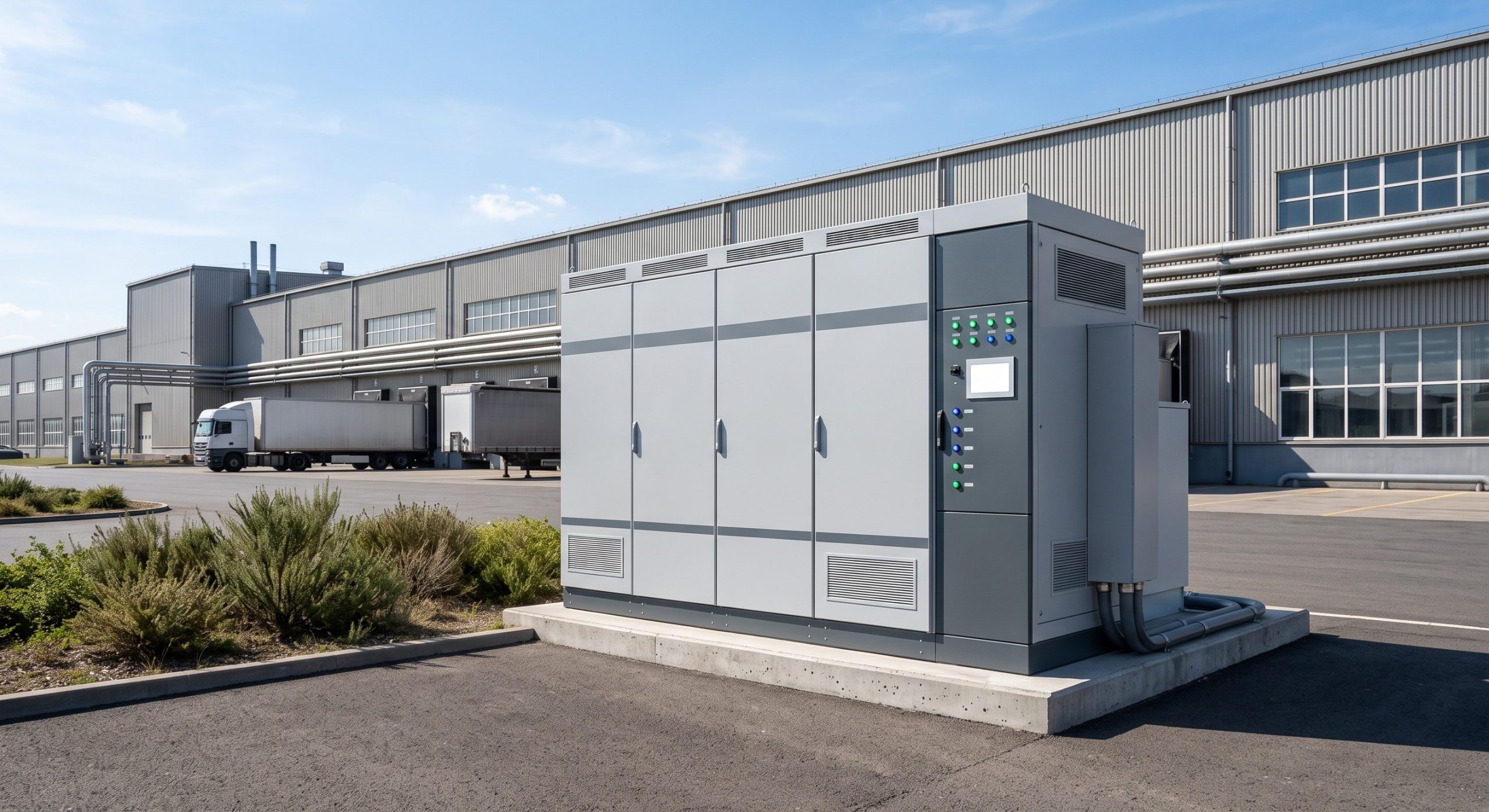
Core Architecture & Battery Management: The Foundation of ROI
The foundational architecture of a BESS significantly influences both upfront capital expenditure (CapEx) and operational expenditure (OpEx). A sophisticated Energy storage ROI calculation must account for the interplay between key hardware components and their performance metrics.
Power Conversion System (PCS) & Battery Management System (BMS)
The PCS is the interface between the battery and the grid or facility load, responsible for AC/DC conversion and power quality. High-efficiency bi-directional PCS units, achieving a peak efficiency of over 98.5%, maximize round-trip efficiency, a critical variable in the ROI equation. Concurrently, the BMS is the neural network of the system, ensuring cell-level safety and longevity. An advanced BMS monitors voltage, current, and temperature across thousands of cells, performing passive or active balancing to mitigate cell inconsistency, which directly impacts capacity fade. Systems incorporating AI-driven BMS algorithms can predict maintenance needs and optimize charge/discharge profiles, thereby enhancing the Energy storage ROI calculation by extending usable life.
Thermal Control: Liquid Cooling vs. Air Cooling
Thermal management is paramount for maintaining optimal battery performance and lifecycle. Air cooling systems, while simpler and lower in initial cost, often struggle to maintain uniform temperatures in high-density or high-discharge scenarios, leading to hotspots and accelerated degradation. Conversely, liquid cooling thermal control offers superior heat dissipation and temperature uniformity, keeping cells within a narrower, optimal operating temperature range. This precision is crucial for achieving the advertised cycle life, reducing auxiliary power consumption, and ensuring consistent performance, all of which provide a tangible boost to the Energy storage ROI calculation.
Cell Chemistry and Cycle Life
Tier-1 LFP (Lithium Iron Phosphate) battery cells are the industry standard for C&I applications due to their inherent safety, long calendar life, and high cycle count. The Depth of Discharge (DoD) and cycle life are intrinsically linked; for example, operating at a 90% DoD might yield 6,000 cycles, whereas operating at 80% DoD could extend cycle life to over 8,000 cycles. This trade-off is a critical financial lever. A comprehensive Energy storage ROI calculation must model the degradation curve to determine the optimal DoD that balances immediate peak-shaving capacity against long-term asset lifespan, directly influencing the amortized cost of storage per kWh.
Technical Specifications: A Data-Driven Evaluation
To ground the Energy storage ROI calculation in verifiable facts, it is essential to reference a system’s core technical parameters. The table below outlines the key specifications that define a modern, high-performance C&I ESS and are pivotal to the financial analysis.
| Key Parameter | Technical Specification |
|---|---|
| Battery Chemistry | Tier-1 LFP (Lithium Iron Phosphate) |
| Cell Capacity | e.g., 280Ah or 306Ah Prismatic Cells |
| System Capacity | Configurable from 100 kWh to 5 MWh+ per unit |
| Nominal Voltage | e.g., 768Vdc to 1331.2Vdc |
| Cycle Life (@ 90% DoD) | >6,000 cycles (EOL at 80% SOH) |
| Round-trip Efficiency | >92% (including auxiliary power at rated power) |
| Thermal Management | Liquid Cooling (Advanced) or Intelligent Air Cooling |
| Operating Temperature Range | -20°C to 55°C (with derating) |
| Protection Degree | IP54 (Outdoor) / IP20 (Indoor) |
| Safety Certifications | Compliant with IEC 62619, UL 9540A, CE, UN38.3 |
Commercial ROI & Grid Support: Beyond Peak Shaving
While peak-shaving—the reduction of demand charges—is the primary driver for C&I storage, a comprehensive Energy storage ROI calculation must incorporate multiple revenue and savings streams to build a robust business case.
Demand Response and Utility Incentives
Beyond mitigating peak demand charges, a BESS can participate in demand response (DR) programs offered by utilities or grid operators. By discharging stored energy during grid stress events, facility owners can secure substantial incentive payments. The system’s smart EMS dispatch is central to this, enabling automated bidding and real-time response to grid signals. Including these recurring revenue streams in the Energy storage ROI calculation can shorten the simple payback period by 1-3 years, transforming the asset from a cost-saving tool into a profit center.
Energy Arbitrage
In markets with time-of-use (TOU) tariffs with significant price spreads, the system can arbitrage energy by charging during low-cost off-peak periods and discharging during high-cost on-peak periods. The viability of this strategy hinges entirely on the system’s round-trip efficiency; a higher efficiency (e.g., >92%) means a greater fraction of the stored energy can be monetized, directly amplifying the Energy storage ROI calculation.
PV-Storage-Charging Synergy
The integration of BESS with on-site solar PV and EV charging infrastructure creates a powerful microgrid. A C&I facility can store excess solar energy generated during the day to power operations during evening peak hours or to support an EV supercharging station. This PV-Storage-Charging synergy maximizes the self-consumption of renewable energy, reduces grid reliance, and can generate additional revenue from EV charging services, making the Energy storage ROI calculation significantly more attractive.
Deployment Scenarios: Maximizing Facility Resilience
The true value of a BESS is demonstrated across diverse commercial and industrial deployment scenarios. Each scenario presents unique challenges and opportunities that shape the final Energy storage ROI calculation.

Industrial Parks and Manufacturing Facilities
Manufacturing plants often have high, consistent base loads and short, intense power spikes from heavy machinery. A BESS can effectively flatten the load curve, reducing the maximum demand charge on the utility bill. Furthermore, it provides backup power protection, safeguarding critical equipment and preventing costly production downtime from grid disturbances. The Energy storage ROI calculation here heavily weighs the cost of a production stop versus the cost of the system.
Data Centers and Critical Infrastructure
For data centers, power quality and reliability are paramount. The BESS’s rapid response (< 20ms) can act as an uninterrupted power supply (UPS), bridging the gap between utility failure and diesel generator startup. Additionally, these systems enhance sustainability metrics, a key driver for corporate ESG goals. The Energy storage ROI calculation for data centers often includes risk mitigation and uptime guarantees as quantifiable financial benefits.
EV Supercharging Stations
The combination of high-power EV chargers and BESS is a rapidly growing sector. The battery buffers the incoming grid supply, allowing for more chargers to be deployed without expensive grid upgrades. It also enables peak-shaving against the high demand charges associated with ultra-fast charging, presenting a clear and compelling case in the Energy storage ROI calculation.
Conclusion
Mastering the Energy storage ROI calculation is the key to unlocking the full economic potential of commercial and industrial energy storage. It is a multifaceted analysis that goes beyond surface-level savings, requiring a deep understanding of the system architecture, advanced thermal controls, and the strategic integration of multiple revenue streams. By adopting a total cost of ownership approach and leveraging high-quality, proven components, businesses can not only decarbonize their operations but also secure a resilient and highly profitable energy future. The time to quantify your energy advantage is now.