
COMMERCIAL SYSTEMS ENGINEERING REFERENCE MANUAL: LITHIUM CELL CHEMISTRY PARAMETER GUIDE
EXECUTIVE SUMMARY
This document serves as the definitive technical reference for the electrochemical parameters governing the Tier-1 Lithium Iron Phosphate (LFP) cells deployed within our commercial energy storage systems. As a cornerstone of our commitment to safety, longevity, and performance, this guide provides system integrators, facility engineers, and procurement specialists with the critical data required for system modeling, thermal management design, and operational strategy development. The parameters detailed herein are derived from extensive cycle life testing, accelerated aging models, and real-world fleet data, ensuring a robust foundation for high-availability BESS deployments.

SYSTEM ARCHITECTURE & SAFETY
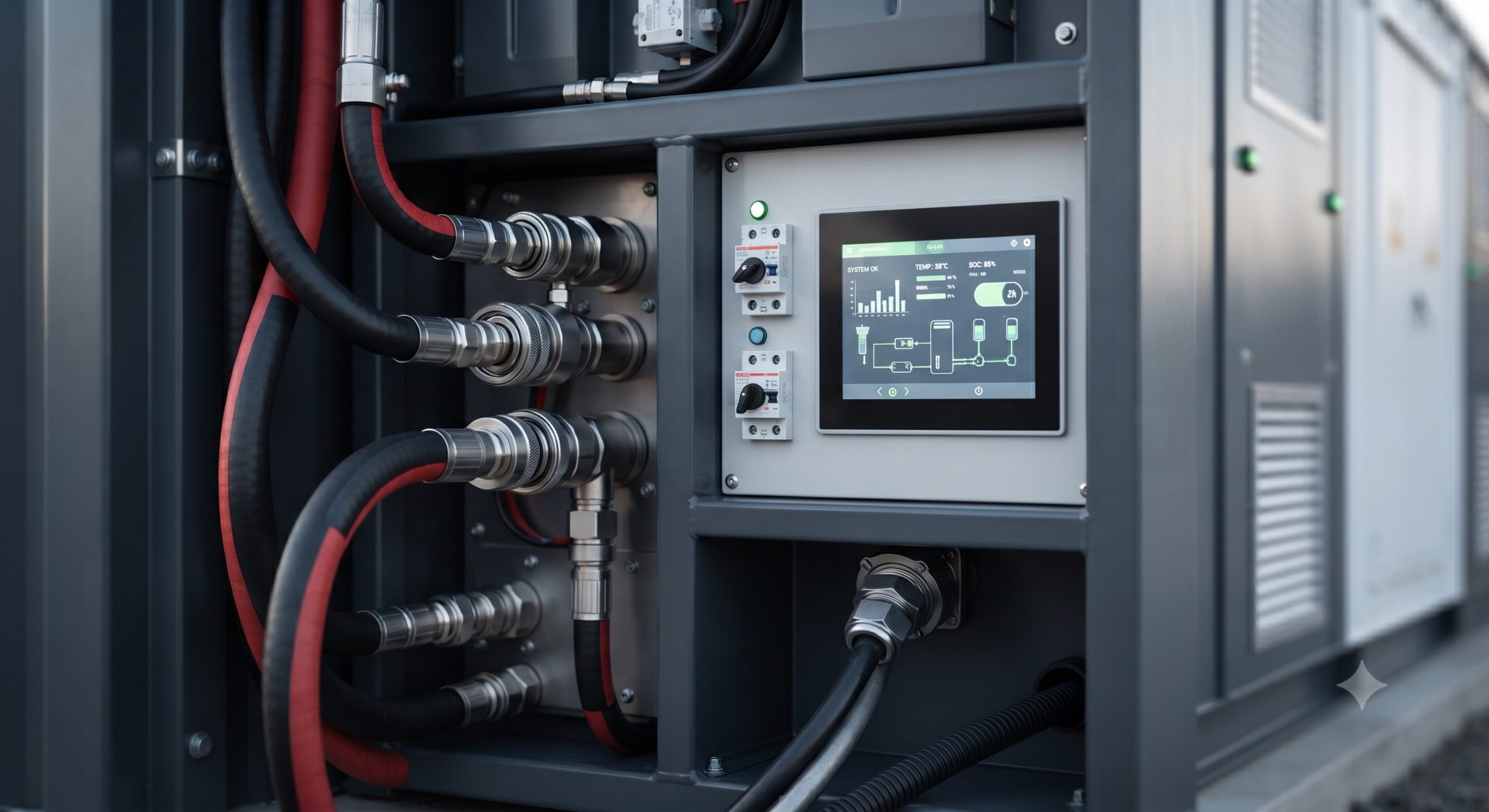
The core of our platform is built upon a prismatic LFP cell architecture, renowned for its superior thermal stability and flat voltage discharge curve. Safety is paramount and is architecturally embedded at the cell level through a ceramic separator and a robust venting mechanism designed to prevent thermal propagation. The cell modules are integrated into a high-voltage battery rack, managed by a triple-layer Battery Management System (BMS) that monitors voltage, current, and temperature at the cell level. This data feeds into a predictive algorithm for State of Charge (SoC) and State of Health (SoH) estimation, ensuring operation within a strict Safe Operating Area (SOA) that maximizes cycle life while preemptively mitigating any anomalous behavior.
KEY FEATURES
– High Cycle Life: Delivers >8,000 cycles at 80% Depth of Discharge (DoD) with <20% capacity degradation, ensuring a 15+ year operational lifespan for most commercial applications.
- Superior Thermal Stability: LFP chemistry provides an intrinsically high thermal runaway threshold (>500°C), reducing the need for aggressive active cooling and enhancing overall system safety.
– High Round-Trip Efficiency: Achieves a round-trip efficiency (RTE) of >95% at nominal power, minimizing operational energy losses and maximizing arbitrage revenue for customers.
– Flat Discharge Curve: The inherent voltage plateau provides stable power output over the majority of the discharge cycle, simplifying inverter control and grid interface management.
COMPLIANCE & STANDARDS
The cell chemistry and the entire system architecture are designed and validated to meet the most stringent global safety and performance standards. Our compliance framework ensures seamless project approval and insurability.
– UL 9540A: Thermal Runaway Fire Propagation Test (Tested and compliant at the module and system level).
– IEC 62619: Requirements for secondary cells and batteries for electrical energy storage systems.
– UN 38.3: Transportation safety testing for lithium batteries.
– UL 1973: Standard for Batteries for Use in Stationary, Vehicle, and Auxiliary Power Applications.
– RoHS & REACH: Fully compliant with environmental and chemical substance regulations.
TECHNICAL SPECIFICATIONS
The following parameters represent the characteristic data for a single prismatic LFP cell, which is the foundational building block of our modular storage platform. All data points are measured under standard test conditions (25°C, 0.5C charge/discharge rate) unless otherwise noted.
| Parameter | Specification |
|---|---|
| Nominal Capacity (per cell) | 300 Ah |
| Nominal Voltage | 3.2 V |
| Operating Voltage Range | 2.8 V – 3.65 V |
| Nominal Energy (per cell) | 960 Wh |
| Cycle Life (@ 25°C, 80% DoD) | ≥ 8,000 cycles to 80% SOH |
| Calendar Life | ≥ 15 years |
| Max Continuous Charge Rate | 1C (300A) |
| Max Continuous Discharge Rate | 1C (300A) |
| Peak Discharge Rate (10s) | 2C (600A) |
| Operating Temperature (Charge) | 0°C to +55°C |
| Operating Temperature (Discharge) | -20°C to +60°C |
| Storage Temperature | -40°C to +60°C |
| Round-Trip Efficiency (RTE) | ≥ 95% |
| Internal Resistance (AC, 1kHz) | ≤ 0.2 mΩ |
| Cell Weight | Approx. 5.2 kg |
INDUSTRIAL DEPLOYMENT
This parameter guide is the key to unlocking the full potential of our BESS in a variety of industrial and commercial settings. For peak shaving, the high cycle life and deep DoD capability allow for daily energy arbitrage without compromising the asset’s long-term value. In micro-grid applications, the intrinsic stability and precise SoC estimation ensure reliable black-start capability and seamless islanding operation. For EV charging infrastructure, the high power capability and stable voltage support the dynamic loads of ultrafast chargers, reducing peak demand charges and enabling grid-friendly EV integration.
CONCLUSION
The LFP cell chemistry parameter guide is not merely a list of values; it is a testament to our engineering rigor and dedication to providing a transparent, reliable, and high-performance energy storage solution. By adhering to these specifications, project developers and end-users can confidently model system performance, optimize operational strategies, and achieve their energy transition goals with a resilient and long-lasting asset.
📥 Download Technical Specification
Click the button below to view or download the full official PDF datasheet.