Overview
Lithium Iron Phosphate (LFP) batteries have become the dominant chemistry for B2B Energy Storage Systems (BESS) due to their superior thermal stability, long cycle life, and lower levelized cost of energy (LCOE). This FAQ addresses critical pre-sales and post-sales technical questions—from BMS monitoring and fire safety to ROI calculation and scalable deployment—designed to help engineers, procurement managers, and system integrators make informed decisions.

Frequently Asked Questions
- Q1: What is the standard cycle life and recommended Depth of Discharge (DoD) for LFP batteries in a commercial BESS?
- The standard cycle life for Tier-1 LFP cells is 6,000 to 8,000 cycles at 80% Depth of Discharge (DoD), with premium cells achieving 10,000+ cycles at 90% DoD. Cycle life is measured under controlled conditions (25°C, 0.5C charge/discharge rate). For daily deep cycling applications like peak shaving or arbitrage, operating at 80% DoD balances capacity utilization against calendar life, typically delivering 10–15 years of service before reaching 70% remaining capacity. Higher DoD accelerates degradation due to increased mechanical stress on the cathode lattice.
- Q2: How does the Battery Management System (BMS) prevent thermal runaway in LFP chemistry?
- LFP chemistry is inherently resistant to thermal runaway, with an onset temperature above 270°C (compared to 150°C for NMC), but the BMS adds four protective layers: real-time cell voltage monitoring (deviation < ±25mV), individual cell temperature sensing (shutdown at 65°C), overcurrent protection (100ms response to 1.5C+ surges), and passive or active cell balancing to prevent overcharge-induced lithium plating. Unlike NMC, LFP does not release oxygen during decomposition, eliminating the primary driver for cascade failure. UL 9540A testing confirms that LFP-based BESS do not propagate fire between modules.
- Q3: How do I calculate ROI and payback period for a grid-tied LFP storage system?
- ROI calculation requires four variables: (1) System cost (USD/kWh fully installed), (2) Annual cycles (typically 300–365), (3) Arbitrage spread (peak vs off-peak price differential after taxes/fees), and (4) Degradation factor (first 10 years: 80% remaining capacity). Formula: Annual Revenue = (Usable kWh × Annual Cycles × Price Spread) — (O&M × 0.02 × CapEx). Example: A 1MWh system at $300/kWh CapEx ($300k), $0.15/kWh spread, 300 cycles/year yields $45k gross revenue. With 2% O&M and 8% capacity loss over 10 years, payback is 6–8 years. Include demand charge reduction (typically $15–25/kW monthly) and local incentives (ITC, SGIP) to shorten payback to 4–6 years. Always model with 10-year LCOE, not simple payback.
- Q4: Can I scale an LFP BESS by connecting multiple cabinets, and what are the limits?
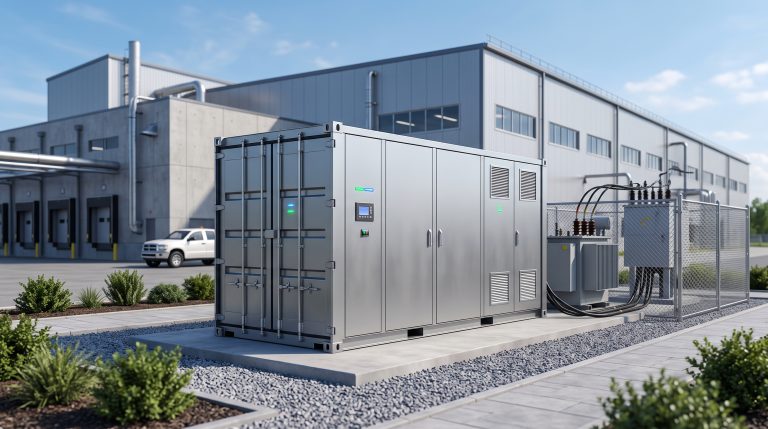
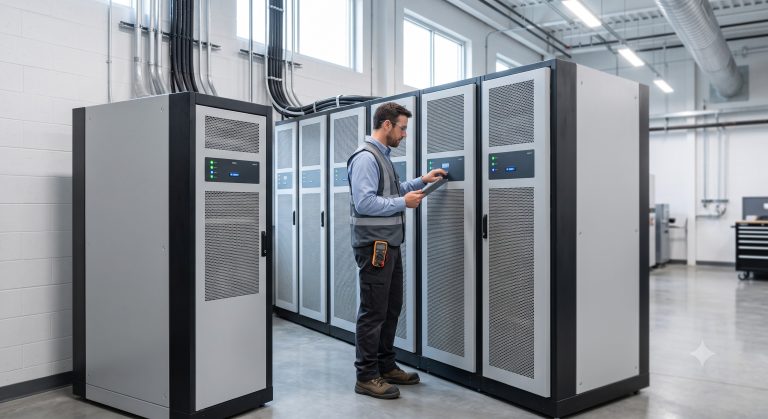
- Yes, LFP BESS supports parallel scalability through shared DC busbars or AC-coupled inverters. Typical limits: Up to 50 cabinets per cluster (10–50MW range) with central EMS coordinating charge/discharge. DC-coupled scaling requires identical string voltages (e.g., 1500VDC bus) and busbar impedance matching to prevent circulating currents. AC-coupled scaling (each cabinet with its own PCS) is more flexible but requires transformer coordination and grid-interconnection agreements above 1MW. Best practice: Use pre-configured modular cabinets (200–500kWh each) with CAN bus communication. Expand incrementally by adding cabinets and updating the EMS logic—no need to redecommission existing units.
- Q5: What is the difference between grid-tie and off-grid LFP configuration, and can the same system do both?
- Grid-tie configuration synchronizes with utility frequency (50/60Hz ± 0.5Hz) for peak shaving, arbitrage, and frequency regulation—requires a grid-following or grid-forming inverter and anti-islanding protection (IEEE 1547). Off-grid (island) configuration operates independently as the voltage/frequency reference, requiring a battery bank sized for worst-case load duration plus 20% reserve, plus a backup generator or solar array to recharge during low-production periods. A hybrid LFP system with a bi-directional PCS and transfer switch can do both: seamless transition (4–20ms) from grid-tie to off-grid mode when utility fails. This requires a system with grid-forming capability and black-start functionality—available on premium commercial BESS (e.g., SMA, Dynapower, Sungrow).
- Q6: What fire safety certifications and active suppression systems are required for LFP BESS?
- Required certifications: UL 9540 (system), UL 1973 (cells/modules), and UL 9540A (thermal runaway propagation test). NFPA 855 mandates spacing, ventilation, and maximum stored energy per unit. Active suppression includes: (1) Tier 1: Gas detection (CO, H2, VOC) triggering ventilation and disconnection, (2) Tier 2: Aerosol or clean agent (Novec 1230, FM-200) injection at cell level, (3) Tier 3: Water mist or pre-action sprinklers for cabinet surroundings (not direct cell injection). LFP’s thermal runaway begins at 270°C+ and releases mainly H2, CO, and electrolyte vapor—not oxygen. Therefore, inert gas flooding (N2, Ar) is effective but not required. Always check local AHJ amendments to IFC 2021, Chapter 12.
- Q7: How does the EMS optimize real-time dispatch for peak shaving and demand response?
- The Energy Management System (EMS) uses load forecasting (24-hour rolling window) and tariff modeling to calculate optimal discharge timing. For peak shaving: EMS sets a kW threshold (e.g., 500kW facility peak), pre-charges batteries during low-cost off-peak hours (12am–6am), and automatically discharges when load exceeds threshold with 200ms response. For demand response (DR): EMS receives openADR 2.0b signals from utility, executes pre-set DR strategy (e.g., discharge 300kW for 2 hours), and logs verification data for incentive claims. Advanced EMS includes weather-adjusted load prediction and battery degradation-aware dispatch—prioritizing charge/discharge at lowest cycle cost. For multi-asset sites, EMS can arbitrage between EV chargers, solar PV, and storage to minimize LCOE.
- Q8: What is the typical lead time and O&M support for turnkey LFP BESS deployment?
- Typical lead time: 8–12 weeks for systems under 5MWh (with standard Tier-1 cells), 16–24 weeks for custom containers (20/40ft) above 10MWh. Expedited air freight of cells adds 30% to logistics cost but cuts lead time to 4–6 weeks. Standard O&M package includes: remote monitoring (24/7 with EMS alerts), annual thermal imaging and torque checks on busbars, BMS firmware updates, and capacity testing (HPPC or EIS) every 12 months. Extended 10-year O&M typically costs 2–3% of CapEx annually and includes proactive cell balancing, cooling system filter replacement, and guaranteed 80% remaining capacity at year 10. Always request local service partners—global OEMs with regional depots reduce mean time to repair (MTTR) to 48 hours or less.