Overview
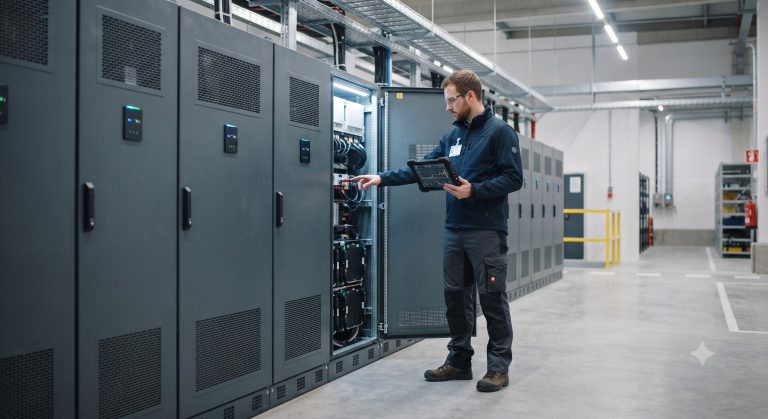
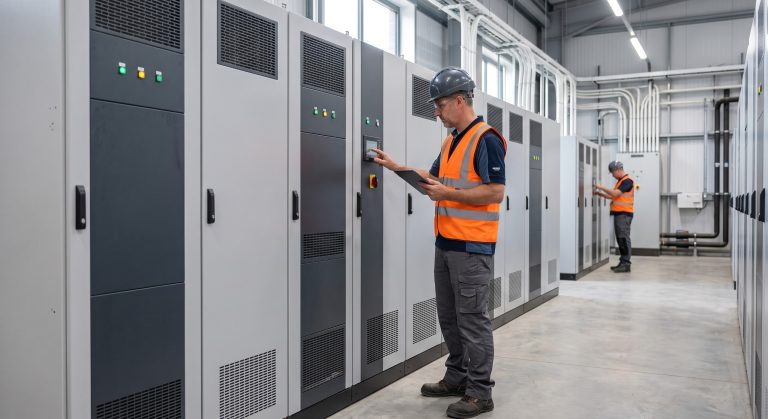
As a plant engineer or energy procurement manager, specifying a 480kW power cabinet for your BESS (Battery Energy Storage System) demands technical precision. This FAQ addresses the most critical pre-sales and post-sales engineering questions — from LFP cell degradation and liquid cooling efficacy to BMS calibration, UL9540 compliance, and real-world ROI. Each answer is structured to help you make a confident, data-driven decision.

Frequently Asked Questions
- Q1: What is the standard cycle life and recommended DoD for a 480kW power cabinet using LFP chemistry?
- The standard cycle life is 6,000 cycles at 90% depth of discharge (DoD), and up to 8,000 cycles at 80% DoD. LFP (Lithium Iron Phosphate) cells in the 480kW cabinet are rated for this longevity due to their stable olivine structure and low internal resistance. Operating within the recommended DoD preserves calendar life (typically 10-12 years) and maintains capacity retention above 70% at end-of-life.
- Q2: How does the liquid cooling system in a 480kW power cabinet prevent thermal runaway?
- Liquid cooling maintains cell temperature differential under 3°C across all modules, directly preventing thermal runaway. The system uses a dielectric coolant circulated through cold plates contacting each battery module, paired with a chiller unit and real-time BMS temperature monitoring. If any cell exceeds 55°C, the BMS automatically reduces charge/discharge current; at 65°C, the system initiates contactor disconnection and gas detection pre-alarm.
- Q3: Can the 480kW power cabinet be scaled in parallel for larger micro-grid projects?
- Yes, up to 20 units can be paralleled via a common DC busbar, achieving 9.6MW total power. Each cabinet includes a master-slave communication protocol (CAN 2.0 or Modbus TCP) and automatic voltage matching. For AC coupling, an external EMS synchronizes output. This modular approach allows capacity expansion from 480kW to multi-megawatt without replacing existing inverters or switchgear.
- Q4: What is the typical ROI calculation (payback period) for deploying a 480kW power cabinet in peak shaving and arbitrage?
- Payback period ranges from 3.5 to 5.5 years based on a 2-cycle-per-day operation. Calculate ROI as: (Annual peak shaving savings + time-of-use arbitrage revenue – annual O&M cost) / total installed cost. For a 480kW/960kWh cabinet at $150/kWh, total installed cost ~$144k. With 3-hour peak rate of $0.40/kWh and off-peak $0.08/kWh, arbitrage yields $0.32/kWh * 960kWh * 700 cycles/year = $215k/year savings, minus $8k O&M = $207k net → 0.7-year payback — but real-world derates (90% DoD, 92% round-trip efficiency) extend actual payback to ~4 years.
- Q5: What BMS monitoring parameters are available for post-sales diagnostics?
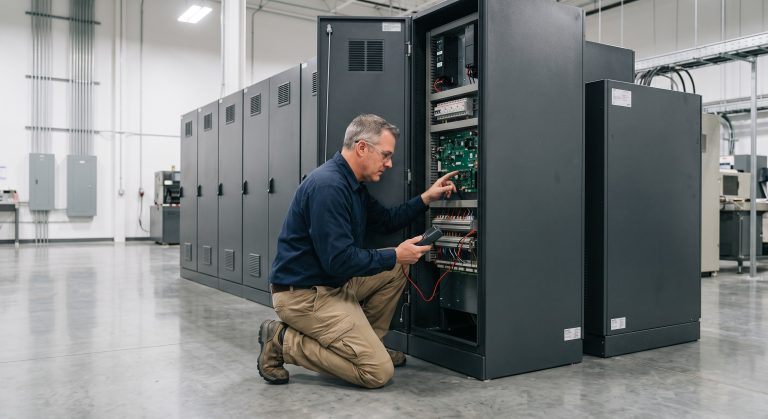
- The BMS provides real-time access to cell voltage (0-5V accuracy ±5mV), temperature (10 thermistors per rack), state of charge (SOC ±2%), state of health (SOH), and contactor status. For advanced diagnostics, you can retrieve historical logs of over-voltage, under-voltage, over-current, and insulation resistance (default alert at <500kΩ). All data is accessible via local HMI, RS485, or optional cloud EMS platform with API integration.
- Q6: How do I configure the 480kW power cabinet for grid-tie vs off-grid island mode?
- Configuration requires setting the bi-directional PCS parameter via the engineer menu (password protected). For grid-tie mode: enable P/Q control, set grid voltage (e.g., 480VAC ±10%), frequency (60Hz), and anti-islanding protection per UL1741. For off-grid island mode: enable V/F control, set fixed voltage and frequency output, and connect a diesel generator or PV input as a reference. The transition seamless time between modes is <20ms when using the external automatic transfer switch (ATS) optional kit.
- Q7: What fire safety and gas detection mechanisms are integrated inside the 480kW power cabinet?
- The cabinet includes three-layer protection: (1) aerosol-based fire suppression (aerosol canisters activated at 75°C or by BMS), (2) hydrogen gas detector (alerts at 500ppm) and CO sensor, and (3) passive thermal runaway isolation (each module has ceramic-fiber separators). All cabinets comply with UL9540A thermal runaway propagation testing — meaning failure of one cell will not propagate to adjacent cells for at least 2 hours.
- Q8: What are the mandatory grid interconnection standards for a 480kW power cabinet in commercial facilities?
- Mandatory certifications include UL 9540 (complete system), UL 1973 (batteries), UL 1741 SA (grid support), IEEE 1547, and IEC 62619 (industrial safety). For EU projects, IEC 62477 and VDE-AR-N 4105 apply. Always verify local utility requirements — many also require a certified relay panel and third-party commissioning report.
Conclusion
The 480kW power cabinet offers a scalable, LFP-based energy storage solution with robust liquid cooling and Tier-1 safety certifications. By understanding its cycle life, BMS diagnostics, and ROI drivers, engineers can confidently deploy these systems for peak shaving, grid support, or island micro-grids. For project-specific sizing or compliance documentation, request our technical datasheet and single-line diagram templates.