Overview
For B2B buyers and project developers, understanding the true expected lifespan of a commercial energy storage system (ESS) is critical for calculating return on investment (ROI) and ensuring long-term asset performance. While the industry standard for lithium Iron Phosphate (LFP) batteries points to a 15 to 20-year operational life, this figure is heavily influenced by factors like battery chemistry, thermal management, depth of discharge (DoD), and the intelligence of the Battery Management System (BMS) . This FAQ addresses the most pressing technical and financial questions regarding the longevity and lifecycle management of commercial BESS, helping you make an informed procurement decision.
Frequently Asked Questions
- Q1: What is the maximum cycle life and depth of discharge (DoD) for a commercial LFP battery system?
- The standard cycle life for a commercial LFP battery system ranges from 4,000 to 10,000 cycles at an 80% depth of discharge (DoD), translating to 15 to 20 years of operational service . However, advancements in cell technology have pushed these boundaries, with some next-generation LFP cells like the ‘Kunlun 302Ah’ achieving over 15,000 cycles with a State of Health (SOH) of 70%, effectively eliminating the need for mid-life battery replacements . Proper thermal management and avoiding prolonged high or low state-of-charge are key to achieving these maximum cycle life figures .
- Q2: How do liquid cooling systems extend the lifespan of an energy storage system?
- Liquid cooling systems significantly extend system lifespan by maintaining precise temperature uniformity across battery cells, reducing thermal stress that accelerates degradation . By employing AI-controlled heat balance technologies that monitor cell temperature and operational data, advanced liquid cooling can reduce auxiliary energy consumption by up to 33% while ensuring the system operates within its optimal temperature range . This constant temperature control (e.g., variance under 3°C) minimizes side reactions in the electrolyte, preserving capacity and ensuring a stable 10+ year lifespan for the cells .
- Q3: What role does the Battery Management System (BMS) play in ensuring system longevity?
- The BMS is the critical ‘brain’ that protects the battery’s lifespan by monitoring cell voltage, temperature, and state-of-charge to prevent overcharge, deep discharge, and thermal runaway . It performs inter-cell balancing to ensure all cells age uniformly; if a BMS fails due to electronic component fatigue (typically 5-7 years for standard components), it can ‘brick’ the entire high-voltage system prematurely, despite the LFP cells still being healthy . A robust, high-quality BMS with regular software updates is essential to bridge the ‘lifespan gap’ and prevent system obsolescence .
- Q4: Is a 15-year lifespan realistic, and what happens after that?
- Yes, a 15-year lifespan is realistic for modern LFP-based commercial energy storage systems, with many manufacturers offering warranties to match this timeline . At the end of this period, the battery capacity will have degraded to a point where it may no longer be financially viable for primary applications . However, full decommissioning isn’t the only option; asset owners can opt for repowering (replacing old cells with new, upgraded technology) or augmentation (adding new battery racks to increase capacity) to restore performance . Planning for end-of-life includes costs for recycling (approximately $60-90 per kWh) and typically takes 6-9 months for full site restoration .
- Q5: How is the ROI and levelized cost of energy (LCOE) calculated for a commercial BESS project?
- ROI and LCOE are calculated by factoring the system’s lifespan and cycle life into the economic model to maximize arbitrage revenue from peak shaving and time-of-use tariffs . For example, by charging with cheap solar energy during the day and discharging during peak evening tariffs, a 1 MW system can save businesses INR 80 lakh to 1 crore annually . Advanced EMS platforms enhance ROI by using AI load forecasting to optimize energy dispatch, a move that can increase overall revenue by over 30% and shorten the payback period to approximately 4 years .
- Q6: What are the key safety mechanisms for thermal runaway prevention in large-scale systems?
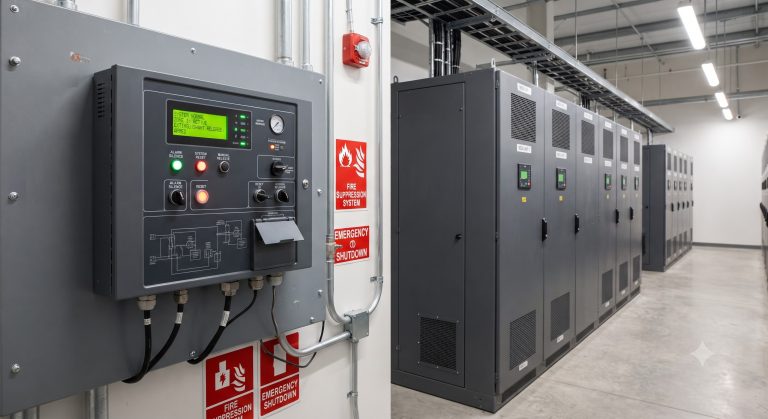
- Commercial systems employ a multi-tiered safety approach to prevent and mitigate thermal runaway, starting with liquid cooling to maintain stable cell temperatures and prevent overheating . Advanced systems utilize ‘fully-immersed’ supermolecule technology that acts as both a coolant and a fire suppressant, ensuring 100% maximum safety and maintaining cell temperature variance under 1.5°C . This is backed by an AI-powered early warning system for gas detection and smoke detection that isolates affected modules before a fire can spread .
- Q7: How does the system handle grid-tie functionality and seamless off-grid switching?
- The Bi-directional Power Conversion System (PCS) enables seamless grid-tie functionality by synchronizing the system’s AC output with the utility grid to support peak shaving and demand response . For off-grid or islanding applications, the system can automatically disconnect from the grid to provide backup power within milliseconds, ensuring continuity of operations for critical industrial loads . This configuration is essential for sites requiring power reliability and is often integrated with local EMS for demand response optimization and EV supercharging infrastructure .