EXECUTIVE SUMMARY
The Residential Storage VDE Certification Document represents a definitive compliance and performance register for the residential energy storage system (ESS) platform, specifically engineered to satisfy the rigorous requirements of VDE-AR-N 4105, VDE-AR-N 4110, and VDE-AR-N 4120 grid connection standards. As the global energy transition accelerates, residential prosumers demand storage hardware that not only maximizes self-consumption of photovoltaic (PV) generation but also guarantees seamless, code-compliant interoperability with the low-voltage distribution network. This document serves as the authoritative technical reference for installers, network operators, and certification bodies, detailing the system’s grid-supportive functions, safety architecture, and certified electrical parameters.
The residential ESS platform integrates Tier-1 Lithium Iron Phosphate (LFP) cell chemistry with a high-efficiency bi-directional power conversion system (PCS) and an intelligent Energy Management System (EMS). The core value proposition of this VDE-certified solution lies in its ability to provide dynamic grid support—including active power curtailment, reactive power compensation, and frequency-dependent active power control—while maintaining the highest levels of electrical safety and operational reliability. This document outlines the system’s adherence to the VDE Application Rules, which are mandatory for grid connection in Germany and widely recognized as a benchmark for European grid codes.
SYSTEM ARCHITECTURE & SAFETY
The residential storage platform is architected around a modular, high-voltage battery system that operates at a nominal DC voltage of up to 400 V, minimizing resistive losses and enabling compact, wall-mounted or floor-standing installation topologies. The system comprises the following primary subsystems:
1. BATTERY MODULE ASSEMBLY: Utilizing prismatic LFP cells with a rated cycle life of 6,000 cycles at 80% Depth of Discharge (DoD), the battery modules are configured in a series-parallel arrangement to achieve the required capacity and voltage. Each module is equipped with an independent Battery Management System (BMS) slave board that monitors cell voltage, temperature, and state-of-health (SoH) in real time.
2. BATTERY MANAGEMENT SYSTEM (BMS): The master BMS coordinates the slave boards, performs active cell balancing, and communicates with the PCS via CAN bus. The BMS implements a multi-level protection hierarchy, including overvoltage, undervoltage, overcurrent, overtemperature, and deep-discharge protection, ensuring the battery operates within its safe operating area (SOA) at all times.
3. BI-DIRECTIONAL POWER CONVERSION SYSTEM (PCS): The PCS is a high-frequency, transformerless inverter designed for single-phase and three-phase low-voltage grid connection. It features a peak efficiency of 98.2% and a European weighted efficiency of 97.5%. The PCS is certified to VDE-AR-N 4105 and VDE-AR-N 4110, providing grid-supportive functions such as:
– Dynamic active power curtailment at the point of common coupling (PCC) in response to grid frequency deviations.
– Reactive power provision (inductive and capacitive) within a power factor range of 0.8 leading to 0.8 lagging.
– Fault Ride-Through (FRT) capability to maintain grid connection during transient voltage dips.
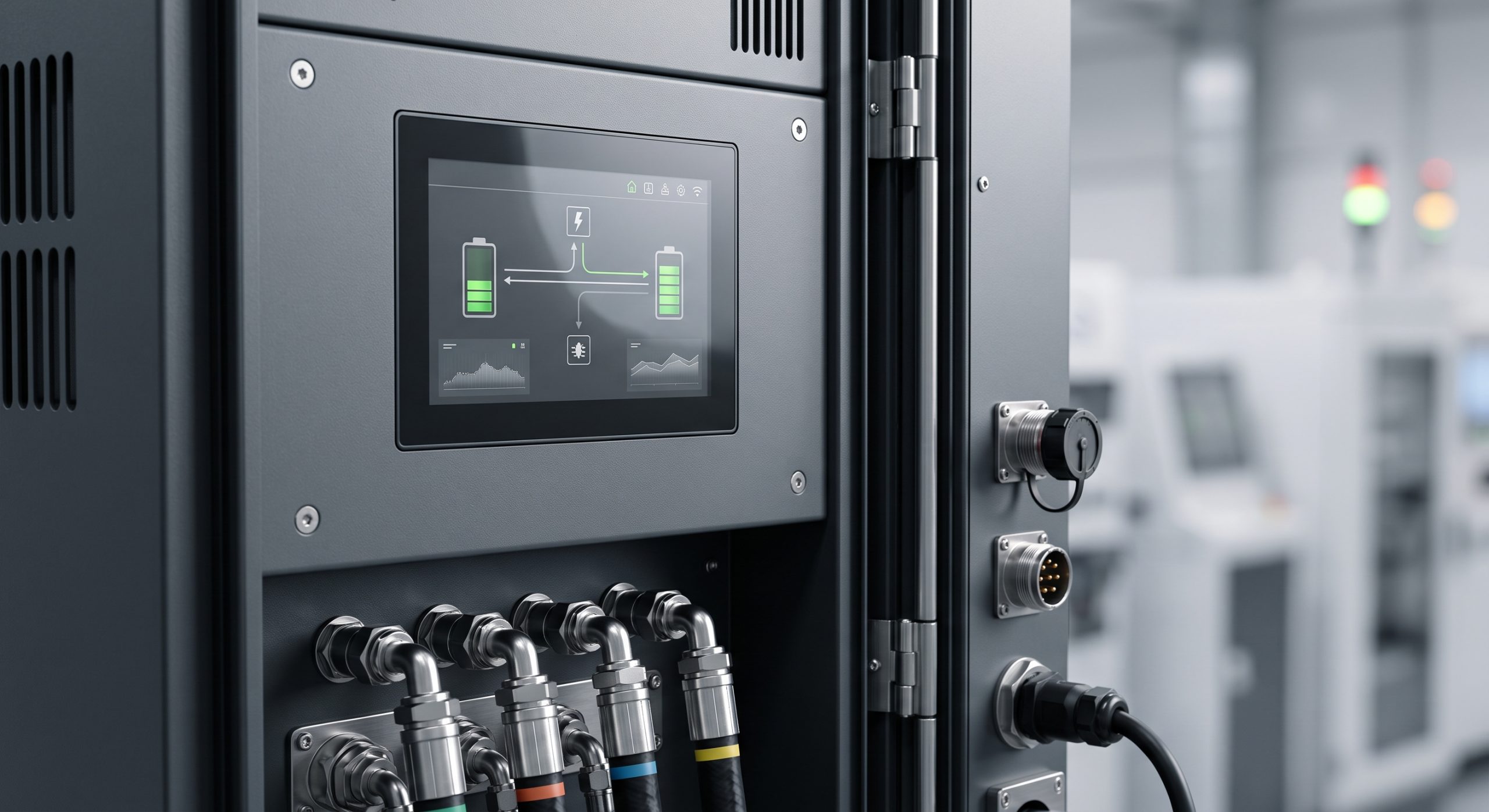
4. ENERGY MANAGEMENT SYSTEM (EMS): The EMS is the central intelligence of the residential ESS. It executes optimization algorithms to maximize PV self-consumption, manage time-of-use (ToU) arbitrage, and provide emergency backup power. The EMS also serves as the communication gateway for remote monitoring, firmware updates, and demand response signals.
SAFETY ARCHITECTURE: The system employs a defense-in-depth safety strategy. At the cell level, LFP chemistry provides superior thermal stability compared to Nickel Manganese Cobalt (NMC) chemistries. At the module level, each battery module is encased in a fire-retardant, IP65-rated enclosure. At the system level, the BMS and PCS are integrated with a comprehensive safety logic that includes:
– Insulation monitoring (RISO) to detect leakage currents.
– Residual Current Monitoring (RCM) to detect DC and AC fault currents.
– Arc fault detection to mitigate fire risks from loose connections.
– Active thermal management using forced-air cooling or optional liquid cooling to maintain optimal cell temperatures between 15°C and 35°C.
KEY FEATURES
– VDE-AR-N 4105 / 4110 Certified Grid Support: The PCS is certified for operation on German low-voltage and medium-voltage networks, providing active and reactive power control, frequency-dependent curtailment, and FRT capability.
– Tier-1 LFP Cell Chemistry: Utilizes prismatic LFP cells from Tier-1 manufacturers, offering superior thermal stability, long cycle life (6,000 cycles at 80% DoD), and a 10-year performance warranty.
– High-Efficiency Bi-Directional PCS: Achieves 98.2% peak efficiency and 97.5% European weighted efficiency, minimizing conversion losses during charging and discharging.
– Modular & Scalable Design: The battery modules can be easily expanded to increase capacity from 5 kWh to 30 kWh, allowing homeowners to scale their storage system as their energy needs evolve.
– Intelligent EMS with Cloud Monitoring: The EMS optimizes PV self-consumption, ToU arbitrage, and backup power. It also enables remote monitoring, diagnostics, and over-the-air (OTA) firmware updates via a secure cloud platform.
– Multi-Layer Safety Protection: Integrated BMS, insulation monitoring, RCM, arc fault detection, and active thermal management ensure the highest levels of electrical and fire safety.
– Seamless Backup Power: Automatic transfer switch (ATS) functionality provides uninterrupted power supply to critical loads during grid outages, with a transition time of less than 20 ms.
COMPLIANCE & STANDARDS
The Residential Storage VDE Certification Document is subject to a comprehensive compliance framework. The system has been tested and certified to the following standards:
– VDE-AR-N 4105: Power generation systems connected to the low-voltage distribution network (LV grid). This includes the specific requirements for inverter grid protection, active power control, reactive power control, and FRT.
– VDE-AR-N 4110: Technical requirements for the connection and operation of customer installations to the medium-voltage network (MV grid). This is applicable for larger residential systems or those connected at the MV level.
– VDE-AR-N 4120: Technical requirements for the connection and operation of customer installations to the high-voltage network (HV grid).
– VDE 0126-1-1: Automatic disconnection device between a generator and the public low-voltage grid.
– VDE 0100-712: Electrical installations of buildings – Part 7-712: Requirements for special installations or locations – Solar photovoltaic (PV) power supply systems.
– IEC 62619: Secondary cells and batteries containing alkaline or other non-acid electrolytes – Safety requirements for secondary lithium cells and batteries, for use in industrial applications.
– UL 9540: Standard for Energy Storage Systems and Equipment.
– UL 9540A: Test method for evaluating thermal runaway fire propagation in battery energy storage systems.
– UN 38.3: Transport of dangerous goods – Lithium metal and lithium ion batteries.
– IEC 62109-1/-2: Safety of power converters for use in photovoltaic power systems.
– EN 50549-1/-2: Requirements for generating plants to be connected in parallel with distribution networks.
– CE Marking: The system complies with all relevant European directives, including the Low Voltage Directive (LVD), Electromagnetic Compatibility (EMC) Directive, and the Radio Equipment Directive (RED).
TECHNICAL SPECIFICATIONS
The following table summarizes the key technical specifications of the Residential Storage VDE Certification Document. All parameters are verified under standard test conditions (STC) unless otherwise noted.
| Parameter | Specification |
|---|---|
| Nominal Capacity | 5 kWh / 10 kWh / 15 kWh / 20 kWh / 25 kWh / 30 kWh (expandable) |
| Nominal DC Voltage | 400 V (high-voltage battery system) |
| Cell Chemistry | Tier-1 LFP (Lithium Iron Phosphate) |
| Cycle Life | 6,000 cycles @ 80% DoD, 25°C, 0.5C |
| Cooling Method | Smart Forced-Air Cooling (Optional Liquid Cooling) |
| Peak Efficiency | 98.2% (PCS) |
| European Weighted Efficiency | 97.5% (PCS) |
| Grid Connection | Single-Phase 230 V / Three-Phase 400 V, 50 Hz |
| Power Factor Range | 0.8 leading to 0.8 lagging |
| Backup Power Transition Time | < 20 ms |
| Protection Degree | IP65 (Battery Modules), IP21 (PCS/EMS) |
| Operating Temperature Range | -10°C to +50°C (derating above 45°C) |
| Communication Interfaces | CAN, RS485, Ethernet, Wi-Fi, 4G (optional) |
| Certifications | VDE-AR-N 4105, VDE-AR-N 4110, VDE-AR-N 4120, IEC 62619, UL 9540, UL 9540A, UN 38.3, CE |
| Warranty | 10 years (Performance), 5 years (PCS) |
INDUSTRIAL DEPLOYMENT
The residential storage platform is designed for seamless deployment in a variety of residential and light commercial environments. The following deployment scenarios are supported:
– RETROFIT PV SYSTEMS: The system can be easily integrated with existing PV installations, allowing homeowners to add storage capacity without replacing their existing inverters. The bi-directional PCS can be configured to operate in AC-coupled mode, interfacing with the existing PV inverter at the AC bus.
– NEW PV + STORAGE INSTALLATIONS: For new installations, the system can be configured as a DC-coupled solution, where the PV arrays are connected directly to the PCS’s DC input. This configuration maximizes round-trip efficiency and reduces installation costs by eliminating the need for a separate PV inverter.
– EMERGENCY BACKUP POWER: The system’s ATS functionality ensures that critical loads (e.g., refrigeration, lighting, communication equipment) remain powered during grid outages. The EMS can be programmed to prioritize backup power for specific circuits.
– TIME-OF-USE ARBITRAGE: The EMS can be configured to charge the battery during off-peak hours (when electricity prices are low) and discharge during peak hours (when prices are high), reducing the homeowner’s electricity bill.
– DEMAND RESPONSE: The system can participate in demand response programs, allowing the utility to remotely curtail or dispatch the battery to support grid stability. This capability is enabled by the system’s VDE-certified communication interface.
📥 Download Technical Specification
Click the button below to view or download the full official PDF datasheet.