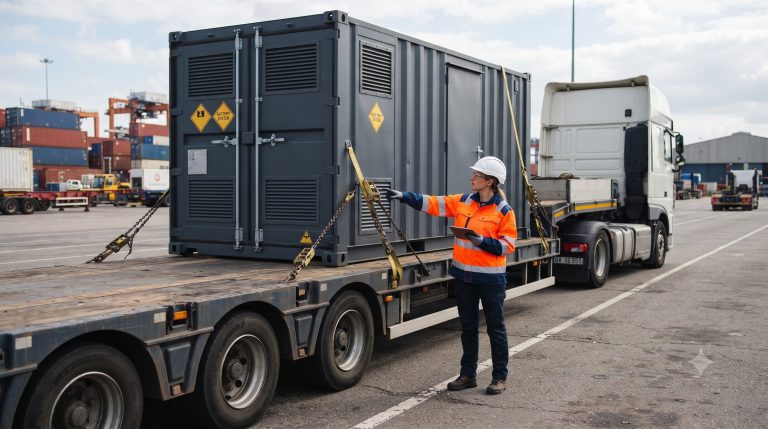
Overview
Our proprietary energy storage micro-controllers run a layered algorithm stack that combines real-time BMS estimation, deterministic PCS control, and AI-driven EMS optimization. This FAQ answers the most common technical questions from plant engineers, EPC contractors, and procurement teams evaluating our BESS platforms.

Frequently Asked Questions
- Q1: What core algorithms run on your proprietary BESS micro-controllers?
- Our micro-controllers run four core algorithm families: Extended Kalman Filter (EKF) for SOC/SOH estimation, Model Predictive Control (MPC) for EMS dispatch, droop-based grid-forming control for PCS synchronization, and active cell balancing logic for BMS thermal management. Each algorithm executes on a dual-core ARM Cortex-R real-time MCU with a deterministic 1 ms control loop. A separate Linux co-processor handles cloud telemetry, API integration, and OTA firmware updates.
- Q2: How does the BMS algorithm estimate State of Charge and State of Health?
- The BMS uses an Extended Kalman Filter combined with coulomb counting and open-circuit-voltage correction to achieve ±2% SOC accuracy. SOH is derived from incremental capacity analysis and internal resistance tracking updated every 100 cycles. This hybrid approach maintains accuracy under partial cycling and variable temperature conditions where standalone coulomb counting drifts.
- Q3: What EMS optimization algorithm handles peak shaving and demand response?
- The EMS runs a Model Predictive Control algorithm that forecasts load, PV generation, and tariff windows to minimize demand charges. MPC solves a rolling 24-hour optimization horizon every 15 minutes using linear programming with battery degradation constraints. The controller supports TOU arbitrage, demand charge management, and frequency response dispatch modes, all switchable via API.
- Q4: Which grid-tie and off-grid control algorithms are implemented in the PCS?
- The PCS implements droop control, virtual synchronous machine (VSM) control, and phase-locked loop (PLL) synchronization for seamless grid-tie and islanding transitions. Grid-forming mode uses VSM to provide inertia and voltage support, while grid-following mode uses PLL for current injection. Transfer between modes completes in under 20 ms, compliant with UL 1741 SB and IEEE 1547 requirements.
- Q5: How do the micro-controller algorithms prevent thermal runaway?
- Thermal runaway prevention uses a multi-tier algorithm: gas and smoke sensor fusion at the module level, model-based temperature rise prediction, and emergency shutdown logic. When sensor fusion detects abnormal gas concentration or a temperature rise rate above 1°C/min, the controller isolates the affected module via relay and triggers the fire suppression sequence. This logic complies with UL 9540A and IEC 62619 test protocols.
- Q6: Can the EMS algorithm integrate with third-party SCADA and API platforms?
- Yes, the EMS exposes RESTful API, Modbus TCP/RTU, and MQTT interfaces for SCADA, DERMS, and VPP integration. The API supports real-time telemetry, dispatch setpoint injection, and firmware OTA updates. Native integrations include Schneider EcoStruxure, Siemens Desigo, and major VPP aggregator platforms. Documentation and sandbox access are provided during the pre-sales phase.
- Q7: What algorithm handles active cell balancing and degradation mitigation?
- Active cell balancing uses a bidirectional DC-DC converter algorithm that transfers charge between cells based on real-time voltage and SOC divergence. The controller targets a maximum cell-to-cell delta of 10 mV and adjusts balancing current dynamically. This reduces capacity fade from cell mismatch and extends pack cycle life by 10-15% compared to passive balancing.
- Q8: How is ROI and LCOE calculated by the micro-controller analytics engine?
- The analytics engine calculates LCOE using cycle life projections, round-trip efficiency, degradation curves, and local electricity tariffs. It updates ROI estimates daily based on actual dispatch data and battery SOH. The model includes capex, O&M, replacement costs, and applicable incentives, outputting a 10-year cash flow forecast accessible via the monitoring dashboard.