“`json
{
“title”: “Liquid Cooling vs. Air Cooling ESS: Thermal Efficiency Optimization in Containerized BESS”,
“content”: “
Introduction: The Critical Role of Thermal Management in Modern Containerized BESS
\n
As the global commercial and industrial (C&I) sector accelerates its energy transition, the deployment of containerized Battery Energy Storage Systems (BESS) has shifted from a novel concept to a mainstream infrastructure imperative. However, the greatest challenge to system longevity, safety, and financial performance is no longer solely the cost of cells, but the effective management of heat. In high-density, multi-MWh containerized systems, inadequate thermal control is the primary accelerator of battery degradation, directly impacting the Levelized Cost of Storage (LCOE) and return on investment. This technical blog provides a deep dive into the engineering and commercial case for advanced thermal optimization in containerized BESS, comparing liquid cooling and air cooling architectures against key performance metrics like cycle life, Depth of Discharge (DoD), and round-trip efficiency. We will explore how modern system architecture, including advanced Battery Management Systems (BMS) and bi-directional Power Conversion Systems (PCS), integrates with these thermal strategies to ensure safe, compliant, and profitable operation for industrial parks, EV supercharging hubs, and micro-grids.
\n[IMAGE_1]\n
Core Architecture & Battery Management in Containerized Systems
\n
The foundation of any high-performance containerized BESS lies in its integrated system architecture. A typical solution packages the battery racks, PCS, BMS, Energy Management System (EMS), and thermal control unit into a standardized, often 20-foot or 40-foot, ISO container. This pre-engineered, turnkey approach drastically reduces on-site Engineering, Procurement, and Construction (EPC) complexity and deployment timelines. At the heart of this integration is the BMS, a sophisticated control system responsible for cell monitoring, state-of-charge (SoC) balancing, and protection. Advanced BMS platforms employ real-time active balancing to ensure uniformity across thousands of cells within the container, a critical factor for maximizing the overall system capacity and preventing premature failure of weaker cells.
\n
Battery Chemistry and Cell Selection
\n
Industry-leading containerized solutions have converged on Tier-1 Lithium Iron Phosphate (LFP) cells as the gold standard for C&I applications. LFP chemistry offers superior thermal stability, a longer cycle life, and a lower risk of thermal runaway compared to other lithium-ion chemistries. High-quality systems utilize LFP cells with a rated cycle life exceeding 8,000 cycles at 90% DoD, ensuring a service life of 15 to 20 years for most applications. The physical configuration of these cells, often in 1P16S or 1P384S arrangements, directly influences the pack’s voltage and capacity, which must be meticulously matched with the PCS for optimal performance.
\n
Liquid Cooling vs. Air Cooling: A Technical Deep Dive
\n
The choice between liquid and air cooling is perhaps the most consequential engineering decision in containerized BESS design. Air cooling, historically the standard, uses forced convection via HVAC systems to maintain ambient temperatures. While simpler and less expensive to implement, it struggles with the increasing energy densities of modern systems, often resulting in significant temperature gradients across the container, which accelerates cell degradation. Liquid cooling, on the other hand, offers superior heat transfer efficiency. It removes heat directly at the cell or module level via a dielectric coolant fluid circulated through a closed-loop system, allowing for tighter temperature control, typically within ±2°C across all cells. This precise management is crucial for maintaining cell consistency, preventing hot spots, and maximizing the system’s calendar and cycle life. Industry projections indicate the liquid cooling market for stationary BESS will grow at a CAGR of 21.55% through 2033, underscoring its status as the future standard.
\n
Technical Specifications and Standards Compliance
\n
For any containerized BESS project, verifying compliance with global safety and performance standards is non-negotiable. Engineering, Procurement, and Construction (EPC) teams and asset owners must specify systems that hold certifications such as UL 9540 for the system as a whole, IEC 62619 for the battery cells, and UN38.3 for safe transport. Furthermore, for grid-connected applications, the system’s PCS must comply with IEEE 1547-2018 standards for interconnection. The table below summarizes key technical specifications for a modern containerized BESS, incorporating the critical thermal management and performance parameters.
\n[TABLE_1]\n
Commercial ROI and Grid Support Optimization
\n
The primary drivers for containerized BESS adoption are the significant financial returns generated through peak shaving, time-of-use (ToU) arbitrage, and demand response participation. Peak shaving reduces demand charges by discharging stored energy during periods of high facility load, while ToU arbitrage exploits price differentials by charging during low-cost off-peak hours and discharging during peak pricing. A well-optimized system can achieve a payback period of 3 to 5 years in many markets. Furthermore, advanced EMS platforms enable participation in grid services such as Frequency Regulation and Virtual Power Plants (VPP), unlocking additional revenue streams. As grid interconnection becomes more complex, modern containerized BESS must support communication protocols like Modbus RTU/TCP and ensure seamless integration with utility SCADA systems.
\n
Deployment Scenarios and Strategic Integration
\n
The versatility of containerized BESS makes them ideal for a wide array of deployment scenarios, from industrial parks to EV supercharging stations. A key emerging application is the “PV-Storage-Charging” synergy, where the BESS is co-located with solar canopies to buffer intermittent solar generation and deliver high-power DC or AC fast charging for electric vehicles, reducing grid stress and maximizing renewable utilization. In an industrial setting, a 1-2 MWh containerized system can generate annual energy savings of up to €195,000 or more through demand charge management and arbitrage, providing a robust hedge against volatile energy prices and contributing to zero-carbon migration goals.
\n[IMAGE_2]\n
Conclusion: The Future of Containerized BESS is Liquid-Cooled and AI-Optimized
\n
Containerized BESS integration represents a paradigm shift in how C&I facilities manage energy. The path to maximizing the value of these assets hinges on advanced, data-driven thermal management. While air-cooled systems served as an effective entry point, the demands of high-cycle, high-discharge applications necessitate the superior performance and reliability of liquid cooling. By adopting liquid-cooled, Tier-1 LFP-based, and UL 9540-compliant containerized systems, enterprises can achieve optimal round-trip efficiency, extended asset life, and maximize ROI across their operational lifespan. As the industry moves toward smarter, AI-driven EMS that can predict thermal events and optimize dispatch in real-time, the containerized BESS is poised to become the cornerstone of a resilient, decarbonized, and profitable energy future.
“,
“images”: [
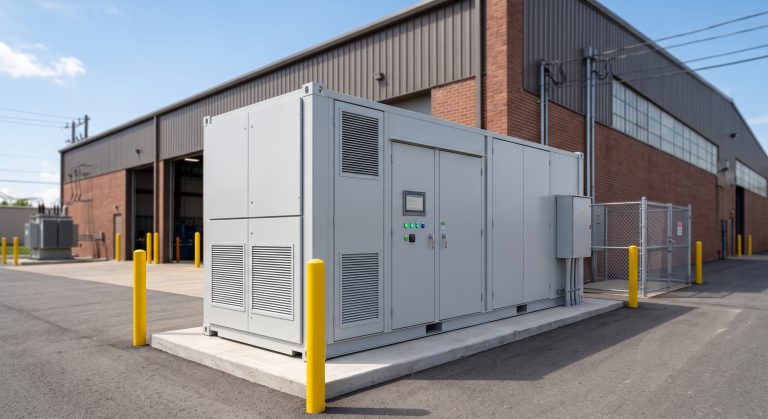
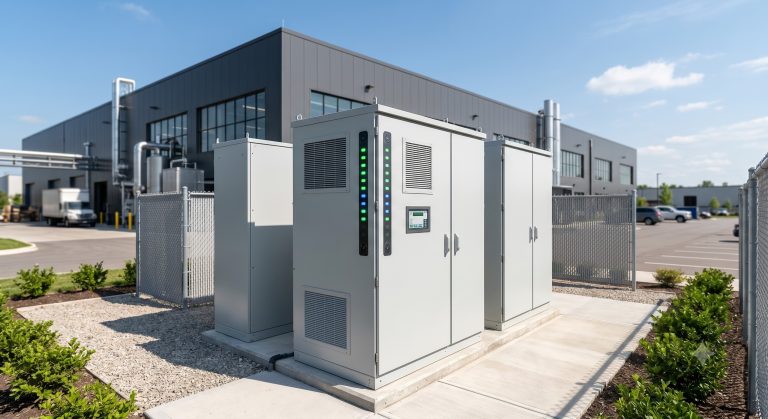
“A high-quality 4K realistic photography of a modern commercial energy storage cabinet (BESS) installed outside a large industrial factory, glowing LED indicators, blue sky, professional corporate vibe, generic unbranded design, no text.”,
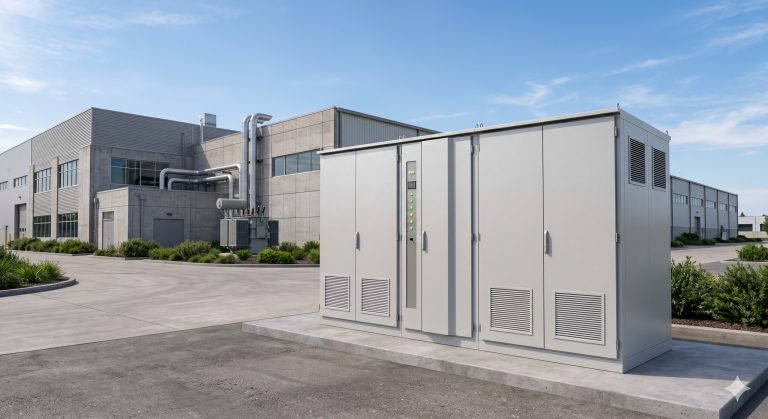
“A high-quality 4K realistic photography of a PV-Storage-Charging (光储充) EV supercharging station, modern electric vehicles charging, solar canopies, energy storage cabinets in the background, eco-friendly future vibe, generic design, no text.”
],
“tables”: [
{
“headers”: [“Key Parameter”, “Technical Specification”],
“rows”: [
[“Battery Chemistry”, “Tier-1 LFP (Lithium Iron Phosphate)”],
[“Thermal Management”, “Liquid Cooling (Active) or Air Cooling”],
[“Cycle Life”, “>8,000 cycles @ 90% DoD”],
[“System Capacity”, “1.2 – 8.46 MWh (Parallel Scalable)”],
[“System Power”, “250 kW – 3 MW+ (Parallel Scalable)”],
[“Round-trip Efficiency”, “>90% (Liquid Cooled Systems)”],
[“Ingress Protection”, “IP54 – IP67 (Container / Pack Level)”],
[“Safety & Compliance”, “UL 9540, IEC 62619, UN38.3, CE”],
[“Operating Temperature”, “-30°C to +50°C (Without Derating)”],
[“Communication”, “Modbus RTU/TCP, Ethernet, RS485”]
]
}
],
“tags”: “commercial energy storage, BESS wholesale, liquid cooling BESS, containerized energy storage, LFP battery”
}
“`