Overview
Welcome to our comprehensive technical support FAQ, designed specifically for B2B energy professionals and plant engineers evaluating containerized energy storage systems (ESS). The choice between air-cooled and liquid-cooled thermal management is one of the most critical decisions affecting system lifespan, safety, and return on investment. This guide addresses the most pressing pre-sales and post-sales technical questions we receive, providing definitive, actionable answers to help you make an informed decision.
Frequently Asked Questions: Air-Cooled vs. Liquid-Cooled Container ESS
- Q1: What is the fundamental operational difference between air-cooled and liquid-cooled BESS containers?
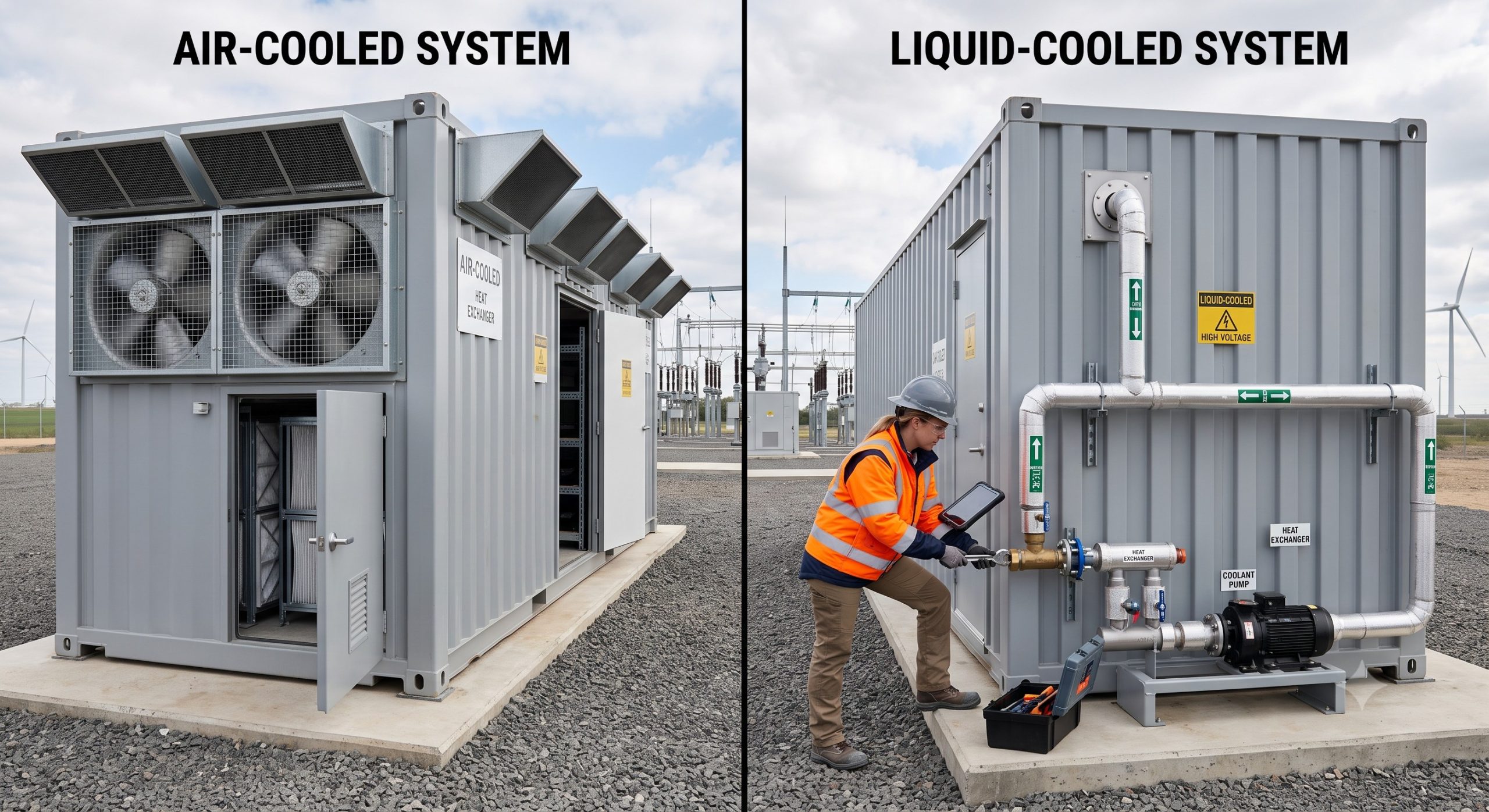
- The fundamental difference is the heat transfer medium: air-cooled systems use forced ambient air to dissipate heat from battery modules via fans and heat sinks, while liquid-cooled systems circulate a dielectric coolant (like water-glycol) through cold plates directly in contact with battery cells. Liquid cooling is significantly more efficient at removing heat, typically achieving a heat transfer coefficient 10-15 times higher than air, enabling higher energy density and more stable operating temperatures for the cells.
- Q2: How do these cooling methods impact battery cycle life and degradation?
- Liquid cooling directly extends cycle life by maintaining a more uniform cell temperature, typically within a ±2°C range across all cells, compared to ±5-8°C for air-cooled systems. This superior thermal uniformity minimizes cell-to-cell imbalances, the primary driver of accelerated degradation. For LFP chemistry, this translates to achieving over 6,000 cycles at 80% Depth of Discharge (DoD) for liquid-cooled systems, while air-cooled systems typically max out around 4,000-5,000 cycles under the same conditions.
- Q3: How does thermal management affect safety and thermal runaway prevention?
- Liquid cooling provides a superior safety profile. The high heat capacity of the liquid coolant acts as a thermal buffer, rapidly absorbing and transporting away heat from potential hotspots, effectively slowing the chain reaction that leads to thermal runaway. Furthermore, advanced liquid-cooled systems often integrate with the Battery Management System (BMS) for early gas detection and automatic coolant flow shut-off, providing an additional layer of protection. While air-cooled systems can be safe, they are more susceptible to localised hot spots in high-ambient-temperature environments, increasing the risk of failure.
- Q4: Which system is easier to maintain and support on-site?
- Air-cooled systems generally have lower upfront maintenance complexity, relying on replaceable fans and filters that are easy to service. However, their maintenance is more frequent and critical, as fan failure can quickly lead to system derating or shutdown. Liquid-cooled systems require more specialized maintenance, including coolant level checks, pump servicing, and annual coolant replacement or analysis, but are generally more reliable with longer service intervals. For remote or harsh environments, the reduced maintenance frequency of a liquid-cooled system often proves more cost-effective and operationally superior.
- Q5: How do these cooling technologies affect the Round-Trip Efficiency (RTE) and operational costs?
- Liquid-cooled systems achieve a higher Round-Trip Efficiency (RTE), typically 92-95%, compared to 85-88% for air-cooled systems, due to more efficient thermal management and reduced auxiliary power consumption for cooling fans (especially at high ambient temperatures). This translates to lower operational expenses (OPEX) over the system’s lifetime. Additionally, the superior energy density of liquid-cooled systems (achieving up to 30-40% more energy per square meter) reduces the balance-of-plant costs and physical footprint, significantly impacting the overall Levelized Cost of Energy (LCOE) favorably over the long term.
- Q6: Can you upgrade an existing air-cooled system to liquid cooling?
- An in-field upgrade from air-cooled to liquid-cooled is generally not feasible. The two systems have fundamentally different architectures, requiring different battery pack designs, piping infrastructure, and control logic. A liquid-cooled battery pack requires integrated cold plates and a coolant distribution network that is physically built into the module, which cannot be retrofitted. Scalability must be planned at the project design phase by choosing a liquid-cooled system initially or selecting a modular platform that supports both, with a clear upgrade path defined from the outset.
- Q7: How do liquid-cooled systems integrate with Energy Management Systems (EMS) for smart dispatch?
- Modern liquid-cooled systems offer advanced EMS integration. The BMS provides real-time thermal data that the EMS can use to optimize dispatch strategies. For example, the EMS can pre-cool the battery during periods of low energy prices to prepare for a high-demand, high-revenue peak-shaving event. This synergistic control prevents thermal throttling and maximizes revenue generation. The integration is typically via standard communication protocols like Modbus TCP or IEC 61850, allowing for seamless API integration into existing plant control networks.
- Q8: What are the specific fire safety and suppression requirements for each system?
- Both systems must comply with rigorous standards like UL 9540A. A liquid-cooled system’s enhanced thermal stability often allows for a slightly lower fire suppression agent requirement. However, the fire suppression system (typically aerosol or gas-based) must be designed to protect the battery cabinets and electrical equipment. Key safety mechanisms include early gas and smoke detection systems that can trigger a pre-emptive shutdown and isolation of the affected container. Liquid-cooled systems, with their better thermal control, offer a longer window for detection and response, significantly improving overall safety margins.