Overview
In the world of Battery Energy Storage Systems (BESS), two software and hardware platforms are critical for safe and profitable operation: the Energy Management System (EMS) and the Battery Management System (BMS). While both are essential, they serve fundamentally different purposes. The BMS is the guardian of the battery’s physical health, focusing on cell-level safety and longevity. The EMS is the strategic commander, optimizing energy dispatch to maximize financial returns and grid stability. This FAQ clarifies the distinct roles, functions, and interactions between these two systems, addressing common B2B queries from procurement to post-deployment.

Frequently Asked Questions
- Q1: What is the fundamental difference between the EMS and the BMS in a BESS?
- The fundamental difference is that the BMS manages the battery’s internal health and safety, while the EMS manages the system’s external energy economics and grid interaction. The BMS monitors cell voltage, temperature, and current to prevent damage and ensure safety, whereas the EMS uses algorithms to decide when to charge, discharge, or idle the system based on energy prices, grid signals, or renewable generation forecasts.
- Q2: How does the BMS monitor battery health and prevent thermal runaway?
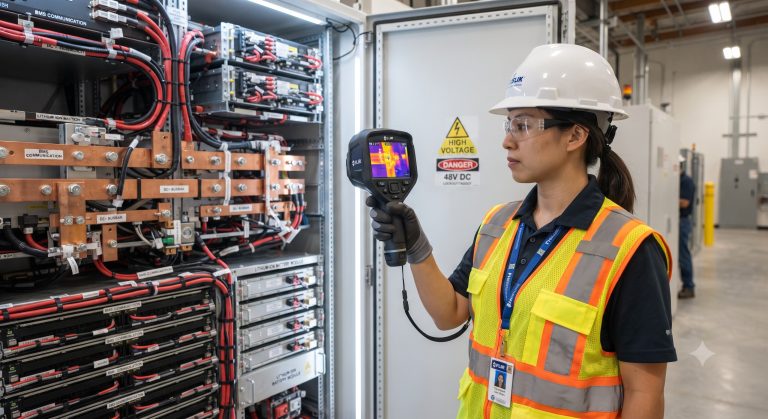
- The BMS continuously monitors thousands of data points per cell, including voltage, temperature, and internal resistance. It prevents thermal runaway by actively balancing cells to ensure uniform charge/discharge and by implementing multi-tiered safety protocols that trigger immediate shutdown or isolation if temperature or pressure thresholds are exceeded. This active, real-time monitoring is distinct from the EMS, which is concerned with the overall system’s operational strategy.
- Q3: How does the EMS optimize energy dispatch and improve ROI?
- The EMS optimizes energy dispatch by using predictive analytics and machine learning to forecast energy prices, weather patterns, and grid demand. It automatically executes a strategy for peak shaving, load shifting, or frequency regulation to maximize revenue from energy arbitrage or grid services, all while respecting the operational limits set by the BMS. This strategic control is crucial for achieving the lowest Levelized Cost of Energy (LCOE) and maximizing the asset’s financial return.
- Q4: Can the EMS and BMS operate independently of each other?
- No, the EMS and BMS cannot operate independently; they are interdependent. The BMS provides critical operational limits (e.g., State of Charge, State of Health, temperature limits) to the EMS. The EMS must operate strictly within these limits to ensure battery safety and longevity. The EMS sends charge/discharge commands to the Power Conversion System (PCS) based on its optimization algorithm, but these commands are overridden or constrained by the BMS’s real-time safety data.
- Q5: What communication protocols are used for EMS and BMS integration?
- Standard industrial communication protocols are used for integration, including Modbus TCP/IP, CAN Bus, and IEC 61850 for substation automation. The BMS and EMS typically communicate via Modbus TCP/IP, providing a reliable and widely supported framework for data exchange, while the EMS often interfaces with the utility grid or plant SCADA system using IEC 61850 or DNP3 protocols for advanced grid support functions.
- Q6: How does the EMS handle grid-tie versus off-grid (islanding) configurations?
- The EMS handles grid-tie and off-grid configurations by switching operational modes. In grid-tied mode, it optimizes for financial arbitrage and grid services. In off-grid or islanding mode, the EMS switches to a frequency and voltage stabilization strategy, balancing the load with the BESS and any local renewable generation. The transition is seamless and is triggered by the EMS detecting a loss of the grid signal through its external communications.
- Q7: What post-sales support is critical for BMS and EMS systems?
- Post-sales support for BMS and EMS systems is critical and includes remote firmware updates to improve algorithms, battery health calibration and re-balancing, and API integration support to ensure smooth data flow with client SCADA or energy trading platforms. A comprehensive O&M agreement should also include annual performance verifications of both systems to ensure they are meeting their operational and financial targets.
- Q8: How does the EMS contribute to demand response and decarbonization goals?
- The EMS contributes to demand response by automatically reducing a facility’s grid draw during peak demand events, reducing energy costs and easing grid congestion. For decarbonization, it can prioritize the use of stored solar energy, enabling a zero-carbon factory integration by charging the BESS from renewable sources and dispatching that clean energy when it is most valuable or needed, thus reducing overall carbon emissions.