Overview
Y-branch connectors are essential components in Battery Energy Storage Systems (BESS), enabling the efficient parallel connection of battery cabinets to a central DC busbar or inverter. These connectors reduce cabling complexity, balance current distribution, and facilitate system scalability. This FAQ addresses critical pre-sales and post-sales technical questions to help you specify, deploy, and maintain Y-branch connectors for optimal BESS performance. Whether you are an engineer, procurement specialist, or system integrator, find expert answers on current ratings, voltage drop, IP ratings, and UL/IEC compliance.
Frequently Asked Questions
- Q1: What is the maximum current rating and cable size for a Y-branch connector in a BESS?
- Y-branch connectors for BESS are available with continuous current ratings from 100A up to 400A, depending on the specific model and cable lug size. Common cable size compatibility ranges from 35mm² to 120mm² copper cables, ensuring a secure and low-resistance connection. It is crucial to select a connector whose rating exceeds the maximum expected current from the battery bank to prevent overheating and ensure operational safety.
- Q2: How does a Y-branch connector impact voltage drop and system efficiency?
- High-quality Y-branch connectors are designed with low contact resistance (typically less than 0.5 mΩ) to minimize voltage drop and energy loss in the DC circuit. The efficient parallel connection reduces the total length of high-current cable runs, which can significantly lower the overall voltage drop across the system. For large-scale BESS, minimizing this voltage drop is critical to maintain system round-trip efficiency and achieve reliable peak shaving or load-shifting performance.
- Q3: What are the IP and safety ratings I should look for in a Y-branch connector?
- For outdoor or harsh environment BESS installations, a Y-branch connector should have a minimum IP65 or IP67 ingress protection rating to be dust-tight and protected against powerful water jets or temporary immersion. Additionally, the connector should be certified to meet UL 4128 or IEC 62619 standards for safety, and feature a flame-retardant housing (UL94 V-0) and touch-proof design to prevent accidental contact with live parts during maintenance.
- Q4: How does the Y-branch connector support the scalability of my BESS?
- The Y-branch connector is a key enabler for modular BESS expansion, as it provides a standardized and tool-less interface for adding new battery cabinets in parallel. To expand capacity, you simply attach the new cabinet’s DC cable to a free branch of the connector or daisy-chain multiple connectors via a DC busbar, maintaining balanced impedance. This plug-and-play architecture allows for incremental capacity upgrades (e.g., from 1MWh to 5MWh) without having to rewire the entire system, reducing deployment time and cost.
- Q5: What are the critical installation and torque specifications for Y-branch connectors?
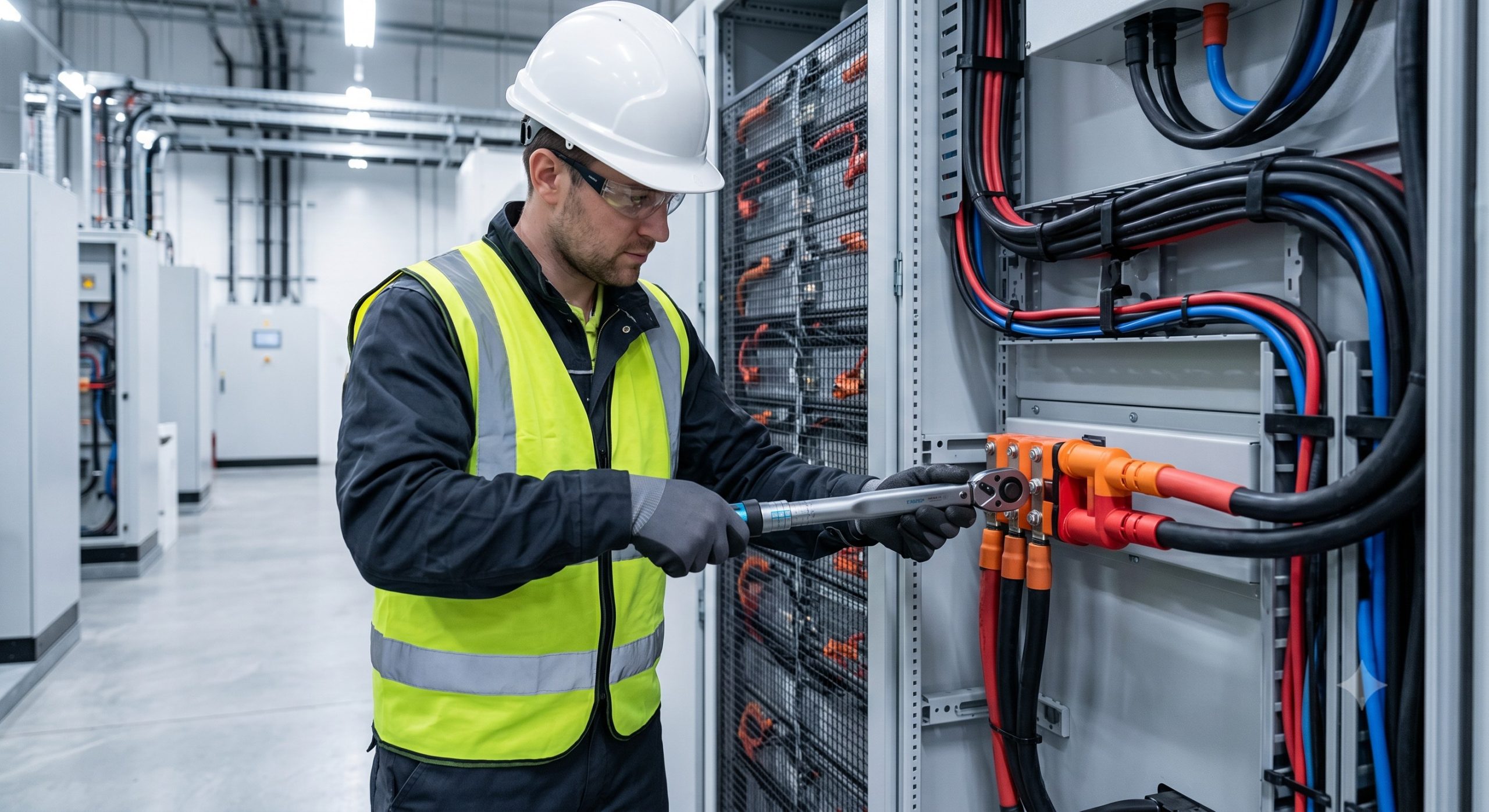
- Proper installation requires using a torque wrench to tighten the connector’s main bolts to the manufacturer-specified torque (e.g., 12-15 Nm for M8 bolts). This ensures optimal contact pressure and prevents loosening due to thermal cycling, which is a common cause of hot spots. The wire stripping length must be precise to ensure full insertion into the terminal, and it is recommended to use a corrosion-inhibiting compound on the cable lugs for long-term reliability.
- Q6: Can the Y-branch connector be used in both grid-tied and off-grid BESS configurations?
- Yes, the Y-branch connector is compatible with both grid-tied and off-grid BESS setups, as it functions purely as a passive DC distribution component. In a grid-tied system, it connects battery racks to the PCS to perform peak shaving and demand response; in an off-grid system, it connects the battery bank to a hybrid inverter for islanding mode. The connector’s performance is independent of the system’s control logic, making it a versatile solution for any high-current DC application.
- Q7: How does the Y-branch connector contribute to fire safety and thermal runaway prevention?
- The Y-branch connector contributes to fire safety by providing a secure, high-contact-force interface that minimizes electrical arcing and resistive heating, which are potential ignition sources. Its flame-retardant (V0) housing contains any internal sparks. For thermal runaway prevention, the connector is often used in conjunction with a BMS that can monitor the temperature of the connection points and initiate a system shutdown if an abnormal temperature rise is detected, isolating the fault.